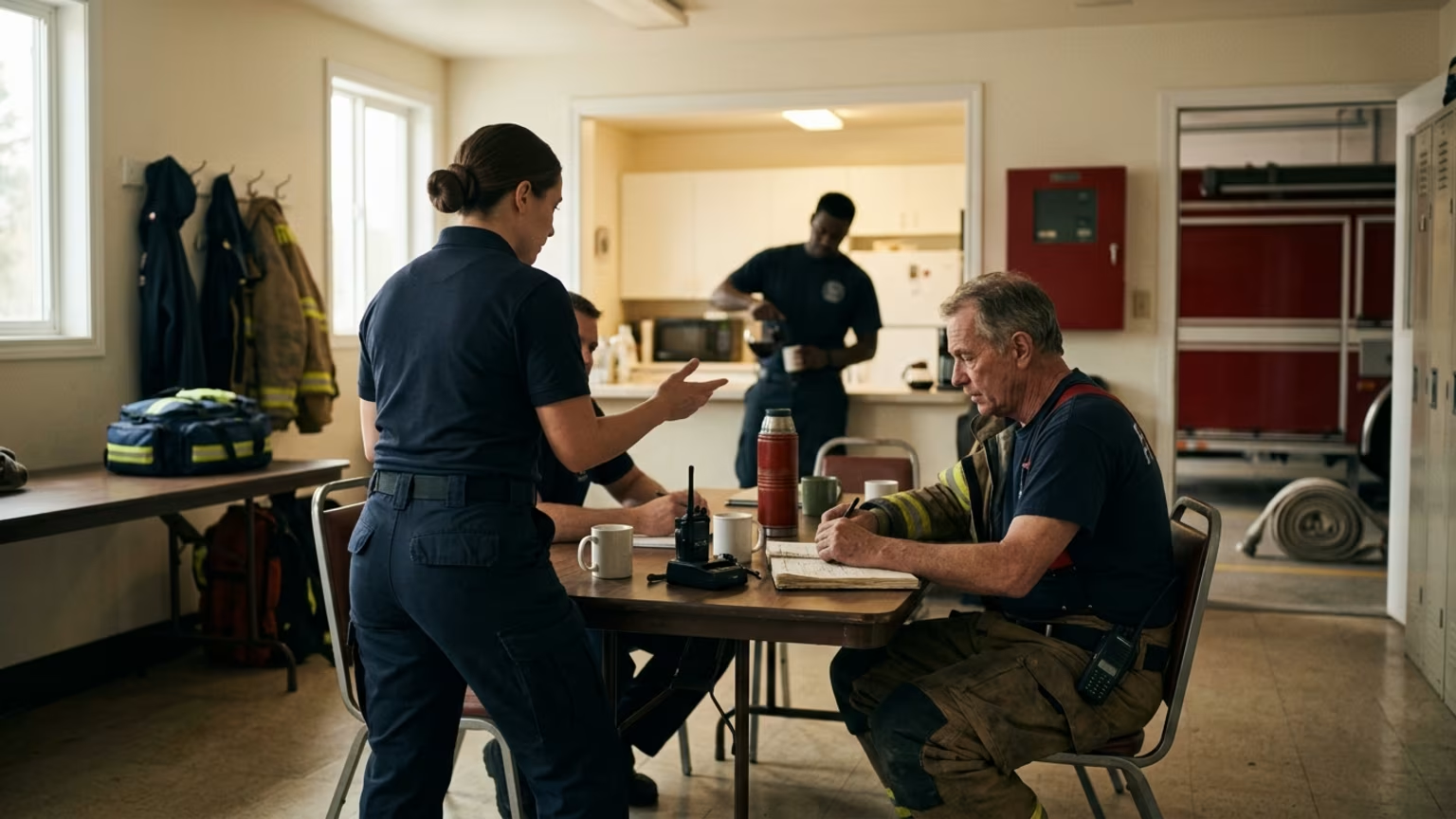

Victoria's shift to a health-led response for mental-health emergencies changes how paramedics and police coordinate. Learn how this impacts frontline crews.





On 28 September 2026, the Victorian government announced new Mental Health Crisis Response Protocols that shift the preferred approach for mental health emergencies to a health-led model. The agreement makes paramedics the primary decision-makers when feasible, with police and protective services officers providing support.
The central policy takeaway from the recent announcement establishes a health-first preference for patients experiencing acute psychological distress. The protocols were jointly signed by the Victorian Department of Health, Ambulance Victoria and Victoria Police. The Victorian government describes this new model as a coordinated effort among first responders, mental-health clinicians and other clinical professionals. It is not a blanket removal of law enforcement from crisis interventions. Under the updated framework, paramedics are positioned to lead the intervention when clinical advice and scene safety allow.
Victoria Police and protective services officers are instructed to support this health-led response wherever possible. However, law enforcement retains its clear responsibility for public safety, maintaining the peace and responding to immediate risks. Police officers and protective services officers maintain their established legal powers to take a person into care and control to prevent imminent and serious harm. The protocols also explicitly favor less restrictive transport methods when they are safe and reasonably available. This provision allows response crews to utilize support from family, carers, specialized mental-health services or non-emergency patient transport before defaulting to a standard ambulance.
Transitioning to a health-led preference directly alters the operational reality for both ambulance and police dispatch systems. The Victorian government reports that Ambulance Victoria responds to more than 60,000 mental-health-related cases each year. Within that total volume, the government notes that 25,000 cases are currently dual-responded with police assistance. The Age also reported that the policy change affects about 60,000 mental-health emergency callouts annually. ABC provided an even broader measure, reporting that Ambulance Victoria counts more than 65,000 annual mental-health calls when physical dispatches are combined with telehealth support through its Triage Services team.
Managing this sheer volume of psychologically complex cases routinely strains emergency service rosters and increases frontline operational stress. Victorian Ambulance Union secretary Danny Hill stated that the union and the workforce were not consulted before the announcement. Hill expressed that he learned more about the specific plan through the media. While Hill noted the union supports a health-led response in principle, he raised concerns about paramedic risk during complicated incidents. He argued that many of these calls still require a joint ambulance-and-police response, pointing out that paramedics can frequently experience harm, aggression and violence on scene.
The Age reported Hill’s ongoing concern that ambulance resources are already insufficient for current operational workloads. Hill indicated that specialist mental-health resources are needed to safely manage these acute calls without exhausting clinical crews. The Health and Community Services Union echoed similar sentiments regarding necessary field support. The union called for mental-health workers to be present alongside police and paramedics, while also pressing for direct investment in community mental-health teams. Implementing this transition will heavily influence how agencies conduct routine after-action reviews to protect crew safety and process difficult shifts.
The repetitive nature of these high-stakes calls carries significant implications for physical and mental recovery between shifts. When paramedics are positioned as the primary decision-makers for tens of thousands of complex cases, the cognitive demand of the job increases substantially. Navigating unpredictable behavioral escalations requires a heightened state of awareness that can deplete energy reserves long before a shift ends. Managing this accumulated wear requires practical strategies, such as establishing targeted physical mobility routines to help process the physical tension built up during high-stress callouts.
This protocol update directly addresses earlier assumptions that equal co-response models provide the most efficient patient care. Mental Health Victoria chief executive Phillipa Thomas stated that the new protocols clarify decision-making and support roles under the Mental Health Act. Thomas noted that previous role confusion between agencies had actively contributed to delays and increased distress for patients, families and carers. Establishing a clear clinical lead aims to reduce the friction that occurs when overlapping agencies arrive without a defined primary decision-maker.
However, Thomas also cautioned against misinterpreting the new dynamic as an unsupported clinical intervention. She emphasized that the protocols should not be understood to mean paramedics will be dispatched without police backup when the situation requires it. The shift challenges the operational habit of defaulting to police transport, pushing crews to assess alternative care pathways first. For shift supervisors trying to maintain long-term team capability, clarifying these on-scene roles is essential for managing the cognitive load of their personnel. Clearer protocols help crews focus on recognizing cognitive bias during crisis interventions without constantly second-guessing command structures.
For operational supervisors and active crews, the immediate priority is tracking how these broad protocols translate into daily dispatch realities. ABC reported that Ambulance Victoria is currently developing further clinical guidelines to support the transition. Until those specific guidelines are formally issued, crews must recognize the practical distinction between a health-led response and a completely unsupported response. The protocols clearly preserve police intervention for immediate safety risks, meaning paramedics should continue to request law enforcement when active threat indicators are present on scene.
Ambulance personnel should prepare for an increased focus on transport decision-making during shift briefings and handover periods. Because the policy favors less restrictive transport, crews will need to actively assess whether a patient can be moved safely by family members, non-emergency patient transport or specialized mental-health services. Documenting these specific decisions accurately will become a larger part of post-incident administrative duties. Supervisors should monitor their teams for signs of operational fatigue, particularly as the frequency of complex behavioral interventions shifts more heavily onto clinical personnel across rotating rosters.
For police officers and protective services officers, daily shift preparation should incorporate the expectation of playing a supporting role on medical calls. Law enforcement briefings should stress that police presence on mental-health calls is intended to secure the scene and support clinical advice. Officers will need to balance standing back to allow paramedics to lead the interaction while remaining vigilant for sudden escalations that require immediate legal intervention. Tracking this balance is a critical part of maintaining overall mental readiness across long-term careers.
In the interim, emergency response agencies should review their immediate support protocols for crews returning from difficult responses. Without clear clinical guidelines finalized, the ambiguity of managing acute psychological crises can increase anxiety and hesitation among responding personnel. Focusing on structured communication protocols can help bridge this gap while formal training is developed. Encouraging crews to utilize established formal operational mental health support is vital during periods of systemic transition and uncertainty.
The long-term success of this operational transition depends entirely on how the guidelines are resourced and executed in the field. The Victorian government frames the change as a mechanism to prioritize patient wellbeing while freeing police to focus on core law enforcement work. However, these are currently stated aims rather than outcome findings from a completed evaluation of the new protocols. The available reporting does not yet provide a firm rollout timetable, a detailed training plan, formalized operational risk-assessment criteria or concrete evaluation measures for the new arrangement.
Future updates must clarify exactly how agencies will decide when police attend a scene and how field crews will rapidly access specialized clinical advice. Financial support for these systemic changes remains a crucial metric to watch over the coming months. The Victorian government noted that the 2026/27 state budget includes $5.5 million to strengthen crisis responses. This funding covers trials for expanded care models and the continuation of the TelePROMPT program, which provides access to mental-health care directly through Triple Zero.
First responders and health advocates should monitor whether this funding genuinely alleviates scene pressure or if resource constraints continue to outpace the shifting operational demands. The union's calls for comprehensive community team investments highlight the ongoing tension between policy expectations and actual frontline capability. The emergency services industry will need to track how less restrictive transport methods are actually arranged and funded in practice. Ultimately, understanding how these specific protocol shifts affect both crew safety and patient care requires a robust evaluation framework that has yet to be published.
Adapting to health-led crisis protocols points toward measurable improvements in baseline physiological recovery when Rescuris guides the operational framework. Sleep disruption from nights, rotating shifts, overtime and unpredictable calls routinely complicates how personnel process these demanding shifts, and Rescuris provides the practical guidance needed to maintain long-term capability. Explore Resources
Rescuris publishes evidence-aware guidance for firefighters, police officers, paramedics and other first responders on fitness, recovery, sleep, nutrition, stress resilience and long-term capability.






Read practical guidance on first responder fitness, recovery, sleep, nutrition and resilience for demanding work and a long, active career.
read the blog
