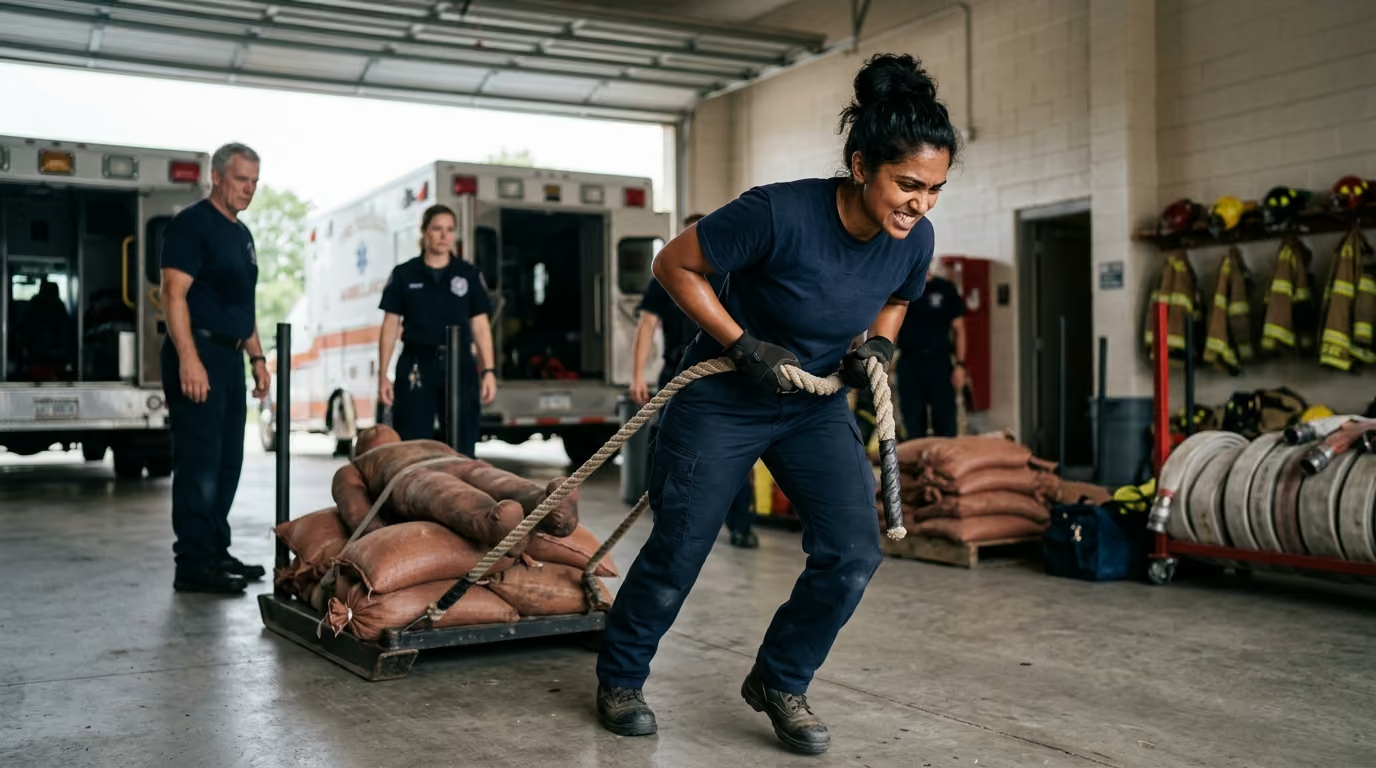

Standard barbells build foundational strength, but awkward-load training using sandbags, dummies, and sleds develops the specific stability first responders need for operational performance.





Awkward-load training is the deliberate practice of lifting, carrying, and dragging non-rigid, asymmetric, or shifting objects to build field capability. It is not an exotic replacement for foundational strength and conditioning. It is also not a substitute for formal rescue techniques, patient-handling protocols, or mechanical lifting devices. Instead, it serves as a bridge between predictable gym barbell work and the chaotic physical demands of emergency response.
This guide provides a detailed breakdown of how to program awkward loads safely and effectively. It covers the mechanical differences between tools like sandbags, rescue dummies, sleds, and ropes. It details when these implements add real value to your performance, when they create unnecessary injury risk, and how to program them around irregular shifts.
For emergency personnel, physical tasks rarely present themselves with knurled steel handles, balanced plates, or level lifting surfaces. Responders must drag uncooperative victims through narrow hallways, haul charged hose lines around sharp corners, and hoist bulky equipment up stairwells. Conventional barbell training builds high levels of absolute strength and muscular force production. However, awkward implements expose the body to dynamic trunk instability, shifting centers of mass, and severe friction demands. When applied with clear intent, awkward loads build resilience in positions of mechanical disadvantage. When applied carelessly, they add fatigue and increase injury risk without improving job capability.
Occupational research across fire and emergency medical services demonstrates that physical capacity directly correlates with job performance. Systematic reviews and performance studies confirm that higher cardiorespiratory fitness, upper-body pulling strength, grip strength, and lower-body power consistently produce faster task completion times during emergency operations.
Fireground operations combine multiple high-demand tasks within short time windows. Systematic evaluations identify primary occupational demands, including equipment carries, hose drags, ladder raises, forcible entry, stair climbs, and victim rescues. In controlled testing, grip strength and aerobic endurance show strong inverse correlations with hose-drag times. This means personnel with greater grip endurance and aerobic capacity complete simulated fireground evolutions substantially faster. Similar research demonstrates that leg power and lean mass predict performance across stair-climb and victim-drag challenges.
However, the scientific literature makes an important distinction between general physical capacity and task transfer. Higher absolute strength developed through basic barbell squats or deadlifts provides a foundation for occupational tasks. A review of tactical load carriage indicates that lower-body power and strength directly predict load-bearing performance in the field. At the same time, heavy load carriage temporarily degrades subsequent leg strength and sprint power.
Research evaluating tactical conditioning indicates that isolated resistance training or isolated endurance training produces suboptimal improvements for occupational demands. The best outcomes occur when structured aerobic conditioning and periodized strength work are combined with dedicated, low-frequency load-carriage sessions. Tactical reviews recommend performing specific heavy load-carriage sessions only once every 7 to 14 days. This frequency provides the necessary neuromuscular adaptation while allowing systemic recovery and avoiding chronic joint inflammation.
The evidence is equally clear regarding patient-handling injuries. Occupational surveillance data indicates that sprains, strains, and disc tears occur at high rates among emergency responders. Research examining mechanical patient-lifting and transfer aids notes high injury incidence rates for both paramedics and firefighters. While physical preparation builds tissue tolerance, physical training alone cannot eliminate the risks of awkward lifts. Awkward-load drills must support approved patient-handling methods, team communication, and mechanical equipment deployment rather than encouraging responders to attempt unsafe solo lifts.
Selecting the right awkward implement requires understanding its mechanical profile. Implements alter leverage, grip requirements, friction, and center of mass in distinct ways. Using the wrong tool for a specific training goal produces poor adaptation and unnecessary fatigue.
Sandbags provide external mass that deforms and shifts during movement. Unlike a rigid barbell, the sand moves away from the center of gravity, which forces the lifter to continuously adjust their posture, grip, and trunk bracing.
Sandbags offer distinct advantages:
Sandbags also have clear limits. A sandbag does not behave like an injured human. It lacks protruding limbs, clothing friction, joint flexibility, and fragile anatomic structures that must be protected. Using a sandbag to simulate a patient rescue builds trunk capacity and grip endurance. However, it does not teach safe patient-extrication mechanics.
Rescue dummies distribute mass across a human-form structure, typically ranging between 100 and 185 pounds. Unlike sandbags or barbells, the weight is distributed along a long lever arm, making victim movement friction-dependent and awkward.
Rescue dummies provide several unique training benefits:
The primary drawback of dummy training is rapid technical degradation under fatigue. When trainees race against a clock, they frequently compromise spinal alignment, round their shoulders excessively, and rely on erratic jerking motions. Dummy work should be treated as high-precision task training before being used in conditioning circuits.
Sleds provide horizontal pushing and pulling resistance with minimal eccentric muscle damage. This allows responders to accumulate high workloads without creating severe delayed-onset muscle soreness that could impair on-shift readiness.
Sleds excel at specific physical adaptations:
Sleds do not fully replicate victim drags or hose work. Sled resistance is determined by the friction coefficient between the sled runners and the ground. A sled on smooth gym turf feels completely different from the same sled pulled across coarse rubber mats, asphalt, or wet concrete. Sleds also feature rigid handles or straps, eliminating the open-hand grip and limb-control demands of real rescue work.
Ropes and charged or uncharged hose lines introduce high friction demands, continuous grip challenges, and variable angles of pull. Pulling a heavy rope or dragging a charged hose line requires dynamic foot placement, anti-rotation core control, and sustained forearm endurance.
These tools are particularly effective for:
Standard gym ropes do not match the bulk, stiffness, or coupling obstacles of charged fire hose. Rope drills build the underlying pulling strength, while occupational hose drills refine technical deployment.
Offset implements include suitcase carries, single-arm kettlebell front-rack holds, unevenly loaded sandbags, and single-arm sled drags. These tools place an asymmetric load on the body, forcing the lateral core musculature to resist lateral flexion and spinal rotation.
Unilateral implements are useful for:
Offset loading becomes counterproductive when the weight is so heavy that the responder cannot maintain an upright, neutral spine. Leaning dramatically away from the weight defeats the purpose of the exercise and introduces shear forces across the lumbar spine.
Using awkward loads simply because they look tough or feel grueling leads to poor programming. Every tool in a training program must earn its place by addressing a specific occupational constraint. You can evaluate whether an awkward implement is appropriate by applying a five-question decision framework.
Define the operational task clearly. Are you trying to improve your performance on a single-rescuer victim drag, a heavy tool carry, a charged hose advance, or extended stair climbs? If the target task cannot be defined, you are using novelty for the sake of novelty. General strength should be developed with predictable barbell, dumbbell, or bodyweight movements. Awkward implements are reserved for targeted preparation.
Determine the limiting physiological factor. If you fail a victim drag because your legs lack absolute force production, heavy trap-bar deadlifts and sled pushes will solve the problem faster than wrestling a light dummy. If your grip gives out while carrying equipment bundles, thick-grip carries and rope pulls address the weakness directly. If your cardiovascular system fails during sustained carries, structured duty fitness programming will provide the necessary aerobic base.
Identify the mechanical element that a barbell or dumbbell fails to provide:
If a conventional lift already provides the necessary stimulus, use the conventional lift. Barbells allow precise, micro-loadable progression that awkward implements cannot match.
For an exercise to produce predictable adaptation, you must be able to track load, volume, distance, time, and rest intervals. If you cannot track these variables, you cannot manage progressive overload. Sled drags should have recorded distances, weights, and surfaces. Sandbag carries should have defined loads and distances. Avoid unstructured circuits where implements are used until total technical failure without measurable metrics.
Every layer of instability, awkwardness, or fatigue increases the technical demand on the trainee. If an unstable sandbag causes severe lumbar rounding during a high-speed drill, the risk outweighs the benefit. Awkward loads must challenge stability within safe biomechanical parameters. When form breaks down completely, the exercise ceases to build capability and begins accumulating tissue damage.
First responders operate under severe systemic constraints that standard gym athletes do not face. Irregular shifts, interrupted sleep, prolonged sedentary posture in patrol cars or ambulances, and acute fireground heat stress alter physical capacity.
Personal protective equipment significantly compounds these physiological demands. Firefighters routinely carry between 22 and 68 kilograms of gear and equipment during emergency responses. Structural turnout gear, self-contained breathing apparatus, tools, and charged hose lines create substantial mechanical resistance and thermal insulation. Research examining the physiological strain of protective gear demonstrates that thermal strain, respiratory restriction, and external load dramatically increase heart rates and accelerate muscle fatigue.
When responders accumulate significant sleep debt, central nervous system recovery and motor control decline. High-skill or highly unstable movements performed under sleep deprivation carry elevated injury risks. In U.S. fireground injury surveillance data compiled by the NFPA, overexertion and bodily strain represent the single leading cause of operational injuries, accounting for approximately 27 percent of all reported incidents. Falls, slips, and trips account for an additional 22 percent.
These statistics emphasize that physical preparedness must prioritize fatigue resistance, movement quality, and smart recovery management. When you are coming off a busy night shift with interrupted sleep, attempting heavy, maximal-effort sandbag clean-and-presses or high-speed dummy drags is poorly advised. The central nervous system is compromised, stabilizing musculature is fatigued, and the risk of spinal or shoulder strain increases substantially.
On low-readiness days, awkward-load training should be modified using a structured framework. Responders can use a shift-work training decision tree to determine whether to push, scale back, or switch to recovery work. Sled dragging is an exceptional tool for low-readiness states because it eliminates spinal axial loading and eccentric muscle damage while sustaining blood flow and work capacity. Sandbag and dummy work should be scheduled on well-rested days when nervous system output and movement control are fully intact.
To manage cumulative fatigue across a multi-day shift rotation, responders must learn to auto-regulate their volume and intensity. Using train readiness strategies ensures that gym sessions build capacity without exhausting the reserves needed for active emergency calls.
Awkward loads must be integrated methodically into a balanced training schedule. They should complement, rather than replace, multi-joint barbell movements, targeted joint accessory work, and dedicated aerobic conditioning.
Tactical load-carriage research recommends performing dedicated heavy carries and drags approximately once every 7 to 14 days. Lighter awkward-load accessory work can be integrated more frequently when volume is tightly managed. Below are four distinct training models designed for different operational goals.
This model is designed for active-duty personnel maintaining year-round operational fitness. It uses conventional strength lifts for baseline force production and integrates one awkward implement per session as a primary accessory or conditioning finisher.
This model is intended for responders preparing for physically intensive deployments, tactical teams, or high-volume stations. It blends strength development with rescue-specific task constraints.
This model targets recruits and candidates preparing for formal physical ability tests, such as the Candidate Physical Ability Test (CPAT) or department-specific hiring evaluations. Department tests frequently feature a 165-pound dummy dragged for 50 feet around obstacles, weighted hose pulls generating roughly 65 pounds of resistance, and weighted stair climbing.
When preparing for physical ability tests, avoid performing full-speed, maximal-effort test simulations every week. Excessive testing builds chronic fatigue and reinforces sloppy movement habits. Focus instead on mastering individual stations at submaximal speeds, building a broad aerobic foundation, and testing the full sequence sparingly.
This model provides a safe progression for personnel returning from minor strains, joint irritation, or extended time off. It prioritizes stable, bilateral movements before gradually re-introducing asymmetric and unstable implements. You can coordinate this structure with broader injury recovery protocols to protect vulnerable joints.
To balance intense training with the realities of unpredictable calls, many responders use minimum effective dose programming. This approach preserves strength and work capacity without accumulating systemic fatigue. On demanding shift rotations, you can also adjust your schedule using programming for shift work to balance high-output days with low-fatigue maintenance sessions.
Awkward-load training carries inherent risks if basic biomechanical principles are ignored. Because the implements are cumbersome, unstable, and hard to grip, poor technique can place excessive stress on the lumbar spine, sacroiliac joints, biceps tendons, and rotator cuff. Adhere to clear safety guardrails during every training session.
Never lift an awkward implement from the ground with a passive, rounded lumbar spine. Even when picking up a flexible sandbag or the torso of a dummy, you must hinge at the hips, bend your knees, brace your abdominal wall, and engage your latissimus dorsi. Pull the implement tightly into your center of mass before initiating the stand.
Rotational strength is essential for emergency personnel, but explosive, uncontrolled twisting while holding heavy, unstable mass introduces severe shear forces to the intervertebral discs. When pivoting with a sandbag, sled harness, or dummy, turn by moving your feet in short, controlled steps rather than planting your feet and violently twisting through your lumbar spine.
Awkward-load drills should end before complete mechanical breakdown occurs. If your grip fails during a carry, your upper back severely collapses, or your knees cave inward during a drag, terminate the set immediately. Pushing through total technical collapse under an awkward load does not build mental toughness; it creates maladaptive movement patterns and spikes injury risk.
Training with heavy rescue dummies can give responders a false sense of solo capability. In actual emergency medical and rescue operations, patient handling must follow established clinical protocols. Use team lifting procedures, clear verbal communication, slide boards, stair chairs, and powered mechanical cots whenever feasible.
Industry operating manuals emphasize that powered patient-handling devices must never be operated as single-person lifts. Physical training gives you the capacity to manage difficult extrications safely when mechanical aids cannot reach the scene. It does not license personnel to bypass standard two-person handling procedures.
Conducting awkward-load circuits while wearing structural turnout gear or weighted vests in hot, humid environments creates severe thermoregulatory stress. Gear traps metabolic heat, driving core body temperature to dangerous levels rapidly. When incorporating gear or heat constraints into training:
Awkward-load training exposes underlying joint restrictions and structural imbalances. If you experience persistent or sharp pain during or after training, stop the activity and seek appropriate professional evaluation.
You should consult a qualified healthcare provider, such as a licensed physical therapist, sports medicine physician, or orthopedic specialist, if you experience:
A physical therapist who understands occupational athletes can identify mobility deficits in the ankles, hips, or thoracic spine that force your lower back to compensate during awkward lifts. Similarly, working with a certified strength and conditioning coach specializing in tactical populations helps refine technique, adjust training volumes, and ensure your exercise selection supports long-term career durability.
Veteran personnel often have accumulated joint wear, disc degeneration, or past structural injuries. Research examining firefighter age demographics demonstrates measurable differences in recovery capacity, absolute grip strength, and task times. Older responders should prioritize joint-friendly implements, such as backward sled drags and neutral-grip carries, while reducing the frequency of heavy, maximal-effort dummy drags. Focus on maintaining muscle mass, movement quality, and aerobic base while allowing 72 hours of recovery between high-intensity loaded carry sessions.
Lighter personnel must move a higher percentage of their body weight when handling standardized equipment and rescue dummies. A 140-pound responder dragging a 175-pound dummy faces an entirely different relative strength challenge than a 220-pound responder. Smaller responders must prioritize relative strength development in basic lifts like squats and deadlifts, master low-hip leverage during drags, and develop exceptional grip endurance. They should also focus heavily on mechanical advantage and team-based lifting tactics rather than relying purely on brute mass.
Novice trainees should first establish baseline movement competency using stable, predictable implements. Learning how to hinge, squat, brace the core, and maintain a neutral spine is much easier with a barbell, dumbbell, or kettlebell. Once a trainee demonstrates consistent movement quality and baseline strength, light sandbag carries and submaximal sled drags can be introduced. High-intensity dummy drags and unstable lifts should be deferred until fundamental movement patterns are fully engrained.
Confined-space operations require moving loads while kneeling, crawling, or working beneath obstacles. You can train these constraints by incorporating low-crawling sled drags, kneeling sandbag transfers, and seated hand-over-hand rope pulls. Keep the external resistance light to moderate during confined-space drills. The objective is to develop trunk stability and joint control in awkward, restricted positions without overloading the spine or knees.
Integrating awkward-load training into your physical preparation bridges the gap between traditional gym strength and the unpredictable demands of emergency service. By using sandbags, dummies, sleds, and ropes with deliberate programming and strict safety guardrails, you build the physical resilience and movement capacity required for high operational readiness throughout a long, healthy career.
Stay connected for research-led guidance on duty fitness, shift-work sleep, injury recovery, stress, nutrition and career longevity. Practical ideas for first responders who want to stay capable on the job, recover well and protect their health for the long run.



Read practical guidance on first responder fitness, recovery, sleep, nutrition and resilience for demanding work and a long, active career.
read the blog



