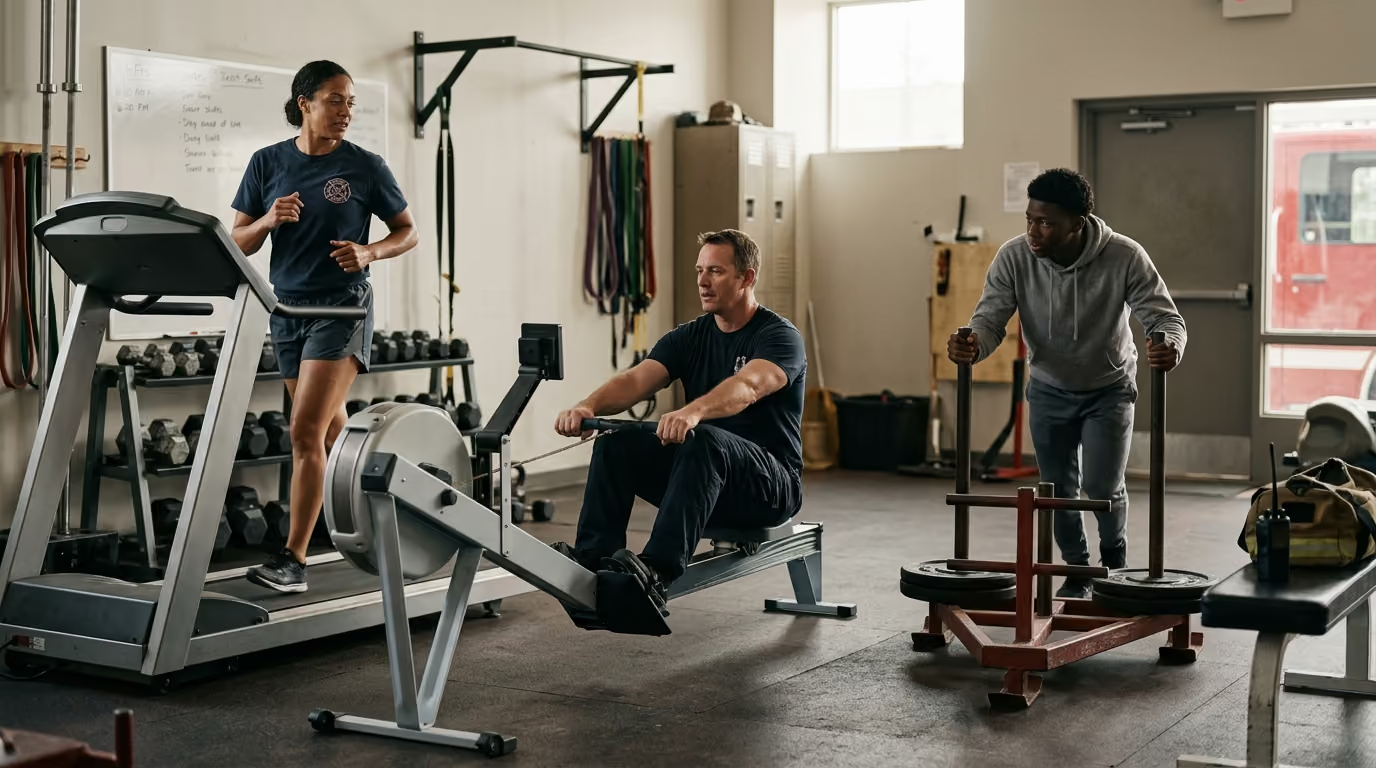

Heavy gear and unpredictable shift schedules demand targeted cardiovascular training to help first responders build resilient stamina without risking joint pain or burnout.





You finish a third consecutive night shift, step into the station gym, and stare at the equipment. Your lower back feels tight from sitting in the rig, your knees are sore from gear, and your sleep was broken by three separate dispatches. You need to maintain your cardiovascular endurance, but you cannot afford to destroy your joints or drain your energy reserves before your next tour.
Choosing the right cardiovascular modality is not about finding one perfect exercise. No single machine or movement pattern duplicates the complex physiological strain of fire suppression, tactical response, wildland hiking, or paramedicine. A complete conditioning strategy uses a portfolio of modalities. It balances low-impact base work to build aerobic capacity with specific upright and loaded sessions that prepare you for duty.
Emergency service tasks place substantial, irregular demands on the cardiovascular system. Structural firefighting requires working in heavy protective gear under extreme thermal conditions. Research indicates that simulated fireground tasks demand an aerobic capacity ranging from approximately 33.6 to 49 mL/kg/min. Many occupational guidelines highlight 42 mL/kg/min as an operational benchmark for structural fire and rescue personnel.
Wildland firefighting involves prolonged hiking, cutting fire lines, and clearing brush over extended shifts. Studies show that wildland tasks require aerobic outputs between 10 and 34 mL/kg/min. While this peak demand is lower than structural firefighting, the work must be sustained for ten to sixteen hours on steep terrain.
Law enforcement demands rapid transitions from sedentary patrol work to high-intensity foot pursuits, physical restraint, or barricade breaches. Research consistently links higher aerobic fitness with better outcomes on occupational physical ability tests. Aerobic capacity supports rapid recovery between high-intensity efforts, helping officers maintain clear decision-making during stressful encounters.
Personal protective equipment significantly alters cardiovascular mechanics. Standard gear adds external mass and restricts heat dissipation. Research shows that wearing personal protective equipment increases the metabolic cost of movement by 6 to 21 percent, depending on the task and speed.
Cardiovascular fitness is only one piece of duty readiness. Conditioning must balance internal strain against external tissue loading. Internal strain includes heart rate, oxygen consumption, and core body temperature. External load involves joint impact, shear forces, spinal compression, and muscle damage. Two workouts can produce the same average heart rate while creating completely different mechanical wear on your body.
Standard fitness programs assume predictable recovery windows, consistent sleep, and structured training blocks. First responders operate under irregular schedules that break these assumptions. Night shifts, rotating hours, and mandatory overtime disrupt circadian rhythms and impair soft tissue repair.
When you train under sleep debt, your perception of effort increases, while motor coordination and reaction times decline. High-impact conditioning performed during severe fatigue sharply increases the risk of overuse injuries. Shin splints, plantar fasciitis, and patellar tendinopathy frequently occur when tired responders push through high-mileage running programs.
Environmental heat adds another layer of physiological stress. Firefighters and tactical officers regularly experience elevated core temperatures during calls. Completing a hard conditioning session right before a shift can leave you pre-fatigued, dehydrated, and less capable of tolerating thermal strain during an emergency call.
Physical duties also create asymmetric musculoskeletal wear. Sitting in patrol vehicles with duty belts strains the lumbar spine and hip flexors. Carrying medical jump bags or advanced life support monitors creates uneven loading across the shoulders and neck.
Your conditioning choices must respect these occupational realities. If your shifts involve extensive standing, climbing, and lifting, your training should not continuously overload the exact same joints. Integrating low-impact modalities allows you to build an aerobic base without adding unnecessary mechanical fatigue to an already stressed body. You can learn more about managing duty wear in our guide to balancing physical training with emergency crew readiness.
Different conditioning tools load distinct muscle groups, joints, and energy systems. Understanding the mechanics of each modality helps you select the right tool for your specific duty goals and injury history.
Running provides an intense cardiovascular stimulus per unit of time. It requires minimal equipment and closely mirrors the mechanics of emergency foot pursuits or rapid repositioning on an incident scene. Running develops bone density and strengthens the elastic recoil mechanisms of the lower limbs.
The primary limitation of running is repetitive impact. Each foot strike sends impact forces through the ankle, knee, hip, and lumbar spine. When training volume, speed, or body mass increases too quickly, the risk of stress fractures and tendon irritation rises. Running is poorly tolerated by responders with active lower-limb tendinopathy or back pain. It also does little to train upper-body endurance, grip strength, or loaded movement capacity.
Running works best for responders who must pass running-specific physical tests or who need to maintain pursuit capability. It should be progressed conservatively, adjusting only one variable at a time, such as frequency, duration, or pace.
Rowing is a whole-body, non-impact modality that recruits the legs, hips, trunk, and upper back. It builds substantial cardiovascular conditioning while eliminating repetitive ground impact. Because it requires a powerful leg drive coupled with a braced core, rowing shares movement mechanics with lifting, dragging, and pulling tasks.
Technical proficiency is essential on the rowing ergometer. Inexperienced rowers often pull primarily with their arms or round their lower back at the catch. Under fatigue, repeated lumbar flexion can irritate the lower back or ribs. Different ergometer models also vary in their resistance profiles and mechanical compliance, which influences perceived exertion and joint loading.
Rowing is an exceptional option for responders seeking whole-body conditioning without joint impact. It is particularly valuable for interval sessions and upper-body muscular endurance. Responders with acute low back flare-ups or limited hip flexion mobility should approach rowing with caution.
Cycling is a highly controllable, low-impact modality. Cadence, resistance, power output, and heart rate can be managed with high precision. Research comparing cycling and running shows that both modalities can produce similar total energy expenditure during matched exercise bouts, making cycling a reliable method for developing aerobic capacity.
Cycling does not reproduce upright gait, stair climbing, or equipment carriage. The fixed, seated posture keeps the hips and spine in continuous flexion. If your bike fit is incorrect, long cycling sessions can aggravate the knees, neck, or lower back.
Cycling is ideal for accumulating large volumes of aerobic base training with minimal recovery cost. It is an effective cross-training tool when recovering from running-related lower-limb injuries. It also serves well as a low-stress active recovery session after demanding shifts.
Swimming is a non-weight-bearing modality that distributes work across the entire body. It provides a unique cardiovascular stimulus while completely unloading the joints of the lower extremities. The hydrostatic pressure of the water can assist venous return, making swimming a restorative recovery modality.
Swimming has limited direct transfer to upright land-based tasks. It does not train impact tolerance, bone density, or loaded upright movement. Furthermore, the repetitive overhead motion of swimming can irritate the shoulders, which are already vulnerable in firefighters and tactical personnel due to heavy gear and overhead tool work.
Swimming is best used for active recovery, off-season conditioning, or aerobic maintenance during lower-body rehabilitation. Responders using swimming should focus on stroke mechanics and balance overhead volume to protect their rotator cuffs.
Incline walking on a treadmill or natural hill raises metabolic output without requiring high running speeds. The American College of Sports Medicine metabolic equations show that increasing the grade dramatically elevates oxygen consumption while keeping foot-strike forces relatively low.
Incline walking reduces impact stress on the knees and hips compared to running. However, it shifts mechanical tension to the calves, Achilles tendons, plantar fascia, and posterior chain. Downhill walking, if performed outdoors, introduces high eccentric braking forces on the quadriceps, which can cause significant delayed-onset muscle soreness if introduced too quickly.
Incline walking is a practical tool for structural and wildland firefighters preparing for stair climbing and steep ascents. It serves as an effective bridge between flat walking and running for personnel returning from injury.
Loaded walking involves carrying external mass in a backpack, weighted vest, or plate carrier while walking. It is the most occupationally specific modality for wildland firefighters, military personnel, and tactical teams. Rucking trains upright posture, trunk stiffness, hip stability, foot tolerance, and pacing under load.
Adding weight fundamentally alters gait mechanics. Research indicates that carrying heavy external loads increases double-support time, alters balance, and increases joint reaction forces. Inclined loaded walking combined with muscle fatigue increases the risk of slips, trips, and falls.
Loaded walking must be dosed with care. Common issues include lower-back fatigue, trap discomfort, foot blisters, and knee strain. Responders should avoid increasing load, distance, speed, and terrain difficulty at the same time. Weighted vests distribute mass closer to the center of gravity, while backpacks create distinct leverage demands that challenge the torso and shoulders differently.
Selecting the right modality requires matching your primary physical goal with your current recovery constraints. No single exercise satisfies every training need.
To understand how to adjust your training volume based on daily readiness, review our framework on managing training around irregular shift schedules.
A balanced conditioning plan can be organized into a four-layer system. This structure ensures that general cardiovascular health, high-output power, and job-specific endurance are developed systematically.
The foundation of the system is low-intensity, steady-state cardiovascular work. The target intensity sits at 40 to 59 percent of heart rate reserve, or a pace where you can maintain a conversation without gasping.
Threshold training develops your ability to sustain a demanding work pace without accumulating excessive lactic acid and metabolic waste. This work sits at a comfortably hard intensity where you can only speak in short phrases.
First responders frequently face short bursts of maximal effort followed by brief pauses. High-intensity repeatability training develops anaerobic power and conditions the body to recover rapidly between intense efforts.
Bridge training connects general cardiovascular fitness to actual duty tasks. It integrates external loads, awkward movement patterns, protective equipment, and task sequencing.
You can read more about selecting appropriate exercises for duty tasks in our comprehensive strength, fitness, and duty performance directory.
A rigid weekly schedule rarely works for emergency personnel. Instead of assigning workouts to fixed days, use a modular approach that matches training stress to your current shift schedule and recovery state.
Workouts performed at the station must not compromise your ability to respond to immediate emergency calls. High-intensity intervals or exhausting circuit sessions on duty can leave you dehydrated and physically depleted when a critical call drops.
On-shift training should emphasize Layer 1 aerobic base work or light mobility circuits. A 30-minute easy spin on a stationary bike or a brisk incline walk elevates cardiovascular fitness without leaving residual fatigue. If you must perform high-intensity work on shift, keep the total volume low and ensure rapid access to hydration and cooling. Research shows that acute physical fatigue increases cardiovascular strain and core temperature during subsequent firefighting simulations.
Use your off-duty days to complete higher-stress sessions that require extended recovery.
When busy tours or mandatory overtime reduce your sleep, automatically downshift your training. Swap planned running or rucking sessions for stationary cycling or incline walking. Reduce the intensity from vigorous to moderate, and shorten session durations by 20 to 30 percent.
For a deeper understanding of how to modify your training volume when duty calls accumulate, explore our guide on autoregulation and readiness for first responders.
These illustrative examples demonstrate how different responders can select and balance cardio modalities based on their operational demands and physical constraints.
A 38-year-old structural firefighter experiences patellar tendon pain when running. However, their position requires negotiating stairs, crawling, and carrying heavy equipment.
A wildland firefighter needs to prepare for steep terrain, long shifts, and the mandatory pack test while avoiding shin splints.
A patrol officer with good general strength struggles with cardiovascular endurance during rapid foot pursuits and struggles to recover quickly after physical confrontations.
A paramedic working frequent night rotations reports feeling constantly drained. High-intensity workouts leave them exhausted for days, compounding shift-related fatigue.
Avoiding standard training mistakes is just as important as selecting the right exercises. Many responders fall into habits that increase injury risk without providing meaningful performance gains.
Running is an effective training modality, but it is not the only way to build an aerobic base. Forcing high running mileage on heavy or injured personnel often leads to joint breakdowns. Cycling, rowing, and incline walking develop equivalent cardiovascular endurance with significantly less orthopedic wear.
Low-impact exercises like rowing, cycling, and swimming can produce high cardiovascular outputs. A hard interval session on an assault bike or rowing ergometer places intense demands on the heart, lungs, and metabolic systems. Do not assume a session was easy simply because your feet did not hit the pavement.
Your heart rate reflects internal cardiovascular strain, but it does not account for muscular damage or mechanical joint load. An hour of rucking with a heavy pack may produce a moderate heart rate while placing severe compressive stress on your spine and feet. Always evaluate the total mechanical load of a workout alongside your cardiovascular numbers.
While occupational bridge training is essential, doing all your conditioning in personal protective equipment creates unnecessary heat strain and soft tissue fatigue. Use standard gym attire for your aerobic base and threshold sessions. Reserve protective gear for specific, controlled task-simulation drills.
When training with weighted vests or packs, change only one variable at a time. If you increase pack weight, keep your distance short and your terrain flat. If you add steep hills, reduce the weight in your pack. Increasing every parameter simultaneously is the most common cause of load-carriage injuries.
Cardiovascular training should build your physical reserves for duty, not deplete them. You must recognize when training becomes counterproductive or hazardous to operational readiness.
Certain physical symptoms and health conditions require assessment by qualified medical and rehabilitation professionals. Do not attempt to train through red-flag symptoms.
Revisit this guide whenever your shift rotation changes, when you are recovering from an injury, or when you are preparing for a new operational role such as wildland deployment or tactical assignment.
Building sustainable conditioning is about selecting the right tool for your current physical state and operational environment. By using a diverse portfolio of cardiovascular modalities, you protect your joints, manage shift fatigue, and maintain duty readiness across your entire career.
Stay connected for research-led guidance on duty fitness, shift-work sleep, injury recovery, stress, nutrition and career longevity. Practical ideas for first responders who want to stay capable on the job, recover well and protect their health for the long run.



Read practical guidance on first responder fitness, recovery, sleep, nutrition and resilience for demanding work and a long, active career.
read the blog



