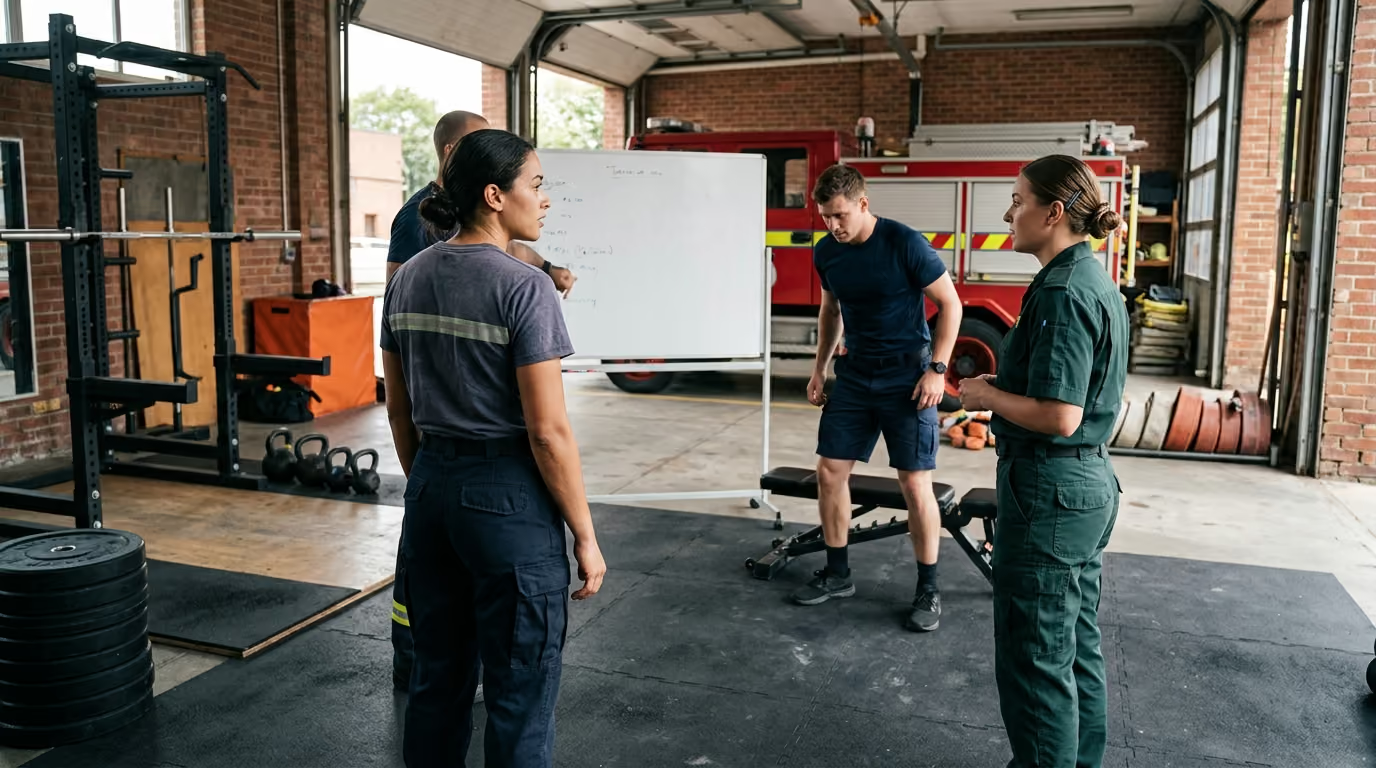
Station-based group training for first responders is a structured method for building physical capacity in a shared environment. It is not an open competition, an unguided circuit, or a test of suffering. When designed well, crew workouts build strength, work capacity, and team cohesion without driving participants into exhaustion or acute injury.
This guide provides a comprehensive framework for planning, scaling, and coaching first responder physical training. It breaks down the physiological demands of emergency service, details how to build station cards, and outlines clear rules to keep training productive across an entire career.
What Is the Safest Way to Structure Group Workouts in Emergency Services?
Group training in emergency services works best when it is collective in structure but individual in prescription. Firefighters, police officers, and paramedics can share a station layout, a workout timer, and a training space without lifting identical loads or chasing identical repetition targets.
Prescribing the same weights, speeds, and volumes to an entire crew creates unnecessary risk. Personnel enter the gym with differing training backgrounds, distinct injury histories, varying body sizes, and unequal levels of acute sleep debt. Successful group design sets a shared physical objective while allowing every member to select appropriate variations and relative intensities.
A durable training format relies on five core elements:
- A Shared Movement Category: Every member trains a functional pattern such as a hinge, squat, carry, push, or pull.
- Individualized Exercise Selection: Each participant picks a variation matched to their current movement quality and readiness.
- Relative Intensity Targets: Workloads are regulated using rating of perceived exertion or repetitions in reserve rather than fixed weights.
- Strict Technical Standards: Repetitions stop when movement quality degrades, regardless of remaining time on the clock.
- Autoregulated Density: Rest intervals are programmed as deliberate recovery rather than treated as wasted time.
This approach preserves the camaraderie and scheduling efficiency of station training while preventing the least prepared responder from racing against the most experienced lifter.
- STATION-BASED GROUP TRAINING ARCHITECTURE
- SHARED STRUCTURE INDIVIDUAL EXPRESSION
- SHARED STRUCTURE INDIVIDUAL EXPRESSION: Common Space & Layout Selected Movement Tier
- SHARED STRUCTURE INDIVIDUAL EXPRESSION: Unified Work / Rest Clock Scaled External Load
- SHARED STRUCTURE INDIVIDUAL EXPRESSION: Shared Movement Category (e.g. Hinge) Regulated Intensity (RIR)
- SHARED STRUCTURE INDIVIDUAL EXPRESSION: Clear Movement Quality Standard Autoregulated Volume
- SHARED STRUCTURE INDIVIDUAL EXPRESSION: COACHING FOCUS: Technical control, safe scaling, and pacing
- SHARED STRUCTURE INDIVIDUAL EXPRESSION: SAFETY RULE: Stop sets when technical form degrades
What Does the Evidence Show About Group Training and Occupational Injury?
The relationship between physical fitness, group training, and occupational safety involves both established data and clear evidence boundaries.
Musculoskeletal injuries represent a major operational concern across emergency services. CDC surveillance data indicate that sprains and strains account for 28% of firefighting injuries, 32% of training-related injuries, and 36% of patient-care injuries. Overexertion and bodily reaction account for roughly 20% of nonfatal injuries in the same dataset.
Data from the U.S. Fire Administration show similar trends. Overexertion or strain caused 29% of reported fire-related injuries, with sprains, strains, and muscular pain making up 23% of total injuries. Physical training sessions themselves frequently appear in occupational injury logs when exercise volume or competition is poorly managed.
Current research provides a nuanced view of how fitness influences these rates:
- Systematic Review Findings: A systematic review examining fitness testing and occupational injuries in emergency responders found limited direct evidence that physical test scores predict injury risk. Better aerobic capacity, however, showed a consistent association with lower injury rates.
- Cardiorespiratory and Muscular Associations: Observational research among firefighters suggests that cardiorespiratory fitness, muscular endurance, and movement quality associate with lower rates of musculoskeletal injuries. These observational findings show positive correlations rather than direct proof of causation.
- Structured Exercise Interventions: Systematic reviews of firefighter exercise programs show that resistance training yields consistent improvements in body composition, muscular strength, and task performance. Movement-centered interventions improve baseline movement mechanics alongside raw fitness metrics.
- Acute Fatigue and Simulated Performance: Recent controlled research demonstrates that intense resistance workouts or high-intensity aerobic intervals create immediate physiological stress without producing immediate improvements in occupational task performance. Training must be paced so it does not impair emergency readiness during shift work.
The scientific literature confirms that regular resistance and aerobic training supports duty performance and tissue tolerance. At the same time, the evidence does not support claims that any single exercise, fitness screening, or workout protocol can completely prevent on-duty injuries.
How Do Shift Demands and Occupational Stress Impact Group Fitness?
Emergency response creates unique physiological stresses that standard gym programs fail to account for. Group training must adapt to environmental conditions, equipment strain, and sleep disruption.
- DUTY DEMANDS VS. EXERCISE DEMANDS
- EXERCISE DEMANDS OCCUPATIONAL REALITIES
- Controlled ambient temperature High heat & thermal strain
- Predictable bar / implement loads Awkward tool & patient mass
- Stable footing and flat surfaces Unstable, cluttered ground
- Planned rest intervals Unscheduled emergency calls
- Standard gym apparel Restrictive PPE & SCBA load
The Metabolic Cost of Protective Equipment
Wearing structural firefighting gear and self-contained breathing apparatus alters basic human physiology. Research shows that wearing personal protective equipment and breathing apparatus can reduce maximal oxygen uptake by 17% to 20%. During submaximal tasks, the added mass and movement restriction increase oxygen consumption by 22% to 33%.
Thermal strain compounds this metabolic cost. When personnel walk in protective gear under uncompensable heat conditions, exercise tolerance drops significantly. In controlled trials, time to exercise termination fell from 134 minutes at 25°C to roughly 67 minutes at 35°C.
Station workouts should rarely combine heavy protective gear, high ambient temperatures, and near-maximal conditioning. Gym-based training should build underlying aerobic capacity and tissue strength in a controlled setting. Adding protective equipment to metabolic conditioning circuits without thermal mitigation creates unneeded heat illness risk without adding meaningful physical adaptations.
Circadian Strain and Fluctuating Daily Readiness
Emergency personnel rarely arrive at station workouts in a fully rested state. Night runs, interrupted rapid eye movement sleep, and extended shift cycles create fluctuating readiness. A responder who deadlifted with excellent form last week may exhibit compromised motor control after three midnight calls.
A systematic review on first responder fatigue highlights that on-duty exercise opportunities support sleep quality, mood, and health. The review cautions that on-shift training must account for acute fatigue. Imposing fixed high-intensity workouts during periods of severe sleep debt increases injury risk. Crew workouts require daily readiness checks and flexible volume adjustments rather than rigid mandates.
Understanding cumulative fatigue from long shift rotations helps leaders design sessions that restore physical readiness rather than deplete it.
Occupational Roles: Fire, EMS, and Law Enforcement
Different emergency service branches present distinct mechanical challenges:
- Structural and Wildland Firefighters: Face high-intensity exertion involving heavy external loads, awkward hose advances, forcible entry, and thermal stress. Their training requires strong lower-body power, loaded carriage capacity, and aerobic recovery.
- EMS Personnel: Regularly perform repetitive lifting in tight spaces, patient transfers, and prolonged sitting interspersed with sudden heavy exertion. Their programming needs robust hinge mechanics, unilateral hip stability, and trunk endurance.
- Law Enforcement Officers: Carry duty belts that alter hip mechanics and lower back loading. They face unpredictable foot pursuits, grappling events, and long periods of vehicular patrol. Their workouts should emphasize hip mobility, multi-directional power, and grip strength.
Group training sessions can accommodate these diverse demands using shared movement categories with role-specific exercise variations.
- OCCUPATIONAL VARIATION MATRIX
- MOVEMENT CATEGORY ROLE PRIMARY SELECTION
- Loaded Locomotion Fire Service Offset Farmer Carry
- EMS Stair Step-Up with Implement
- Law Enforcement Single-Arm Suitcase Carry
- Posterior Chain Fire Service Trap Bar Deadlift
- EMS Elevated Kettlebell Sumo Deadlift
- Law Enforcement Romanian Deadlift from Blocks
How Should You Separate Group Structure From Individual Prescription?
Building an effective crew session requires separating the training structure from the individual prescription. Group architecture refers to the organizational flow of the room. Individual prescription defines what a specific person does at each station.
- GROUP VS. INDIVIDUAL PRESCRIPTION
- GROUP ARCHITECTURE INDIVIDUAL PRESCRIPTION
- (Universal to all members) (Tailored per member)
- Total session duration Exercise tier selection
- Work-to-rest time intervals External load or resistance
- Station rotation direction Target repetition count
- Movement pattern category Repetitions in reserve
- Room safety and spacing Range-of-motion limits
Shared Structure
The group structure organizes logistics, time management, and equipment usage:
- Common Time Intervals: The session uses an interval timer, such as 45 seconds of work followed by 75 seconds of rest and rotation.
- Defined Movement Stations: Stations are arranged logically across available equipment, covering hinges, pushes, pulls, knee-dominant movements, carries, and steady aerobic work.
- Universal Safety Rules: All participants adhere to identical standards for bar lowering, floor clearance, and controlled transitions.
- Synchronized Breathing and Rest: Rest intervals are kept quiet and orderly so participants can bring their heart rates down between stations.
Individual Prescription
Within each station, individuals customize the stimulus to match their physiology:
- Movement Tier: A participant with a cranky lumbar spine performs an elevated trap bar lift, while a healthy colleague performs a standard deadlift.
- Load and Intensity: Weights are selected to match a target effort rating rather than an absolute poundage.
- Movement Tempo: Trainees perform controlled eccentric and concentric phases rather than rushing to accumulate high repetition counts.
- Repetitions in Reserve: Trainees stop each set when they still have 2 to 4 technically clean repetitions left in the tank.
Applying daily readiness and autoregulation strategies prevents peer pressure from dictating loading decisions.
- CAPACITY, READINESS, AND EXPOSURE
- MAXIMUM CAPACITY
- CURRENT READINESS
- (Impacted by sleep, calls, stress, heat)
- SESSION EXPOSURE
- (MUST match Readiness, NOT Capacity)
How Do You Design Station Cards and Movement Menus?
A successful station-based workout relies on clear visual instructions. Station cards placed on walls or equipment racks eliminate confusion, remove the need for verbal lecturing, and normalize movement scaling.
Station Card Architecture
Every station card should communicate five critical variables:
- Station Objective: The target physical quality, such as posterior chain strength, upper body pulling endurance, or loaded locomotion.
- Standard Movement: The baseline exercise suitable for most trained individuals.
- Scaled Movement Tiers: Accessible regressions and challenging progressions.
- Target Work Dose: The recommended repetition range, work window, and relative effort target.
- Stop Criteria: Clear technical faults or physical sensations that mandate an immediate stop or load reduction.
- SAMPLE STATION CARD
- STATION 1: HINGE PATTERN AND POSTERIOR CHAIN STRENGTH
- TIER 1 (Supported / Regressed): Elevated Kettlebell Deadlift (16kg)
- TIER 2 (Standard Movement): Floor Kettlebell or Trap Bar Deadlift
- TIER 3 (Loaded / Advanced): Barbell Romanian Deadlift
- DOSAGE: 40-second work window Perform 6 to 8 slow, crisp reps
- TARGET EFFORT: RPE 7 (Leave 2-3 clean reps in reserve)
- STOP CRITERIA: Rounding of lumbar spine, hitching, or back tightness
Movement Menus Across the Fundamental Patterns
Below are practical movement menus covering the primary movement categories used in first responder group programming.
1. The Hinge Pattern
- Tier 1 (Supported / Reduced Range): Kettlebell deadlift from a 12-inch box or hip hinge with band resistance.
- Tier 2 (Standard): Trap bar deadlift from standard height or dual-kettlebell Romanian deadlift.
- Tier 3 (Advanced): Conventional barbell deadlift, snatch-grip deadlift, or single-leg Romanian deadlift with dumbbells.
- Primary Coaching Cue: Push the hips straight back, maintain a neutral spine, and brace the trunk before initiating movement.
2. The Squat Pattern
- Tier 1 (Supported / Reduced Range): Counterbalance goblet squat to a 16-inch box or suspension trainer-assisted squat.
- Tier 2 (Standard): Free-standing goblet squat or double kettlebell front squat.
- Tier 3 (Advanced): Barbell safety-bar squat or front squat.
- Primary Coaching Cue: Spread the floor with the feet, keep the chest proud, and maintain flat foot pressure throughout the descent.
3. The Upper-Body Push Pattern
- Tier 1 (Regressed): Incline push-up from a barbell in a rack or standing cable chest press.
- Tier 2 (Standard): Floor push-up with controlled 3-second descent or dual dumbbell flat bench press.
- Tier 3 (Advanced): Neutral-grip dumbbell overhead press or weighted push-ups with a sandbag.
- Primary Coaching Cue: Keep elbows tucked at roughly 45 degrees, lock the ribcage down, and avoid shrugging the shoulders toward the ears.
4. The Upper-Body Pull Pattern
- Tier 1 (Regressed): Chest-supported dumbbell row or standing resistance band row.
- Tier 2 (Standard): Inverted suspension trainer row with knees bent or single-arm dumbbell row from a bench.
- Tier 3 (Advanced): Strict bodyweight pull-ups, weighted inverted rows, or heavy barbell bent-over rows.
- Primary Coaching Cue: Drive the elbows toward the hips, pause briefly at peak contraction, and control the lowering phase.
5. Loaded Locomotion and Carries
- Tier 1 (Regressed): Light bilateral farmer carry with kettlebells (20% body mass total).
- Tier 2 (Standard): Moderate farmer carry (40% to 50% body mass total) or single-arm suitcase carry.
- Tier 3 (Advanced): Offset carry with one weight at the shoulder and one at the side, or heavy trap bar carry.
- Primary Coaching Cue: Maintain tall posture, resist side-bending during unilateral carries, and take short, controlled steps.
6. Ground Transfers and Mobility
- Tier 1 (Regressed): Tall-kneeling to half-kneeling transitions with hand support on a bench.
- Tier 2 (Standard): Half-kneeling to standing get-ups without external load.
- Tier 3 (Advanced): Turkish get-up with a kettlebell or loaded sandbag floor-to-standing transitions.
- Primary Coaching Cue: Move slowly between positions, establish solid base contact at each step, and maintain steady breathing.
Integrating these movement categories forms the foundation of tactical duty fitness programming.
What Are the Five Mechanical Levers for Scaling Exercises?
Coaches and peer fitness trainers need simple tools to adjust exercise difficulty on the fly. Rather than guessing, instructors can manipulate five distinct mechanical levers to make an exercise safer or more challenging.
- THE FIVE MECHANICAL SCALING LEVERS
- 1. LOAD Adjust external weight or resistance band tension
- 2. LEVERAGE Modify body angle or moment arm length
- 3. RANGE Alter depth, box height, or start position
- 4. TEMPO Slow down lowering phase or add pauses
- 5. DENSITY Adjust work-to-rest ratios or total rounds
1. External Load
Load adjustments are the most common scaling method. Beginners, fatigued personnel, or those returning from leave can use lighter implements while maintaining identical movement patterns. Advanced trainees can add external resistance while preserving movement quality. The goal is matching resistance to technical capability rather than chasing arbitrary milestones.
2. Mechanical Leverage
Adjusting the angle of the body changes the percentage of body weight being lifted. For example, elevating a trainee's hands during a push-up onto a barbell or bench reduces the gravitational load on the upper extremities. In contrast, elevating the feet onto a box increases the load. Leverage adjustments allow personnel to perform complex movement patterns without requiring external weights.
3. Range of Motion
Modifying the depth or distance of an exercise accommodates mobility limits or joint irritation. Raising a deadlift using blocks or a high trap bar reduces the required hip flexion angle at the bottom. Box squats allow individuals to train lower-body strength within a pain-free range of motion while gradually building tolerance.
4. Movement Tempo
Slowing down the tempo of an exercise increases muscle tension while reducing joint impact. Requiring a 3-second lowering phase on squats or push-ups eliminates bouncing and momentum. This builds motor control and connective tissue tolerance without requiring heavy spine loading.
5. Training Density and Work Intervals
Density refers to the amount of work completed within a specific timeframe. Instead of adding weight, coaches can increase difficulty by shortening rest intervals within safe limits. For fatigued crews, expanding rest periods from 60 seconds to 120 seconds drops cardiovascular strain while maintaining movement quality.
Guidelines from the National Strength and Conditioning Association emphasize that manipulating rest intervals within a 2-to-5-minute window during heavy strength work allows complete neuromuscular recovery and autoregulation.
How Do You Coach and Pacing First Responder Group Sessions?
Effective coaching in an emergency service setting differs fundamentally from commercial fitness instruction. The goal is not entertainment or exhaustion. The goal is preparing personnel to perform high-stakes work safely.
- FOUR-PHASE SESSION ARCHITECTURE
- PHASE 1: DYNAMIC PREPARATION (10-12 Minutes)
- Core temperature elevation
- Joint articulation & mobility
- Movement pattern rehearsal & light loading
- PHASE 2: PRIMARY STRENGTH & POWER (15-20 Minutes)
- Hinge, squat, push, pull, or carry stations
- Regulated via Repetitions in Reserve (RIR 2-4)
- Generous rest intervals (60-90s per station)
- PHASE 3: WORK CAPACITY OR AEROBIC FLOW (10-15 Minutes)
- Cyclic ergometers, sled drags, light carries
- Paced at sustainable aerobic threshold (RPE 5-7)
- PHASE 4: DOWN-REGULATION & DECOMPRESSION (5-8 Minutes)
- Light cyclical walking or spinning
- Passive decompression and box breathing
Pre-Session Screening and Readiness Checks
Before anyone lifts a weight, the lead coach or peer trainer should conduct an informal readiness check. This takes two minutes and evaluates five simple variables:
- Shift Sleep Deficit: How many hours of uninterrupted sleep did the crew get overnight?
- Recent Call Volume: Did the crew handle strenuous calls, structural fires, or heavy patient extrications within the last 12 hours?
- Heat and Environmental Exposure: Has the crew been working in direct sunlight, structural heat, or heavy bunker gear?
- Current Pain or Joint Irritation: Is anyone dealing with acute twinges, neck stiffness, or low back tightness?
- Physical Readiness Color Code: Crew members self-select their training tier: Green (normal training), Yellow (volume reduced by 30%), or Red (low-intensity mobility and recovery only).
The Washington State FIIRE safety program recommends maintaining cardiovascular training at moderate-to-hard aerobic intensities (RPE 5 to 8) for 10 to 60 minutes. The guidelines specifically caution first responders against treating daily shift training as an all-out competition.
Managing Work-to-Rest Ratios
Group workouts often break down because rest intervals are too short. Inexperienced instructors frequently use 30 seconds of work followed by 15 seconds of rest. While this spikes heart rates, it also causes rapid technical breakdown on strength movements.
A more defensible structure uses longer work-to-rest intervals:
- Strength and Power Stations: 30 to 40 seconds of work, followed by 60 to 90 seconds of rest. This preserves neural drive and motor control.
- Aerobic Capacity Stations: 60 seconds of steady, sustainable effort, followed by 60 seconds of nasal-breathing recovery.
- Loaded Carry Stations: 20 to 30 seconds of slow, deliberate walking, followed by 60 seconds of unloaded mobility or rest.
This timing keeps heart rates within productive aerobic zones and ensures that every repetition is completed with crisp mechanics. Combining this layout with managing minimum effective dose training delivers consistent physiological adaptations without leaving personnel exhausted on shift.
- WORK-TO-REST TIMING COMPARISON
- UNSAFE METABOLIC CIRCUIT SUSTAINABLE CREW TRAINING
- 40s Work / 15s Rest 40s Work / 80s Rest
- Rapid, sloppy repetitions Controlled, crisp tempo
- Spikes heart rate to near max Controlled aerobic output
- Severe technical fatigue Low mechanical failure risk
- Depletes shift readiness Preserves duty readiness
How Can Crews Build Accountability Without Destructive Competition?
Competition in first responder station gyms is a double-edged sword. While it can motivate attendance, it often leads to poor exercise form, skipped ranges of motion, and ignoring early injury warning signs.
- HEALTHY VS. DESTRUCTIVE TRAINING CULTURE
- DESTRUCTIVE TRAINING CULTURE SUSTAINABLE PROFESSIONAL CULTURE
- Timed leaderboard races Consistency & session tracking
- Rewarding reps done with poor form Praising disciplined scaling
- Shaming those who regress load Respecting sleep & shift state
- "No pain, no gain" mentality Early reporting of joint pain
- Max-effort training while on duty Training for career longevity
Why Whiteboards and Leaderboards Often Backfire
Posting daily workout times, maximum weights, or round totals on an open whiteboard creates an incentive structure that rewards speed over safety. Under competitive pressure, trainees often:
- Shorten their range of motion on squats and push-ups to log faster times.
- Rush through heavy deadlifts or kettlebell swings while in a state of cardiovascular fatigue.
- Conceal acute musculoskeletal twinges to avoid dropping down the station rankings.
- Train through systemic illness or deep sleep deprivation to avoid being perceived as uncommitted.
Eliminating competitive leaderboards shifts the focus back to technical execution, long-term health, and duty readiness.
Constructive Tracking Metrics
Departments should replace competitive leaderboards with process-driven metrics that support long-term capability:
- Weekly Attendance and Consistency: Rewarding crews that complete their planned physical training sessions without unexcused absences.
- Disciplined Movement Quality: Recognizing individuals who choose appropriate scaling options based on their daily readiness state.
- Aerobic Recovery Rates: Tracking how quickly heart rates drop during standardized two-minute post-session recovery periods.
- Individual Strength Progression: Logging personal training loads privately over 8-to-12-week blocks rather than comparing them across the crew.
- Rehabilitation Compliance: Supporting members who complete prescribed physical therapy exercises during workout hours.
Structuring sessions this way ensures that the group succeeds when every member finishes an appropriately scaled workout, rather than when one person posts the fastest time.
What Are Four Field-Tested Group Workout Templates?
Below are four practical session templates designed for fire, police, and EMS stations. Each template handles mixed abilities and operates within standard station equipment footprints.
- FOUR FIELD-TESTED CREW WORKOUT TEMPLATES
- TEMPLATE 1: STRENGTH & CARRY Full-body power & locomotion
- TEMPLATE 2: LOW-READINESS RECOVERY-- Post-shift movement & bloodflow
- TEMPLATE 3: AEROBIC CAPACITY Sustainable aerobic intervals
- TEMPLATE 4: PROGRESSIVE CIRCUIT Phased occupational patterns
Template 1: The Crew Strength and Carry Session
This session develops total-body strength, grip endurance, and loaded locomotion. It is ideal for normal readiness days when personnel are rested.
- Total Duration: 45 minutes.
- Structure: 4 stations, 4 total rounds. 40 seconds of work, 80 seconds of rest and rotation.
- TEMPLATE 1: CREW STRENGTH & CARRY (4 ROUNDS)
- STATION 1: HINGE PATTERN
- Tier 1: Elevated Trap Bar Deadlift (from 6-inch blocks)
- Tier 2: Standard Floor Trap Bar Deadlift
- Tier 3: Barbell Romanian Deadlift with slow eccentric
- Target: 6-8 reps RIR 2-3
- STATION 2: UPPER PUSH & CORE
- Tier 1: Hands-Elevated Push-Up on Barbell
- Tier 2: Standard Floor Push-Up with 2-second pause at bottom
- Tier 3: Neutral-Grip Dumbbell Floor Press
- Target: 8-10 reps RIR 2
- STATION 3: UNILATERAL KNEE-DOMINANT
- Tier 1: Bodyweight Reverse Lunge to 4-inch step
- Tier 2: Goblet Reverse Lunge from Floor
- Tier 3: Rear-Foot-Elevated Split Squat with Dumbbells
- Target: 6 reps per leg RIR 2
- STATION 4: LOADED CARRIAGE
- Tier 1: Bilateral Kettlebell Farmer Carry (Light / Moderate)
- Tier 2: Single-Arm Dumbbell Suitcase Carry
- Tier 3: Offset Carry (One Kettlebell Racked, One at Side)
- Target: 30 seconds continuous walk Stop if posture breaks
Template 2: The Low-Readiness Recovery Shift
Designed for days following demanding night calls, heavy emergency runs, or elevated systemic fatigue. The goal is stimulating blood flow and joint mobility without stressing the nervous system.
- Total Duration: 30 minutes.
- Structure: Continuous flow through 5 stations at a deliberate, unhurried pace. 45 seconds of work, 45 seconds of transition. 3 total rounds.
- TEMPLATE 2: LOW-READINESS RECOVERY FLOW
- STATION 1: CYCLIC AEROBIC
- Stationary Bike, Rower, or Incline Walk
- Target: Nasal breathing only RPE 4-5
- STATION 2: ASSISTED SQUAT & HIP OPENER
- Suspension Trainer Deep Squat Hold with gentle side-to-side shifts
- Target: Smooth joint articulation No fatigue
- STATION 3: HORIZONTAL PULLING
- Chest-Supported Row with light dumbbells or Resistance Band Row
- Target: 10-12 smooth reps with 2-second squeeze at contraction
- STATION 4: TRUNK & HIP STABILIZATION
- Bird-Dog or Side Plank from Knees
- Target: 20 seconds per side Focus on deep diaphragmatic breathing
- STATION 5: THORACIC MOBILITY
- Quadruped Thoracic Rotations or Half-Kneeling Rib Cage Reach
- Target: 6-8 slow reps per side
This recovery format fits naturally into plans for training around shift work, supporting tissue recovery without compromising duty alertness.
Template 3: The Repeatable Aerobic Interval Circuit
Builds sustainable cardiovascular capacity without turning training into an exhaustive sprint. The emphasis is maintaining identical power outputs across every round.
- Total Duration: 35 minutes.
- Structure: 4 ergometer or locomotion stations. 45 seconds of work, 75 seconds of light active recovery. 5 total rounds.
- TEMPLATE 3: REPEATABLE AEROBIC INTERVALS
- STATION 1: CONCEPT2 ROWER
- Maintain steady stroke rate (22-24 SPM)
- Pacing Target: RPE 6-7 (Sustainable 2000m pace 10-15 seconds)
- STATION 2: FAN BIKE (AIRDYNE / ECHO)
- Smooth, rhythmic pedal and push cadence
- Pacing Target: Maintain constant RPM across all 5 rounds
- STATION 3: SLED PUSH OR INCLINE TREADMILL
- Moderate load sled push or 10% incline brisk walk
- Pacing Target: Strong forward drive, controlled breathing
- STATION 4: SKIERG OR JUMP ROPE
- SkiErg rhythmic pulls or steady boxer step rope work
- Pacing Target: Smooth technical rhythm Avoid upper-body pump
Template 4: The Progressive Task Preparation Circuit
Prepares personnel for physical tasks such as stair climbs, equipment hoisting, and dragging without introducing unnecessary operational risks.
- TEMPLATE 4: PROGRESSIVE TASK PREPARATION
- PHASE 1: MOVEMENT QUALITY (Weeks 1-4)
- Unloaded Step-Ups (16-inch box)
- Light Sled Drag (Forward & Backward)
- Half-Kneeling Sandbag Clean to Shoulder
- Suspension Trainer Inverted Rows
- PHASE 2: LOAD ACCUMULATION (Weeks 5-8)
- Dumbbell-Loaded Step-Ups (15-20% body mass)
- Moderate Sled Drag (Simulating body drag resistance)
- Sandbag Ground-to-Shoulder Transitions
- Strict Hand-Over-Hand Sled Rope Pull
- PHASE 3: DENSITY & COMPLEXITY (Weeks 9-12)
- Weighted Step-Ups with uneven loads (Suitcase carry style)
- Multi-Directional Sled Drags with Direction Changes
- Sandbag Carry and Over-the-Bar Transfers
- Strict Rope Pulls paired with Loaded Off-Axis Carries
What Are the Non-Negotiable Safety Limits and Stopping Rules?
Every station-based group training program requires clear stopping rules. Instructors and crew members must understand when a movement requires modification, when a session should end, and when a symptom demands medical evaluation.
Individual Exercise Stopping Criteria
A crew member must stop an exercise immediately if any of the following occur:
- Technical Breakdown: Inability to maintain spinal alignment, knee tracking, or joint stability under load.
- Pain Signals: Any sharp, shooting, catching, or radiating pain in joints, muscles, or the spine.
- Loss of Control: Inability to lower or control a weight through the eccentric phase of a repetition.
- Excessive Breathing Distress: Inability to speak in short phrases during programmed rest intervals.
- SYSTEMIC STOPPING RULES MATRIX
- OBSERVED SYMPTOM MANDATED ACTION
- Form breakdown Regress movement tier or reduce load
- Sharp joint pain Stop exercise; substitute safe pattern
- Lightheadedness / Nausea Stop session; sit down, cool and drink
- Radiating chest pain Halt all activity; emergency medical
- Severe heat distress Move to AC, hydrate, active cooling
Medical Emergency Stop Flags
The American College of Sports Medicine outlines clear clinical warning signs that require halting exercise and seeking medical assessment:
- Discomfort, pressure, fullness, or pain in the chest, neck, jaw, arms, or back.
- Sudden onset of unusual shortness of breath out of proportion to the exercise intensity.
- Lightheadedness, dizziness, near-syncope, or loss of balance.
- Heart palpitations, fluttering, or sudden irregular rhythms.
- Confusion, slurred speech, or loss of motor coordination.
- Severe heat-illness symptoms, including sudden cessation of sweating, hot flushed skin, nausea, or vomiting.
Stations must maintain a written emergency action plan. This plan should specify the location of automated external defibrillators, establish communication protocols, and ensure clear apparatus bay access for medical response.
When Should a First Responder Seek Licensed Medical Evaluation?
Station-based exercise builds physical capability, but peer instructors are not diagnosticians. Knowing when to refer a colleague to licensed medical professionals protects crew safety and preserves long-term career longevity.
- PROFESSIONAL REFERRAL DIRECTORY
- CLINICAL SYMPTOM SPECIALTY REFERRAL
- Persistent joint or back pain Physical Therapist (DPT)
- Recurrent dizziness or chest pain Board-Certified Cardiologist
- Chronic insomnia or fatigue Occupational Sleep Clinic
- Lingering post-concussion symptoms Neurologist / Concussion
- Persistent low energy / metabolic Occupational Medicine
Consulting a licensed physical therapist, sports medicine physician, or occupational clinician is recommended in the following scenarios:
- Persistent Musculoskeletal Pain: Joint or tendon discomfort that lasts more than 7 to 10 days, worsens during warm-ups, or impairs routine duty movements.
- Post-Injury Return-to-Duty: Personnel returning from sprains, fractures, concussions, or surgical procedures should complete a formal rehabilitation progression before jumping into full crew workouts.
- Cardiorespiratory Anomalies: Unexplained drops in aerobic capacity, unusual exercise-induced asthma symptoms, or excessive recovery times following submaximal efforts.
- Chronic Sleep Disruptions: Inability to obtain restorative sleep on off-duty days, severe daytime drowsiness, or chronic fatigue that does not improve after standard rest days.
Department leaders should maintain relationships with occupational healthcare providers who understand the physical demands of emergency service work.
Frequently Asked Questions
How do you handle station training in tight apparatus bays with limited gear?
Use bodyweight leverage, suspension trainers, resistance bands, and kettlebells. A single open bay floor can accommodate a four-station circuit using elevated push-ups, band-resisted hinges, goblet squats, and suitcase carries without requiring barbells, power racks, or large cardio machines.
Should kettlebells or barbells serve as the primary lifting tool for crew workouts?
Kettlebells and trap bars are generally preferable for mixed-ability group settings. They allow rapid setup, accommodate diverse body sizes without extensive rack adjustments, and present lower spinal shear forces for lifters with limited mobility or fatigue.
What should an instructor do if the entire crew had heavy calls all night?
Cancel high-intensity circuits and switch to a low-readiness recovery flow. Run a 20-to-30-minute session consisting of light cyclical movement on a bike, dynamic mobility drills, joint decompression, and diaphragmatic breathing. This promotes physical recovery while preserving duty readiness.
How should peer fitness trainers manage members who refuse to scale their weights?
Shift the focus to movement tempo, pauses, and technical execution. If an experienced member insists on using heavier loads, enforce strict technical rules: mandatory 3-second lowering phases, full ranges of motion, and zero spinal deviation. If technique breaks down, enforce an immediate load reduction.
Group workouts for first responders should build durable physical strength and support crew capability across a long career. By setting clear station frameworks, normalizing individual scaling, and keeping competitive egos off the training floor, emergency service personnel can build physical resilience without compromising on-shift readiness.
Sources
- FF / EMS Musculoskeletal Injury Prevention On-Duty Fitness ...
- Association between physical fitness and musculoskeletal ...
- Fitness Policies Within the Fire Service: A Pilot Investigation of ...
- Preparticipation Screening Prior to Physical Activity in Community ...
- TSAC Report|Exercise Science|First Responder Wellness - NSCA
- Effect of wearing personal protective clothing and self ...
- Effect of Heat Stress and
- NSCA's Essentials of Tactical Strength and Conditioning ...
- The effects of exercise interventions on health and fitness of firefighters
- Personal Training Quarterly
- The effect of training interventions on the physical fitness ...