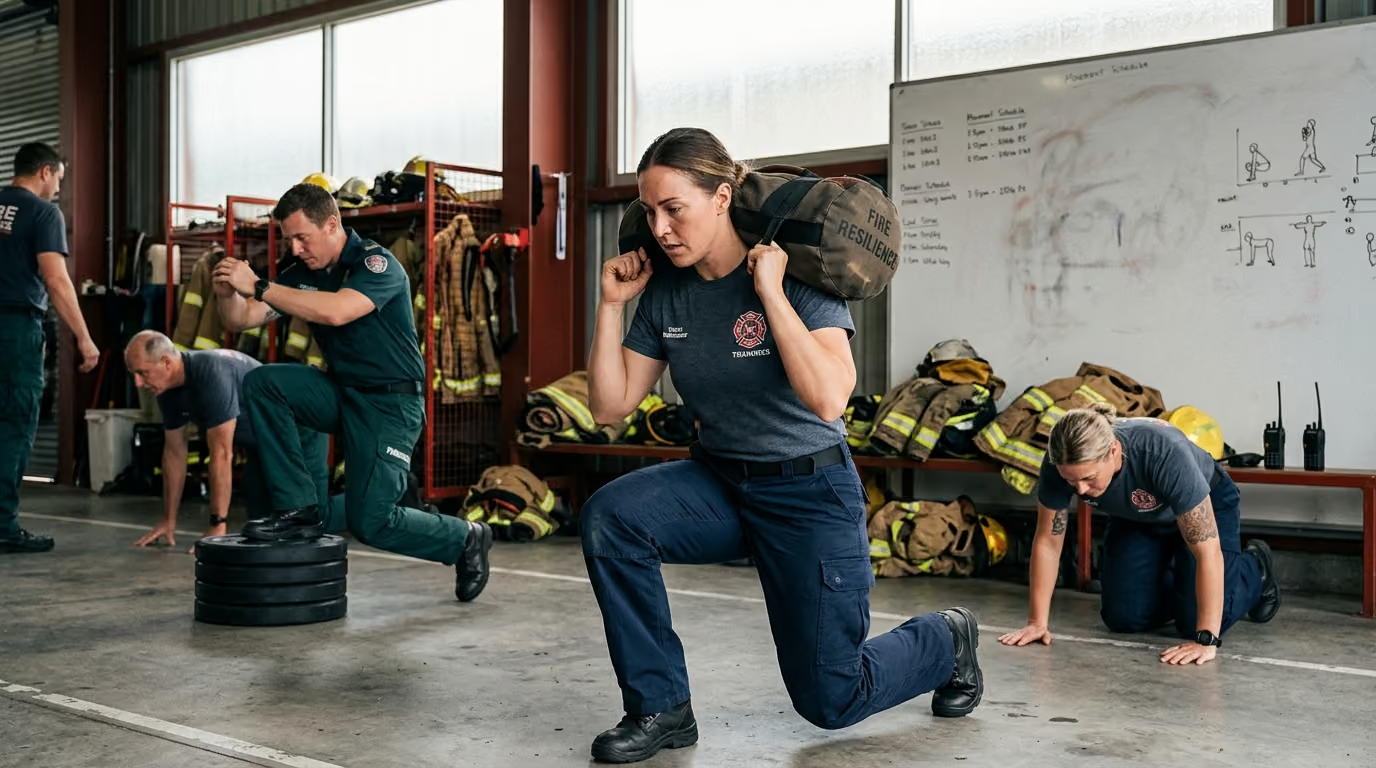

First responder knee resilience depends on targeted strength training, progressive neuromuscular conditioning, and smart movement strategies to handle heavy operational duty demands safely.





You step off the apparatus onto wet, uneven gravel with fifty pounds of gear on your back. Your foot slips an inch, your knee catches your body weight at an awkward angle, and you immediately transition into carrying tools up three flights of stairs. By the third call of a long night shift, every step down feels stiff, grinding, or unstable.
Knee resilience is the ability to repeatedly tolerate these real-world demands without breaking down. It means maintaining the tissue strength, movement control, and joint capacity required for stair climbing, kneeling, crawling, and heavy carries across an entire career. Building resilient knees does not require avoiding all kneeling or chasing textbook lifting technique. It requires balancing physical capacity against operational exposure, managing workload spikes, and modifying activity before minor irritation becomes a career-threatening injury.
Occupational research confirms that emergency service work places substantial physical strain on the lower limbs. Epidemiological data on firefighters shows that 77 percent of reported musculoskeletal injuries occur in the lower extremities. In that research, knee injuries were more than twice as common as ankle injuries, accounting for 22.6 percent of total injuries compared to 10.7 percent for ankles. Systematic reviews across first responder populations consistently identify the lower back and the knees as the primary sites of work-related musculoskeletal damage.
The biological mechanism behind occupational knee strain centers on the relationship between capacity and exposure. When tissues are exposed to force, they adapt and grow stronger if given adequate recovery time. If exposure outpaces adaptation, tissue breakdown begins. Systematic reviews on occupational physical activities demonstrate that long-term, cumulative kneeling and heavy squatting correlate with higher rates of knee osteoarthritis. An occupational meta-analysis estimated an odds ratio of 1.26 for every additional 5,000 lifetime hours of occupational kneeling or deep squatting. Heavy lifting, rapid ladder climbing, and sudden impact loads add mechanical friction and compressive forces to joint cartilage and surrounding tendons.
Neuromuscular training programs provide strong counter-evidence against the idea that joint wear is completely unavoidable. Meta-analyses of clinical trials demonstrate that structured neuromuscular training reduces the risk of knee and lower-extremity injuries by roughly 25 to 28 percent. These programs combine progressive strength training, balance work, landing mechanics, and agility drills. Short training doses performed consistently produce meaningful adaptations in joint stability and force dissipation. While much of this intervention data originates in athletic cohorts, the mechanical principles translate directly to emergency personnel who must produce and absorb force under unstable conditions.
Workload management research provides critical context regarding how and why injuries happen. Sudden spikes in physical activity, unaccustomed running, or abrupt increases in shift volume create vulnerability. However, research evaluating the acute-to-chronic workload ratio indicates that mathematical ratios cannot serve as standalone prediction formulas. Load monitoring must account for sleep debt, previous injury history, equipment mass, and joint symptoms rather than relying on a single training metric.
First responder duties place distinct stresses on the knee joint that rarely occur in controlled gym environments. Personnel do not simply run or squat on flat rubber flooring. They work in heavy protective garments that restrict joint range of motion, carry asymmetrical tools, and operate on unpredictable terrain under time pressure.
Ascending stairs requires repeated concentric force from the quadriceps, gluteal muscles, and calves while balancing on a single leg. Descending stairs is often more demanding because it requires eccentric braking forces to control gravity. When carrying heavy medical bags, hose bundles, or patients, knee joint compression increases substantially. Slippery treads, poor visibility, and awkward turn landings increase the shear forces placed across the patellofemoral joint and meniscal structures.
Paramedics and firefighters spend substantial working hours kneeling on hard surfaces, concrete, or vehicle floors. Deep kneeling produces extreme joint flexion combined with direct contact pressure on the patella and prepatellar bursa. Crawling introduces asymmetrical weight shifts, rotational torque, and continuous compressive loading. Over years of service, sustained low positions without adequate recovery can irritate the joint capsule, patellar tendon, and articular cartilage.
Stepping down rapidly from a high apparatus step, jumping over obstacles, or sprinting toward a scene requires rapid force absorption. When landing from a jump, the lower extremities must absorb several times the responder's total body weight within milliseconds. If fatigue impairs muscle timing or the foot lands on uneven rubble, the knee may collapse into excessive internal rotation and valgus stress. This sudden loading pattern places high tension on the anterior cruciate ligament, collateral ligaments, and menisci.
Emergency scenes frequently involve mud, loose gravel, wet grass, ice, and debris. Moving over broken ground requires the ankle, knee, and hip to function as a responsive, coordinated chain. If ankle mobility is restricted by rigid boots or the hip stabilizers are fatigued, the knee joint absorbs unintended rotational forces. Rapid changes of direction during dynamic entries or patient handling amplify these multi-planar stresses.
Protecting the knee does not mean avoiding heavy work. The most effective strategy is building high physical capacity across the entire kinetic chain so occupational tasks demand a lower percentage of your maximum capability. You can find comprehensive training structures in our first responder training around shift work guide to balance these movements with your duty schedule.
The quadriceps act as the primary braking system for the knee during stair descent, landing, and deceleration. Training must include both concentric lifting and controlled eccentric lowering.
Clinical guidelines for knee pain emphasize combining hip-targeted exercises with local knee training. The gluteus medius, gluteus maximus, and deep hip rotators control the alignment of the femur, preventing the knee from collapsing inward during single-leg tasks.
The hamstrings protect the anterior cruciate ligament by resisting excessive forward movement of the tibia. Meanwhile, the calves and ankles absorb ground reaction forces before they reach the knee joint.
First responders rarely carry symmetrical loads. Carrying gear unevenly challenges your core musculature to prevent spinal twisting and off-axis knee loading.
Neuromuscular drills train the central nervous system to coordinate muscle firing under rapid, unstable conditions. Incorporate 5 to 10 minutes of dynamic balance and landing work into your regular warm-up.
How you move during calls directly affects the cumulative wear on your joints. Applying sound movement mechanics distributes stress across large muscle groups rather than concentrating force into joint cartilage.
When ascending stairs under load, place your entire foot securely on the step rather than driving solely through your toes. Push through the midfoot and heel to engage the gluteal muscles and hamstrings alongside the quadriceps. Maintain an active, slightly forward-leaning trunk to distribute the carried weight over your center of mass.
During stair descent, control your speed before stepping down. Avoid dropping heavily from step to step, which creates sharp spikes in patellofemoral pressure
. Keep your tracking knee aligned with your second toe as you bend the joint, avoiding excessive inward collapse. Whenever operationally feasible, use a handrail to provide an extra point of contact and reduce total joint loading.
When performing patient care or equipment work on the ground, avoid resting passively at the end range of knee flexion for extended durations. Shift your posture periodically between bilateral kneeling, a half-kneeling position, and a low squat. Using a half-kneeling stance allows one leg to support a portion of your body weight while relieving direct pressure from the trailing knee.
To rise from the floor safely with equipment, establish a solid base of support first. Step your front foot forward until it is flat on the ground with the shin relatively vertical. Lean your torso slightly forward over the front thigh, drive through the front heel and midfoot, and extend the hip and knee simultaneously. Avoid twisting your body while your trailing knee is pinned to the floor. Alternate which leg leads the movement during training sessions to balance physical wear.
The traditional rule that knees must never travel past the toes is outdated and physically impractical for emergency operations. When lifting a patient in a narrow hallway or working beneath a dashboard, forward knee movement is natural and necessary. The key is ensuring that the knee tracks in the same direction as the foot and that the movement remains controlled.
Before initiating a heavy lift, establish a stable foot position. Engage the hips and posterior chain so the lower back and gluteals share the load with the quadriceps. Avoid abrupt, jerky transitions out of a deep squat, especially when fatigued. If space permits, position yourself as close to the load as possible to reduce the mechanical moment arm acting on your spine and knees.
Crawling requires coordinated weight transfer across the limbs while wearing heavy protective gear. Distribute your weight evenly between your hands, forearms, knees, and toes rather than dropping all force onto the patellar surface. Keep your core active to prevent excessive pelvic rotation and spinal sagging. Practice transitioning smoothly from crawling to a half-kneel and standing position during non-duty training drills.
Exiting emergency apparatus is a frequent source of acute knee trauma. Never leap blindly from a cab or tailboard onto unknown terrain. Look at the ground surface before stepping down to identify ice, loose gravel, oil, or debris. Use grab handles to maintain three points of contact until your feet are securely on the ground. When jumping down is unavoidable, land softly with bent hips, knees, and ankles to absorb the impact smoothly.
Physical capacity is not fixed. It rises with consistent training and drops with cumulative fatigue, illness, and lack of sleep. Managing your total workload protects joint health over decades of active duty. Responders looking to calibrate their daily output should review our train readiness and autoregulation guide for practical workload adjustment tools.
Think of your knees as operating within a daily and weekly load budget. Every flight of stairs, hour spent kneeling, heavy lift, run, and jump draws from this budget. When total exposure exceeds your available recovery resources, tissues become irritated.
Tracking your workload does not require complex algorithms. Pay attention to cumulative volume across these key operational categories:
Injuries often occur when a responder suddenly introduces high volumes of an activity they have not performed recently. Follow these progressive loading rules:
Use a simple three-tier decision model to adjust your training based on current readiness and shift demands:
If you are balancing limited time on shift, applying principles from our minimum effective dose training guide can help maintain joint capacity without adding unnecessary physical fatigue.
External equipment and environmental factors heavily influence the forces transmitted through the lower extremities. Choosing and maintaining the right gear provides an essential protective layer.
Duty boots must balance ankle support, puncture resistance, and traction against weight and mobility. A boot that is excessively rigid can restrict natural ankle motion, forcing the knee joint to absorb additional rotational torque during dynamic movement.
When selecting footwear, verify that the boot provides a secure heel lock and a wide toe box that allows your toes to splay naturally. Look for outsoles with tread patterns designed for wet, oily, or icy surfaces to prevent slipping incidents. Inspect your duty footwear regularly for uneven tread wear or midsole compression. Footwear with broken-down internal cushioning changes foot alignment and increases impact forces on the knee.
Occupational health guidelines recommend knee protection for workers who perform sustained kneeling tasks. Knee pads reduce direct contact pressures over the patellar tendon and bursa while shielding the joint from sharp objects.
Select knee pads that stay firmly in place during crawling and transitions without pinching behind the knee or restricting blood flow. Pads built directly into turnout pants or tactical trousers offer consistent protection without requiring strap adjustments. For paramedics performing extended patient care on hard floors, carrying a portable foam kneeling pad in the response bag provides rapid, high-density cushioning. Remember that knee pads reduce contact pressure but do not eliminate the internal joint strain caused by sustained deep flexion.
Navigating slick or unstable surfaces requires deliberate movement adjustments. When transitioning from dry pavement onto wet tile, mud, loose gravel, or ice, shorten your stride length. Keeping your feet beneath your center of mass reduces the braking shear forces placed on the knee and lowers slipping risk. Scan your pathway continuously for trip hazards, electrical cords, and uneven ground when carrying patients or equipment.
Experiencing mild knee discomfort does not automatically mean tissue is breaking down. Joint pain is information that should guide your daily loading decisions. For deeper insight into managing physical recovery alongside sleep debt, explore our injury and recovery resources.
For active personnel, complete absence of pain is not always realistic, especially among experienced responders with decades of physical service. Clinical guidelines for joint health emphasize that mild, stable discomfort during or after exercise is acceptable as long as it behaves predictably.
Use this symptom monitoring checklist to evaluate knee response:
When a knee becomes irritated after a heavy shift or intense training drill, complete immobilization is rarely the best answer. Prolonged rest leads to muscle atrophy, reduced tendon capacity, and joint stiffness. Instead, use active modification:
First, temporarily remove the specific provocative trigger, such as running, deep squats, or heavy stair descents. Second, maintain low-impact aerobic circulation through stationary cycling, rowing, or swimming to promote joint lubrication. Third, continue performing pain-free strength movements, such as isometric holds, hip hinges, and gluteal bridges. Fourth, reintroduce occupational tasks gradually, starting with unloaded movements before adding external equipment and speed.
Tissue recovery depends directly on systemic lifestyle factors. Protecting your sleep architecture is essential for muscle protein synthesis, tissue repair, and neuromuscular coordination. Learn how to structure your rest across rotating shifts in our shift-specific sleep plan guide.
Maintain adequate daily protein intake to support muscle repair and connective tissue remodeling. Stay consistently hydrated, particularly when working in heavy turnout gear or hot environments, because dehydration impairs tissue elasticity and increases fatigue. Incorporate brief, light active recovery sessions on off-duty days to promote blood flow without adding mechanical wear.
Avoiding common training errors is just as important as performing the right exercises. Many responders fall into predictable traps that undermine long-term knee durability.
Having a heavy back squat does not make your knees immune to injury. Responders need single-leg balance, eccentric deceleration control, rotational stability, and tolerance for prolonged kneeling. A well-rounded program must address all of these movement domains.
Dogmatic rules like keeping the torso completely vertical or never letting the knees cross the toes fail on real emergency scenes. Resilient responders develop capacity through varied movement angles, awkward positions, and diverse foot placements in the gym so their joints tolerate chaotic real-world demands.
Shutting down all physical activity at the first sign of knee aching causes muscle deconditioning and lowers overall joint capacity. Modifying load, reducing range of motion, and maintaining low-impact strength work preserves tissue durability while allowing irritation to settle.
Wearing knee pads does not grant immunity from joint strain. Pads disperse contact pressure over the kneecap, but they do not eliminate the rotational forces, deep flexion stress, or hip fatigue associated with long kneeling tasks. Position changes and physical conditioning remain necessary.
Pushing training sets to absolute muscular failure right before or during a shift degrades motor control and joint stability. When an unexpected emergency call arrives, fatigued stabilizer muscles cannot protect the knee against sudden dynamic loads. Keep reserve capacity in your training sessions while on duty.
Self-management and progressive training are effective for general joint resilience, but certain knee symptoms require formal medical evaluation. Continuing to push through mechanical dysfunction can turn a treatable condition into permanent joint damage.
If you experience any of the following signs, stop high-load training and consult a physician, physical therapist, or qualified orthopedic specialist:
A licensed physical therapist or sports medicine physician can assess joint kinematics, ligamentous stability, and soft tissue health. For chronic conditions like patellofemoral pain syndrome or mild-to-moderate osteoarthritis, authoritative medical guidelines recommend structured, individualized exercise therapy as the primary intervention. Routine imaging like X-rays or MRIs is often unnecessary for gradual, non-traumatic knee aches, as structural findings on scans frequently do not correlate directly with daily physical performance.
Work with your healthcare provider to establish clear return-to-duty milestones. A structured rehabilitation plan will progress from isolated joint strengthening to multi-joint movements, task-specific drills in gear, and simulated operational duties before clearing you for unrestricted emergency service.
Review this guide whenever your operational assignments change, such as moving to a station with heavy high-rise stair exposure, returning from an extended medical leave, or experiencing an initial flare of front-of-knee discomfort.
Building durable knee resilience ensures you can handle the unpredictable physical demands of emergency response today while protecting your joint health for an active life long after your service ends.
Stay connected for research-led guidance on duty fitness, shift-work sleep, injury recovery, stress, nutrition and career longevity. Practical ideas for first responders who want to stay capable on the job, recover well and protect their health for the long run.



Read practical guidance on first responder fitness, recovery, sleep, nutrition and resilience for demanding work and a long, active career.
read the blog



