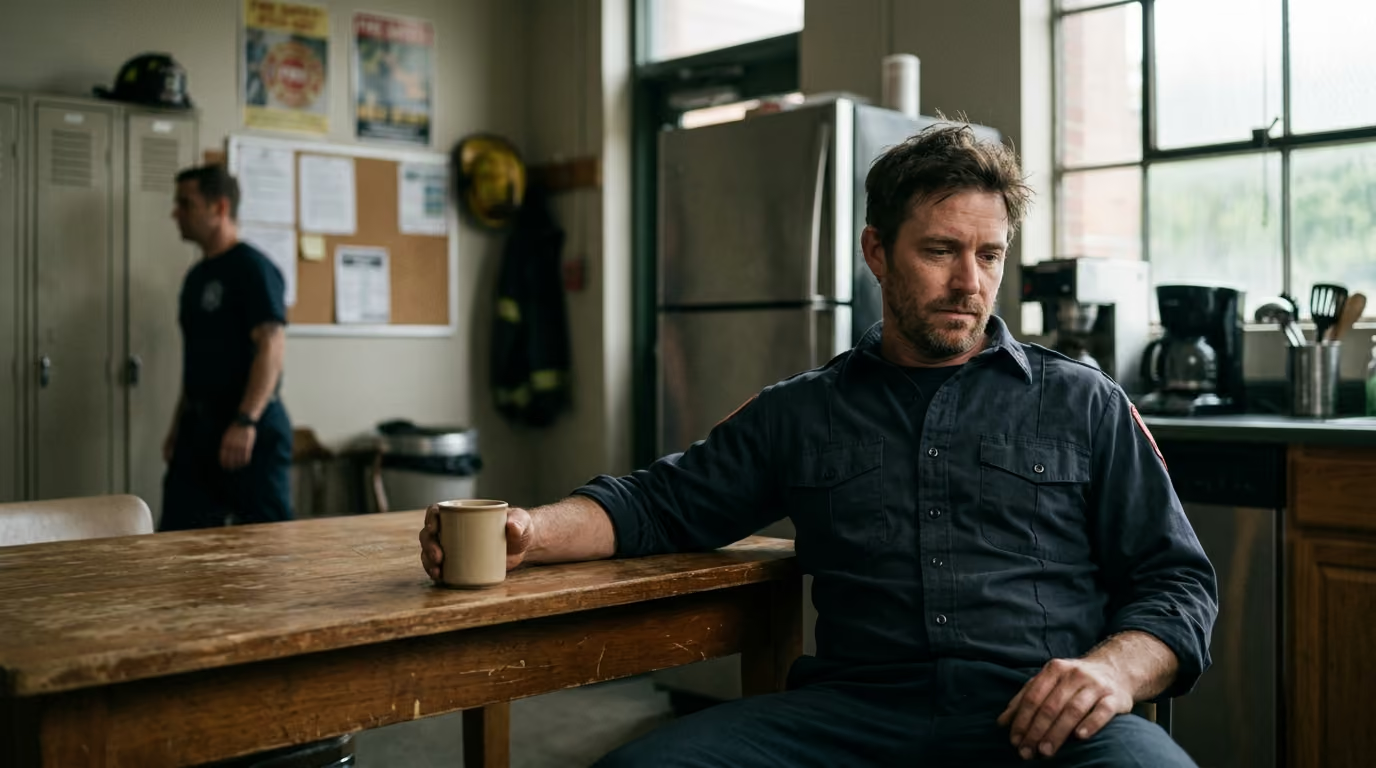

A systematic review of 28 studies and 20,424 rescue workers shows how cumulative stress and operational automaticity mask significant psychological strain.





The tones drop at three in the morning. A senior officer with fifteen years on the job steps off the apparatus and runs a complex call with mechanical precision. Every radio report is calm. Every tactical assignment is executed without hesitation.
Two weeks later, that same officer struggles to sleep, snaps at junior crew members during routine equipment checks, and feels a strange paralysis when facing an ambiguous, low-stakes decision. Nothing obvious went wrong on the call, yet their internal operating baseline has shifted.
The belief that past resilience guarantees future immunity is one of the most persistent misunderstandings in emergency services. Experience, skill, and past survival do not build a permanent shield against acute stress or cumulative occupational wear. Understanding why even veteran personnel experience disruption is essential for maintaining operational safety and career longevity.
Resilience is not a permanent personality trait or an armor that prevents psychological and cognitive strain. According to definitions established by the American Psychological Association, resilience is an active process and outcome of adapting to difficult conditions through behavioral, cognitive, and emotional flexibility.
A responder can remain dedicated, courageous, and technically proficient while still experiencing sleep disturbances, intrusive thoughts, emotional numbness, and altered risk appraisal after difficult calls. Highly rehearsed motor skills and procedural drills often remain intact under heavy stress. However, complex decision-making, working memory, and adaptive judgment can deteriorate quietly beneath a polished exterior.
True operational readiness requires recognizing that competence and vulnerability exist side by side. Past performance proves past adaptation, not future invulnerability.
Occupational research across emergency medical services, firefighting, law enforcement, and emergency nursing provides a nuanced picture of responder mental health. The evidence separates short-term performance capacity from long-term psychological health.
Performance literature often focuses on mental toughness. In sports and tactical psychology, mental toughness refers to a psychological edge that allows an individual to remain determined, focused, confident, and in control during high-pressure events. It is a capacity applied in the acute window of execution.
Resilience, by contrast, operates over a much wider timeline. Research demonstrates that resilience involves individual coping strategies, social support, organizational resources, and physiological recovery. An individual may demonstrate exceptional mental toughness during a chaotic twelve-hour shift yet experience significant post-incident strain during the days that follow.
Confusing immediate toughness with long-term resilience leads organizations to ignore post-event decompression. When leaders assume that composure on scene equals complete immunity, recovery needs are overlooked.
The scientific literature shows that post-traumatic stress disorder and chronic psychological distress are real risks in emergency response, but prevalence rates vary considerably based on research methodology.
These variations reflect differences in diagnostic criteria, regional working conditions, shift lengths, and whether studies measured transient symptom spikes or diagnosed clinical disorders. The central finding across these datasets is consistent: psychological distress is a measurable occupational risk, but positive adaptation remains common when proper support exists.
Higher baseline resilience scores among emergency personnel correlate with lower symptom severity six months after severe critical incidents. Yet resilience does not eliminate baseline human physiology. It simply provides a foundation from which recovery can take place.
The relationship between professional experience and stress reactivity is non-linear. Many agencies assume that veteran personnel are insulated from performance degradation. Systematic reviews examining acute stress and decision-making challenge this assumption.
Automaticity is the ability to execute complex, overlearned motor actions and procedural workflows with minimal working memory load. When a paramedic draws medication, or a firefighter advances a hose line into a structure, extensive repetition allows these sequences to run on neurological autopilot.
This automaticity creates an operational paradox:
Occupational evidence shows that while post-traumatic stress symptoms do not reliably impair basic, overlearned skills, they significantly alter risk assessment in situations requiring subtle professional judgment. A responder can perform routine airway management flawlessly while misjudging environmental safety or overlooking diagnostic cues that contradict their initial impression.
Experienced personnel rely heavily on pattern recognition. When an incident matches a scenario seen dozens of times before, the brain rapidly retrieves an intuitive solution. This process saves vital seconds in emergency work.
However, pattern recognition becomes dangerous when acute stress and fatigue narrow attention. A tired, stressed responder may force a novel, non-standard event into a familiar mental category. They miss subtle discrepancies that indicate a different approach is necessary.
True operational adaptability requires two distinct cognitive steps: rapid pattern recognition and continuous pattern reassessment. Acute stress preserves the first step while suppressing the second. Responders who trust their experience unconditionally may double down on an ineffective strategy rather than adjusting their tactics.
Emergency work discussions often center on the single bad call. Cinematic portrayals suggest that trauma arrives in one dramatic, unforgettable incident. While catastrophic incidents certainly impact personnel, the reality of occupational strain is far more cumulative.
A systematic review examining emergency medical services and emergency dispatch personnel found that approximately 69 percent of first responders did not have sufficient time to recover fully from stressful events because incidents occurred with high frequency.
When recovery windows are continuously compressed, the nervous system remains in a state of baseline hyperarousal. This occupational reality creates a distinct vulnerability:
When an experienced responder suddenly experiences performance disruption on an apparently routine call, that call is rarely the sole cause. It is simply the final load placed on an already depleted physiological system.
To better manage this physical and cognitive drain, responders can examine structured self-regulation strategies for cumulative duty fatigue.
Resilience is physiologically impossible without adequate sleep. In emergency services, sleep deprivation is frequently normalized as an unavoidable condition of the job. Occupational health studies demonstrate that sleep loss degrades the exact cognitive faculties required for high-stakes adaptation.
A systematic review on occupational fatigue in emergency responders confirmed that chronic sleep restriction, night shifts, and broken rest directly increase safety-compromising behaviors and clinical errors. Laboratory research evaluating 24 hours of sustained wakefulness reveals precise cognitive losses:
Sleep-deprived individuals can still make simple, binary choices with acceptable accuracy. However, tasks requiring the integration of multiple shifting information streams suffer dramatic impairment. In an emergency, conditions are rarely simple or binary. A sleep-deprived company officer may successfully choose an initial tool while failing to monitor changing smoke patterns, crew exhaustion, and structural stability simultaneously.
Research shows that total sleep restriction directly impairs the brain's ability to process corrective feedback. When a sleep-deprived person receives information that an initial decision is failing, they struggle to update their cognitive framework. They tend to repeat the original, ineffective behavior with greater intensity.
For frontline personnel managing irregular schedules, understanding evidence-based recovery baselines is critical. Responders can explore established recovery standards outlined in the CDC shift-work fatigue guidelines.
Cultural myths inside emergency agencies often prevent personnel from recognizing cognitive strain until an operational error occurs. Addressing these misconceptions openly improves team safety and operational execution.
Resilience is not emotional detachment. It is the ability to navigate emotional disruption, adapt behavior, and return to an effective baseline over time. Expecting oneself or others to feel nothing after horrific calls leads to emotional suppression. Suppression increases systemic blood pressure, disrupts sleep architecture, and accelerates burnout.
Experience expands a responder's library of mental models and builds confidence. However, experience does not alter basic autonomic neurobiology. When acute physiological arousal passes an individual threshold, higher-order working memory deteriorates regardless of whether a responder has one year or twenty years on the street.
If an apparatus returns to quarters without an accident and the patient is delivered alive, leaders often assume the crew functioned at peak capacity. This outcome-bias ignores near-misses and hidden cognitive strain. Overlearned procedural competence can push an incident to completion even while situational awareness, risk calibration, and verbal recall are severely degraded.
Repeated exposure only builds resilience when paired with adequate recovery time, peer processing, and emotional stability. Repeated exposure without recovery causes cumulative sensitization. Over time, the nervous system treats an increasing number of ambiguous stimuli as immediate threats.
Many responders hide their fatigue or intrusive thoughts because they fear losing their crew's trust. Research demonstrates that collective efficacy and team cohesion are actually reinforced when teams communicate honestly about physiological readiness and cognitive bandwidth. Personnel can learn more about how organizational culture influences resilience in our analysis of sustainable mental performance in emergency response.
To move beyond generic discussions of mental toughness, agencies and crews require a practical operational model. Performance at any given moment is determined by the dynamic interaction between task demands, the responder's current internal state, and the availability of recovery systems.
Not all emergency tasks place equal demands on cognitive bandwidth. Leaders and responders should evaluate operational demands across two primary categories:
Instead of asking simple yes-or-no questions about readiness, responders and company officers should monitor specific behavioral markers that indicate autonomic overload:
When operating in complex, high-consequence environments, crews should introduce brief, structured pauses to interrupt automatic overgeneralization. These pattern interrupts require only a few seconds and can prevent major operational errors:
For crews navigating rigorous shift structures, balancing physical and mental training is essential. Guidance on structuring workouts around fatigue is detailed in our guide on training around shift work.
Maintaining capability requires establishing clear boundaries for operational safety. When fatigue, trauma exposure, or acute stress impair an individual's cognitive flexibility, continuing to operate without modification creates unacceptable safety risks for both the responder and the public.
Emergency organizations must build cultural permission for tactical self-regulation and peer intervention. If an engineer has operated for 24 continuous hours without sleep due to severe weather recalls, allowing that engineer to drive heavy apparatus at emergency speeds is an organizational failure.
Practical duty modifications do not require taking personnel entirely off the roster. They involve sensible operational adjustments:
Never encourage an emergency responder to push through severe cognitive impairment or untreated trauma symptoms under the banner of mental toughness. When safety boundaries are crossed, the risk of serious operational error increases dramatically.
Transient distress following a horrific incident is a normal human response. However, when symptoms persist, intensify, or begin degrading daily functional life, professional evaluation by a licensed clinician familiar with first responder culture becomes essential.
Responders, supervisors, and family members should watch for specific clinical markers that indicate the need for dedicated professional care:
Early engagement with specialized clinicians prevents acute stress reactions from solidifying into chronic post-traumatic stress or depressive disorders. Modern legislative efforts are increasingly supporting specialized mental health programs for public safety personnel, as seen in updates regarding specialized emergency responder mental health initiatives.
Revisit this operational framework whenever your agency experiences a high-stress critical incident, during extended periods of mandatory overtime, or when onboarding new personnel into high-call-volume assignments. Use these concepts during post-incident reviews to examine decision-making quality without falling into outcome-bias or personal blame.
Sustainable capability across a decades-long emergency services career is not built on pretending to be unbreakable. It is built on honest self-monitoring, structured recovery habits, and the professional humility to recognize that resilience is an ongoing practice rather than a permanent state of immunity.
Stay connected for research-led guidance on duty fitness, shift-work sleep, injury recovery, stress, nutrition and career longevity. Practical ideas for first responders who want to stay capable on the job, recover well and protect their health for the long run.



Read practical guidance on first responder fitness, recovery, sleep, nutrition and resilience for demanding work and a long, active career.
read the blog



