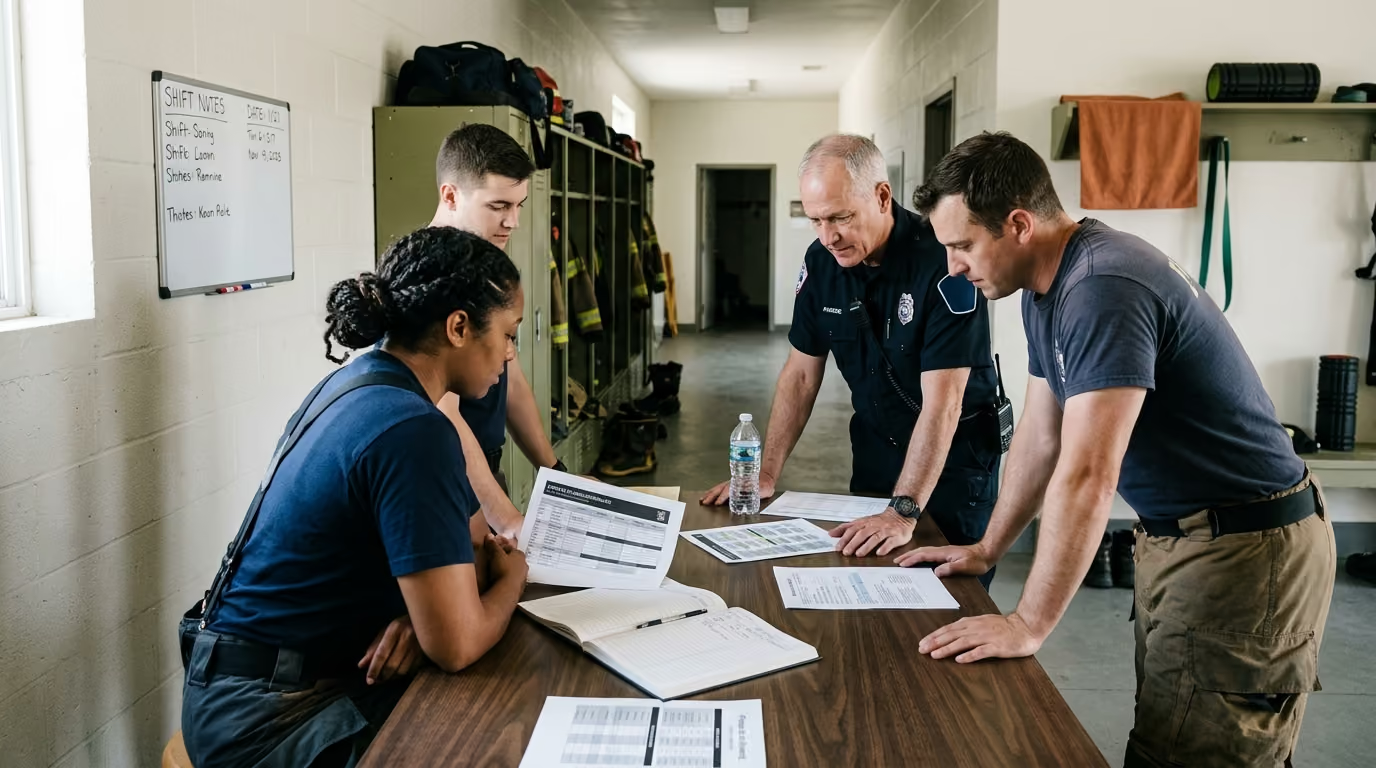

Seven-day acute workload spikes cause severe tissue strain, but systematic progression protocols protect emergency responders from injury during major duty transitions.





How to return to hard physical training after time off without getting hurt is one of the most common questions in emergency services. The plain answer is straightforward. Workload spikes occur when the physical demands of your training or duty rise faster than your body can adapt. To avoid injury, you must keep your weekly increases gradual, adjust only one physical stressor at a time, and match your schedule to your current capacity rather than your past peak fitness.
A workload spike is an acute mismatch between current physical exposure and recent preparation. The problem is rarely hard work on its own. The real issue is exposing tissues to sudden, unfamiliar demands without giving them adequate time to build tolerance.
When tracking workload, exercise scientists distinguish between external and internal loads. External workload represents the measurable physical work completed. This includes miles run, flights of stairs climbed, pounds lifted, or hours spent wearing body armor. External load is straightforward to log, but it does not tell the full story.
Internal workload describes the biological and psychological stress experienced by the individual. It is shaped by heart rate, rating of perceived exertion, muscle fatigue, sleep debt, thermal strain, and psychological pressure. Two firefighters carrying an identical hose bundle over the same distance complete the same external work. However, the firefighter who slept two hours and is fighting a mild viral infection experiences a much higher internal workload.
Understanding this distinction helps explain why training variables must be managed carefully. The most common variables include:
Physical systems adapt to these variables at noticeably different rates. Cardiovascular fitness and aerobic enzyme activity often rebound within a few weeks of consistent training. Muscles also regain contractile strength relatively quickly. In contrast, passive structures like tendons, ligaments, joint cartilage, and cortical bone adapt much more slowly.
This difference in biological timelines creates a common trap. A first responder returning from a quiet period or light duty often feels aerobically capable after two weeks of conditioning. Their breathing is controlled, and their perceived exertion is low. Yet their patellar tendons, plantar fascia, and lumbar spine may still lack the structural tolerance for high-impact running or heavy carries. When cardiovascular readiness outpaces structural tolerance, the risk of overuse injury increases rapidly.
Research examining training loads highlights the danger of large, sudden increases in acute work. Acute workload represents the total physical stress accumulated over the preceding seven days. Chronic workload represents the rolling weekly average over the prior three to six weeks. When the acute workload exceeds the chronic workload by a wide margin, soft-tissue injury rates tend to rise.
In professional athletes, sudden jumps where acute work doubled chronic baselines produced significant spikes in soft-tissue injuries according to sports medicine research. While elite sports data cannot be mapped directly onto emergency services, the underlying physiological principle remains true. When recent preparation is low, rapid increases in physical exposure place connective tissues at risk.
At the same time, mathematical ratios should serve as general planning guides rather than exact diagnostic rules. Systematic reviews demonstrate high statistical variation across different populations and sports. Workload ratios cannot account for individual injury history, age, movement mechanics, or sudden emotional stress. Instead of relying on a rigid formula, professionals should focus on consistent progression and systematic tracking.
A classic heuristic in endurance sports is the ten percent rule, which advises against increasing weekly training volume by more than ten percent. International clinical consensus statements on bone stress injuries continue to reference weekly volume and intensity increases below ten percent as a conservative guideline. However, this figure is a rule of thumb rather than an unbreakable law. A novice returning from prolonged bed rest may need much smaller increments. Conversely, an experienced professional performing low-intensity cross-training may safely tolerate slightly higher relative shifts. The key is keeping adjustments modest, predictable, and reversible.
Emergency service personnel operate under physical conditions that standard athletic models rarely capture. Firefighters, law enforcement officers, paramedics, and military service members face unpredictable physical demands that occur without a standard warm-up. These tasks are frequently performed in extreme thermal environments while carrying heavy external equipment.
Musculoskeletal disorders represent a massive occupational burden across all branches of emergency services. Research on occupational firefighter injuries indicates that overall musculoskeletal disorder prevalence reaches roughly 46 percent across international cohorts. The anatomical regions most frequently affected include:
A common assumption is that the majority of occupational injuries occur during urgent emergency responses. Data from the United States Fire Administration and the National Fire Protection Association presents a different reality. In occupational studies of firefighter injuries, non-fire emergencies and standard station duties account for tens of thousands of reported injuries annually.
A five-year study examining 1,311 Canadian firefighters revealed that 65 percent of musculoskeletal disorders occurred at the fire station or during physical training sessions. Only 15 percent were directly attributed to fireground operations. Recent research similarly notes that approximately 55 percent of musculoskeletal injuries among tactical personnel occur during training environments rather than on rescue scenes.
These statistics offer an important practical lesson. Controlled physical preparation represents both a point of vulnerability and a major opportunity for prevention. Because more than half of all injuries happen during station training and conditioning, adjusting how you progress your physical workload can significantly reduce your injury risk.
Workplace injury data consistently lists sprains, strains, and muscular pain from overexertion as the primary causes of lost duty time. Bending, lifting, carrying, squatting, and slipping under load generate substantial mechanical stress. When high duty stress combines with an aggressive gym routine, cumulative fatigue compromises movement quality.
Fatigue alters movement mechanics in predictable, hazardous ways. As trunk stabilizers and lower-limb muscles fatigue, personnel exhibit:
When fatigue causes poor movement mechanics, structural tissues absorb forces they are not prepared to handle. Managing training volume alongside shift demands protects your baseline movement patterns from breaking down under pressure.
Most recreational fitness programs treat progression as a simple equation of adding weight to a barbell or miles to a running app. For first responders, physical workload is multidimensional. Changing your operating environment or gear alters your mechanical stress just as much as adding miles to a run.
To plan your progression safely, you must track at least ten distinct dimensions of workload:
The foundational rule of durable physical preparation is the Rule of Single Progression:
> Never increase volume, intensity, frequency, terrain difficulty, protective equipment burden, and operational complexity at the same time.
The most hazardous transitions happen when multiple small increases compound across several categories. A tactical officer might decide to resume conditioning by adding one mile to their weekly running distance. On its own, a ten percent volume increase is completely reasonable.
However, if that officer also runs on a steep trail, wears newly issued duty boots, carries a weighted vest, and cuts rest periods in half, they have not made a ten percent increase. They have multiplied the cumulative mechanical load on their feet, calves, and lumbar spine.
When designing a progression, choose one primary variable to adjust over a seven-to-fourteen-day period. Keep all other variables completely stable.
If you are increasing your weekly running duration, keep your running shoes, pace, and running surface identical. If you are introducing structural stairs or hill repeats, reduce your total session duration to account for the higher eccentric forces. If you are introducing heavy protective gear, reduce your movement speed and stay on flat, predictable ground until your joints and core musculature adapt.
Applying the principles of duty fitness requires understanding that progression is not just about moving heavier loads. It is about systematically exposing your body to operational demands without exceeding your recovery capacity.
Career transitions in emergency services create sudden shifts in physical workload. Personnel moving through these milestones are often vulnerable to training spikes because their daily physical routines change overnight. Applying structured progression models helps maintain physical durability across these critical transitions.
Returning to full duty after personal leave, medical recovery, or a quiet operational cycle requires rebuilding a base of physical tolerance. Your training baseline must reflect your current physical state, not your historical personal records.
A safe return follows a predictable four-stage progression:
Personnel looking for efficient ways to rebuild baseline strength can use minimal effective dose strategies to reintroduce foundational resistance work without causing severe muscle soreness or lingering fatigue.
Academy environments place recruits at high risk for workload spikes. Recruits face sudden increases in physical training volume, rigorous drill yard evolutions, heavy academic study loads, and restricted sleep opportunities simultaneously.
To reduce overuse injuries during recruit training:
Promotions to supervisory positions, such as company officer, sergeant, or battalion chief, present an overlooked workload challenge. While intense physical labor on scene may decrease, total daily stress often increases through longer shifts, administrative burdens, irregular sleep schedules, and sudden emergency responses.
Supervisors often attempt to maintain high-volume athletic training routines while dealing with increased sleep debt. This creates a mismatch between internal stress and recovery capacity.
To manage this transition:
Personnel working irregular schedules can find useful strategies in this guide to training around shift work, which provides frameworks for adjusting session intensity based on shift-related fatigue.
Protective gear changes physical mechanics. Wearing body armor, structural firefighting turnout gear, SCBA units, heavy tactical boots, or loaded equipment belts alters your center of mass and restricts joint mobility.
Gear alters your physical workload in several distinct ways:
When breaking in new protective gear, follow a structured familiarization timeline:
Moving your training from a gym floor or track to outdoor terrain represents a major mechanical jump. Shifting to loose sand, steep hills, broken trails, or structural stairs significantly increases joint stabilization demands and calf loading.
Military load-carriage research shows that moving across steep, uneven, or sandy surfaces increases metabolic energy expenditure and injury rates compared to flat pavement.
Follow this sequential progression when changing training surfaces:
Never introduce heavy loads, high speeds, and complex terrain in the same training session. Master the surface with bodyweight before adding operational equipment.
You do not need expensive laboratory equipment or complex software to monitor physical workload. A practical monitoring system requires only a simple logbook or phone note combined with honest self-assessment.
To catch workload spikes before they cause an overuse injury, track these daily variables:
Tracking internal load scores over time makes sudden workload jumps immediately apparent. If your weekly score averages 1,200 units over three weeks, jumping to 2,400 units in a single week represents a major spike that requires adjustment.
Using a simple green, yellow, and red indicator system helps first responders make daily decisions about when to train hard, when to modify, and when to rest.
When yellow indicators appear, modify your planned session. Reduce your volume by 30 to 50 percent, lower your intensity, switch to low-impact cardiovascular modes, or prioritize soft-tissue mobility. Learn more about managing these daily modifications in this autoregulation guide for tactical athletes.
Red indicators signal potential tissue damage. Continuing to train through red indicators turns minor, manageable tissue irritation into severe, long-term injuries.
Workload numbers are estimates of stress, not exact measures of biological tissue capacity. A GPS watch or training app can record mileage and pace, but it cannot assess heat strain, operational stress, dehydration, or muscle fatigue from a long structural fire.
Sports science research emphasizes that training-load algorithms cannot reliably predict individual injuries on their own. Numbers and ratios are tools to structure your thinking, not absolute rules. Always combine workload metrics with subjective feedback, movement quality assessments, and honest evaluations of your physical recovery.
Balancing operational readiness with physical development requires recognizing real-world trade-offs. Emergency responders cannot manage their physical exposure like professional athletes who control their sleep, meals, and recovery schedules. Duty calls happen without warning, shifts extend unexpectedly, and sleep gets interrupted.
Accepting these operational constraints requires clear safety guardrails:
Understanding your operational constraints helps you apply the principles of injury recovery before minor wear and tear becomes a career-limiting problem. To make quick, practical decisions during demanding shift cycles, reference this shift-work training decision tree to determine whether to push, adjust, or rest.
Differentiating between normal training discomfort and early structural injury is essential for long-term health. Mild, generalized muscle soreness that peaks 24 to 48 hours after a new workout and resolves with light activity is a normal biological response to exercise.
In contrast, structural tissue injuries require professional evaluation. You should step away from standard training and consult a licensed physical therapist, athletic trainer, or physician when experiencing:
Working with an occupational health provider, physical therapist, or qualified tactical strength and conditioning specialist allows you to maintain fitness safely. These professionals can adjust your exercises to offload irritated tissues while keeping your healthy joints and systems active.
Long-term physical durability is built through patient, consistent preparation rather than aggressive, sporadic training bursts. By systematically managing your training variables, respecting tissue adaptation timelines, and avoiding compound workload spikes, you protect your body from preventable injuries and build physical capability that lasts across an entire career.
Apply these steps this week to protect yourself from training and workload spikes:
Stay connected for research-led guidance on duty fitness, shift-work sleep, injury recovery, stress, nutrition and career longevity. Practical ideas for first responders who want to stay capable on the job, recover well and protect their health for the long run.



Read practical guidance on first responder fitness, recovery, sleep, nutrition and resilience for demanding work and a long, active career.
read the blog



