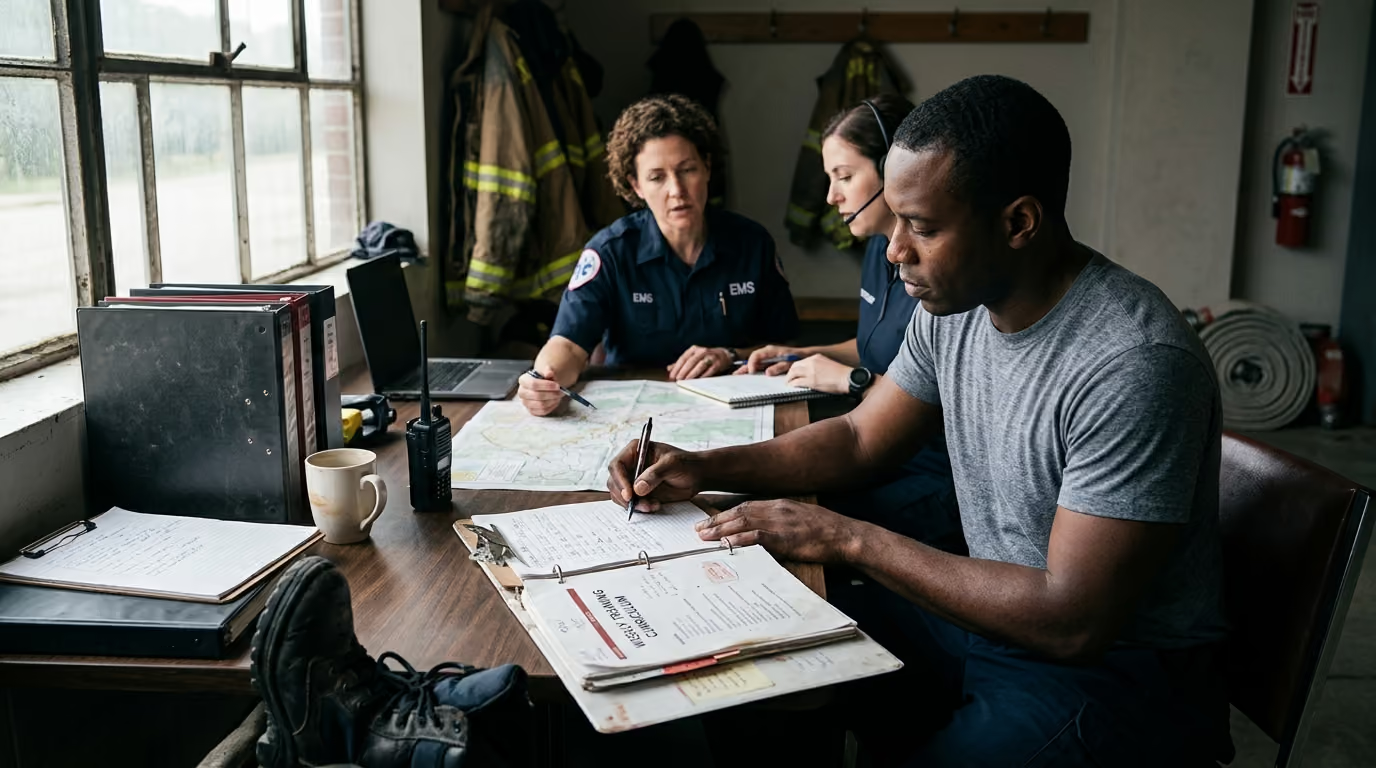

Carrying heavy gear across demanding callouts requires evidence-based movement templates and adaptable weekly schedules that build lasting operational strength.





Most physical preparation programs for emergency personnel fail not because they lack hard work, but because they treat an unpredictable emergency response career like a predictable fitness hobby. Conventional bodybuilding splits and rigid endurance calendars assume unbroken sleep, scheduled meals, and regular rest days. When emergency calls interrupt the night or extended operations demand hours of heavy physical labor, rigid training plans rapidly collapse.
A sustainable first responder weekly training template must be built as an adaptable system rather than a fixed calendar. It prioritizes foundational strength, aerobic work capacity, joint integrity, and movement quality while allowing daily training stress to expand or contract based on operational recovery. By viewing weekly training through the lens of minimum effective doses and autoregulation, first responders can maintain operational capability across decades of service without creating excessive physical exhaustion.
Emergency response work requires an uncommon blend of multiple physiological systems. A firefighter advancing an attack line, a paramedic lifting a patient in a confined stairwell, or a police officer managing a combative subject must draw on distinct metabolic pathways. These duties require both immediate peak force and sustained energy output.
Research on firefighter human performance demonstrates that occupational tasks demand high levels of both aerobic and anaerobic energy production. Operational activities frequently drive heart rates between 84 percent and 100 percent of maximum values. Oxygen uptake during simulated emergency tasks often reaches 63 percent to 97 percent of maximal aerobic capacity.
Short bursts of high-intensity activity, such as forcible entry or rapid patient extraction, rely heavily on the phosphagen energy system. Sustained tasks lasting one to two minutes, such as equipment carries or dragging charged hoses, place high demands on glycolytic pathways. Extended tasks like searching structures, stair climbing under load, or working prolonged vehicle extrications depend fundamentally on the oxidative system.
The relationship between physical fitness and workplace injury has received extensive attention across occupational health research. A systematic review investigating physical fitness and occupational injury in emergency responders noted limited overall evidence, but identified a probable association between higher aerobic capacity and reduced injury risk. Additional evidence in firefighter populations highlights that cardiorespiratory fitness, muscular endurance, and joint flexibility collectively correlate with lower rates of musculoskeletal injuries.
Physical capacity testing alone does not tell the full story. A review of pre-employment physical testing for paramedics found insufficient evidence to prove that test scores reliably predict future musculoskeletal injury. Musculoskeletal injury epidemiology in emergency service recruits shows that physical training itself represents a common source of injury when volume and intensity are poorly regulated. Fitness serves as a valuable buffer for physical performance, but it cannot eliminate the inherent hazards of emergency operations.
Public health benchmarks offer a baseline starting point. World Health Organization physical activity guidelines recommend that all adults accumulate 150 to 300 minutes of moderate-intensity aerobic physical activity, or 75 to 150 minutes of vigorous-intensity aerobic physical activity per week. These guidelines also recommend muscle-strengthening activities involving all major muscle groups on two or more days per week. For older adults, guidelines recommend multicomponent physical activity that emphasizes functional balance and strength training on three or more days per week.
These public health baselines establish general health support, but they do not fully prepare a responder for the physical demands of emergency duty. A complete operational template must exceed baseline health guidelines by developing specific strength, power, trunk stability, and work capacity. At the same time, it must avoid imposing excessive fatigue that degrades on-duty safety.
Operational schedules create physical stressors that standard fitness programming ignores. Rotating shift work, night duty, mandatory overtime, and interrupted sleep disrupt natural circadian rhythms. These disruptions impair tissue repair, alter hormone balance, and reduce neurological readiness.
A responder who has spent the night running multiple calls experiences significant systemic fatigue. Forcing a high-intensity workout after a sleep-deprived shift increases injury risk and degrades long-term health. The training stress must be balanced against the total physiological cost of the shift.
Physical demands on duty are also highly variable. Long stretches of sedentary monitoring or vehicle operation can be punctuated by sudden bursts of maximal physical effort in heavy personal protective equipment. Carrying 40 to 75 pounds of gear alters gait mechanics, elevates thermal strain, and increases compressive forces on the spine and lower extremities.
A training template must account for these realities by maintaining flexibility. A fixed Monday, Wednesday, Friday split often breaks down when an individual works a 24-hour shift on Monday and faces severe sleep debt on Tuesday. Successful templates organize workouts by training qualities and recovery readiness rather than calendar days.
First responders benefit from applying autoregulating training based on daily readiness. When sleep is adequate and operational stress is low, trainees can push volume and load. When duty demands create significant exhaustion, training must automatically shift to active recovery or low-stress maintenance.
Bodybuilding splits that isolate single muscle groups generate localized muscle soreness that interferes with unexpected emergency calls. A responder cannot afford severe quadriceps soreness when stepping off an apparatus or carrying a stretcher down a narrow flight of stairs.
Organizing a weekly plan around foundational movement patterns creates balanced physical capacity while distributing joint stress evenly. These movement patterns directly transfer to real-world tasks on the fireground, in the street, or at a rescue scene.
Squatting mechanics support lifting equipment from the ground, negotiating obstacles, and stabilizing during dynamic patient movement. Bilateral squats build absolute lower-body strength, while unilateral variations address muscular imbalances and build hip stability.
The hip hinge is the foundational mechanic for deadlifting patients, hoisting equipment, and dragging hoses or victims. A strong posterior chain protects the lumbar spine during heavy, awkward lifts.
Upper-body strength supports forcible entry, ladder raises, stretcher handling, and upper-body control during subject management. Balancing pushing and pulling volume protects the shoulder girdle from overuse injuries caused by heavy equipment handling.
Carrying heavy, awkward loads builds work capacity, grip endurance, and core stiffness. A rigid trunk transfers force effectively between the lower and upper body while protecting the spine.
Conditioning must develop both the aerobic base and high-intensity work capacity. An efficient aerobic system accelerates recovery between calls and allows responders to work longer before reaching fatigue.
A well-structured training template provides clear weekly targets while remaining flexible enough to absorb schedule disruptions. Each individual session should be built with clear layers to prevent excessive fatigue.
Depending on shift patterns, family obligations, and recovery reserves, responders can select from several weekly architectures.
This template fits fixed daytime administrative schedules or responders on consistent day shifts with stable recovery.
This schedule balances volume and recovery, making it suitable for field personnel with moderate operational demands.
A three-day full-body model offers significant schedule flexibility. If a duty shift interrupts one session, the workout can be completed the following day without disrupting the entire week.
During periods of mandatory overtime, extended operations, or intense personal stress, responders can rely on minimum effective dose training principles. Two focused sessions per week are sufficient to maintain strength and muscular size.
Supplement this two-day lifting framework with daily 10-minute mobility sessions and easy walking whenever duty schedules allow.
Shift work breaks the traditional seven-day weekly cycle. Responders working rotating schedules must treat training as a rolling series of sessions rather than assigning workouts to specific calendar days.
Adapting your approach using a shift-work training decision framework prevents the common error of forcing intense lifting sessions onto days when physical reserves are depleted.
The 24-hour on-duty, 48-hour off-duty schedule requires careful management of the immediate post-shift period.
The 48-hour on-duty, 96-hour off-duty rotation provides a prolonged four-day window to build capacity, but requires disciplined pacing to avoid accumulating fatigue before returning to work.
Working consecutive night shifts requires strategic timing of workouts to prevent interference with daytime sleep.
Detailed strategies for organizing physical preparation around variable work blocks can be reviewed in our guide on training around irregular shifts.
Responders do not need specialized athletic facilities to maintain operational capacity. Basic implements, bodyweight exercises, and station equipment can build robust physical qualities when programmed with progressive overload.
Perform this circuit for 3 to 5 controlled rounds, resting 90 seconds between rounds:
Physical capacity naturally shifts across a decades-long career. Early-career responders often focus on building absolute strength and power, while senior personnel must prioritize joint health, multi-directional balance, and recovery management.
World Health Organization guidance emphasizes that older adults should incorporate varied multicomponent physical activity that prioritizes functional balance and muscle strengthening on three or more days per week. These elements reduce fall risk and improve general functional capacity.
Career role transitions also require template adjustments. A responder moving into an administrative or supervisory position often faces prolonged sitting, increased administrative stress, and reduced daily physical activity. These responders should maintain two to three weekly full-body strength sessions and prioritize regular walking to offset sedentary time.
Responders preparing for physically demanding promotional testing or specialized tactical assignments should gradually increase task-specific training over 8 to 12 weeks. Progression must be gradual, increasing volume, load, or conditioning density one variable at a time to prevent overuse injuries. Trainees can consult comprehensive duty fitness resources for role-specific preparation frameworks.
Many first responders fall into predictable programming traps that undermine long-term progress and compromise duty readiness.
A training session should leave a responder prepared for emergency operations, not completely incapacitated. Training to complete muscular failure on compound lifts creates severe neurological fatigue and extended soreness. Keep one to three repetitions in reserve on most working sets.
Many responders prioritize short, intense metabolic circuits while completely skipping steady-state aerobic conditioning. A well-developed aerobic system is essential for clearing metabolic byproducts, sustaining energy during long incidents, and recovering between consecutive emergency calls.
Wearing full protective gear and breathing apparatus during every workout creates unnecessary thermal and spinal stress. Specific drills are valuable, but broad physical capacity should be built through standard resistance and aerobic exercises. Reserve full-gear training for scheduled department drills and occasional testing.
Cumulative occupational stress requires planned reductions in training volume. Every four to eight weeks, reduce total training sets by 30 to 50 percent while maintaining moderate loads. Deload periods allow connective tissues to adapt, restore nervous system readiness, and clear lingering fatigue.
Training should never compromise operational readiness or public safety. Attempting heavy lifts, intense sprinting, or complex movements while experiencing acute sleep deprivation impairs motor control and significantly increases injury risk.
If an individual experiences severe fatigue, persistent dizziness, joint pain, or significant cognitive slowing following an arduous duty period, training should be deferred. Driving to a gym, operating heavy machinery, or handling free weights while impaired by extreme sleep loss presents unnecessary hazards. Active recovery, simple mobility routines, or dedicated sleep must take priority over rigid adherence to a training calendar.
Physical training supports health, but it cannot resolve underlying medical conditions, structural injuries, or clinical sleep disorders. First responders frequently experience occupational exposures, joint trauma, and sleep disturbances that require formal clinical evaluation.
Consult a qualified healthcare provider, physical therapist, or occupational medicine specialist if you experience:
Working with licensed physical therapists or certified strength specialists familiar with emergency services ensures safe rehabilitation after injury and smooth transitions back to full duty.
Physical preparedness in emergency services is a long-term professional responsibility that requires consistent, intelligent management of both training stress and physical recovery across an entire career.
Stay connected for research-led guidance on duty fitness, shift-work sleep, injury recovery, stress, nutrition and career longevity. Practical ideas for first responders who want to stay capable on the job, recover well and protect their health for the long run.



Read practical guidance on first responder fitness, recovery, sleep, nutrition and resilience for demanding work and a long, active career.
read the blog



