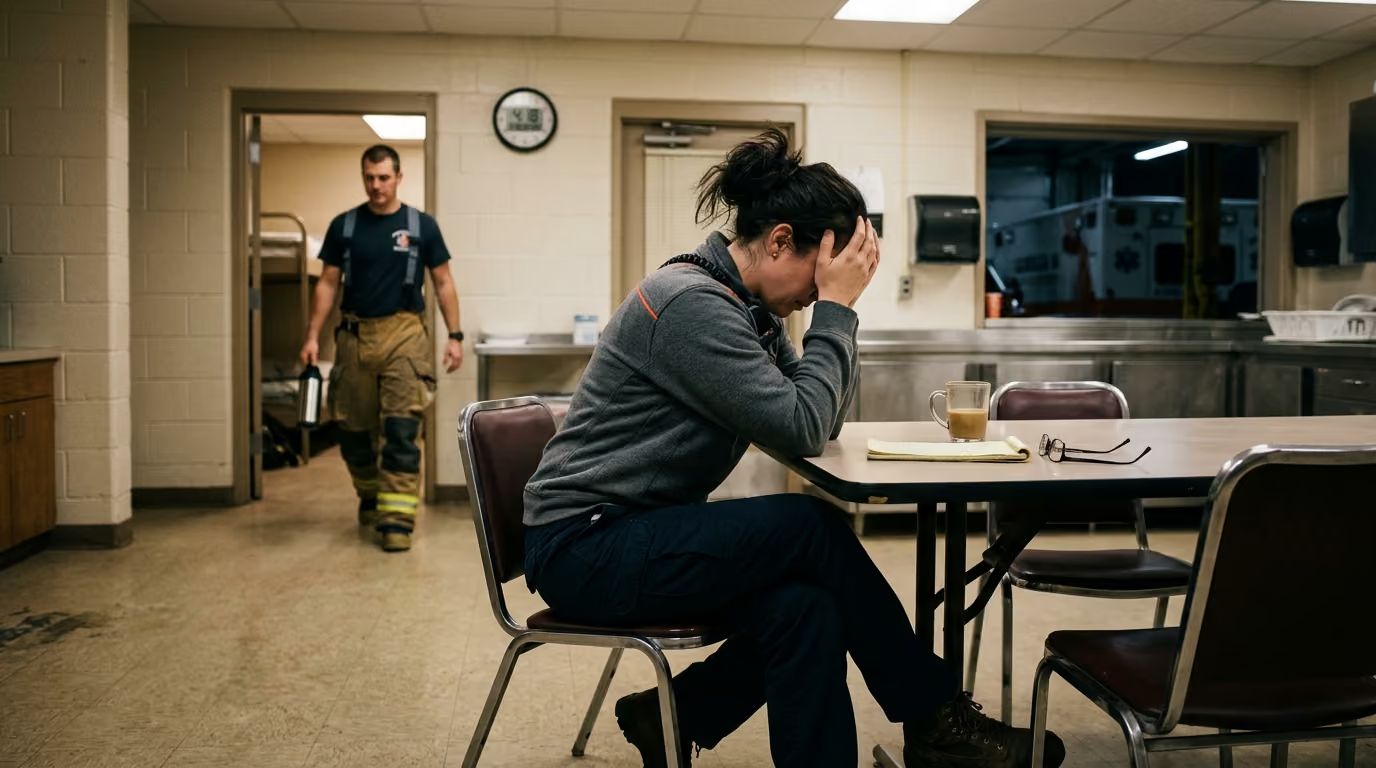

Consecutive nights of interrupted sleep impair responder reaction times, operational judgment, and physical safety during high-stakes emergency calls.





Sleep loss in emergency services is not a personal discipline issue or a temporary inconvenience. It is an operational hazard that systematically degrades reaction speed, working memory, emotional regulation, neuromuscular control, and clinical judgment. This performance cost extends far beyond feeling tired. It creates a state where a responder remains physically capable of initiating a task while becoming significantly less capable of detecting hazards, processing unexpected information, or recognizing their own impairment.
Across fire suppression, emergency medical services, law enforcement, and disaster response, duty schedules routinely combine extended wakefulness, fragmented sleep, circadian misalignment, and heavy physical loads. Understanding the biological cost of sleep debt allows crews and leadership to treat fatigue as a manageable operational risk rather than an inevitable badge of honor.
The scientific literature on emergency responder fatigue demonstrates consistent patterns across physiological, cognitive, and safety metrics. Systematic reviews of first responder cohorts show that occupational sleep loss creates measurable deficits across multiple domains of capability.
The evidence base is strong regarding cognitive slowing, attention lapses, and safety incidents during extended work hours. Laboratory and field assessments confirm that acute sleep deprivation slows psychomotor speed and impairs visual-motor coordination.
Data regarding complex tactical decision-making and prolonged fire-ground simulations remain moderately limited due to the ethical and logistical difficulties of running controlled experiments during live emergencies.
Controlled sleep restriction studies provide clear benchmarks for how progressive sleep debt accumulates. Research demonstrates that maintaining a schedule of six hours in bed per night for 14 consecutive days produces cognitive performance deficits equivalent to 24 hours of continuous wakefulness.
In operational settings, cognitive errors and lapses in visual attention peak sharply after approximately 27 hours of continuous wakefulness. These findings demonstrate that fatigue is cumulative. Experiencing moderate sleep restriction across multiple consecutive shifts builds an operational deficit that closely mirrors total sleep deprivation.
Fatigue is a physiological state characterized by reduced mental and physical capability. The International Civil Aviation Organization defines fatigue as a state resulting from sleep loss, extended wakefulness, circadian phase, or heavy workload that impairs alertness and duty performance.
To manage fatigue effectively, emergency personnel must distinguish between several distinct sleep-related disruptions that occur on the job:
Sleep fragmentation represents one of the most common operational profiles in emergency services. A crew may spend seven hours in their bunks, but repeated tones, radio traffic, and adrenaline surges interrupt their sleep architecture.
Breaking sleep into short fragments prevents the brain from sustaining deep slow-wave sleep and rapid eye movement stages. As a result, time spent in bed does not equal restorative sleep. A fragmented four-hour sleep window leaves substantial physiological sleep debt that impairs morning readiness.
Circadian misalignment adds another layer of strain. The human central nervous system is biologically programmed to reduce core body temperature, lower blood pressure, and increase sleep propensity between 02:00 and 06:00.
Performing high-acuity tasks during this biological low point forces personnel to operate when cognitive processing speed and neuromuscular activation are naturally suppressed. Managing energy and caffeine during night duty requires aligning nutritional intake with these natural circadian rhythms to avoid worsening metabolic stress.
Emergency work requires continuous vigilance punctuated by rapid, accurate physical and mental interventions. Reaction time is not a single, isolated reflex. It is a multi-step cognitive sequence that requires an individual to detect a sensory signal, interpret its operational meaning, decide on an appropriate action, initiate a motor response, and adjust that movement as conditions change.
Sleep loss creates distinct points of failure within this reaction sequence:
In research tracking Canadian wildland firefighters over a 17-day deployment, Psychomotor Vigilance Task testing showed that average reaction times slowed steadily from 253 milliseconds on day five to 267 milliseconds on day 13.
In another deployment study, responder fatigue increased by 95 percent, subjective sleepiness more than doubled, and objective alertness dropped by 47 percent over 13 days. Initial-attack firefighters facing heavy workloads showed morning reaction times of 425 milliseconds compared to 372 milliseconds in project-fire personnel.
The primary hazard of sleep-induced cognitive slowing is not simply a uniform delay. The primary hazard is reaction-time variability.
A fatigued driver or pump operator may respond at a normal speed three times in a row, only to experience an attentional lapse on the fourth trial. In emergency vehicle operations or structural fire operations, an unexpected two-second lapse can produce catastrophic outcomes.
Cognitive capacity extends beyond raw processing speed into working memory, spatial orientation, risk assessment, and tactical prioritization. When personnel face acute sleep loss or chronic sleep restriction, the prefrontal cortex shows marked reductions in metabolic activity. This neurological change directly degrades executive function.
A central danger of responder fatigue is the self-assessment paradox. Research confirms that as sleep debt accumulates, an individual's ability to accurately evaluate their own performance declines. Personnel frequently report feeling adapted to chronic short sleep, even while objective testing shows continuous performance degradation.
A responder who is severely compromised may honestly believe they are operating at full capacity. Relying entirely on self-reporting creates a dangerous vulnerability on the fireground or during complex medical care.
This cognitive breakdown manifests in distinct field scenarios:
Emergency response is fundamentally collaborative. Maintaining clear communication, mutual trust, and de-escalation skills requires significant emotional control and distress tolerance. Sleep loss directly destabilizes the neural circuitry connecting the amygdala to the prefrontal cortex, leading to heightened emotional reactivity and reduced interpersonal patience.
The relationship between sleep deprivation, occupational stress, and psychological health is bidirectional:
Studies evaluating emergency service personnel report elevated rates of mood disruption linked directly to shift patterns and poor sleep. Depression has been documented in approximately 15 percent of firefighters in some cohorts, and up to one-third of firefighters and paramedics in other evaluations. Post-traumatic stress symptoms appear in roughly 16 percent of paramedics surveyed across high-volume systems.
In day-to-day operations, emotional dysregulation appears as abrupt communication, uncharacteristic irritability with crew members, impatience when interviewing patients, and resistance to safety challenges from junior personnel.
When team members stop speaking up about perceived hazards because an officer appears hostile or exhausted, the safety margin of the entire crew collapses. Using structured stress skills, such as a practical 90-second reset between emergency calls, helps down-regulate physiological arousal, though it cannot replace consolidated sleep.
The impact of sleep loss on physical output is nuanced. Laboratory and field research reveals that maximal strength, such as a single maximum-effort lift, often remains remarkably stable following moderate sleep restriction. A rested responder and a sleep-restricted responder may produce identical peak force during a brief, static test.
The critical vulnerability lies in rapid force production and dynamic neuromuscular control. Neuromuscular testing shows that while maximal knee-extension strength remains relatively unchanged after shift cycles, rapid force production at 50 milliseconds drops by approximately 25 percent.
Emergency operations rarely allow for slow, deliberate force generation. Responders must generate force almost instantly to arrest a slip, catch a shifting stretcher, or stabilize themselves on an unstable roof structure.
Dynamic balance tests performed on firefighters following fatiguing duty cycles show marked increases in postural sway, greater center-of-pressure displacement velocity, and significant reductions in anterior reach on the Y-Balance test.
These balance deficits explain why slips, trips, and falls represent the single most common injury mechanism in fire suppression, while lifting-related overexertion dominates EMS injury logs. Navigating stairs, climbing ladders, carrying heavy rescue tools, or moving across wet, uneven terrain while carrying 50 pounds of gear requires continuous, rapid micro-adjustments.
Sleep debt degrades these automatic motor adjustments, turning routine movements into high-risk injury events. Structuring physical training around duty cycles using evidence-based training readiness frameworks ensures responders do not overload an already exhausted neuromuscular system.
The epidemiological link between provider fatigue and operational safety compromises is well established across emergency medical services, law enforcement, and fire operations. When personnel work under high fatigue, the probability of adverse clinical events, occupational injuries, and vehicle collisions rises sharply.
In occupational studies of emergency medical personnel, responders categorized as fatigued demonstrated roughly 2.9 times the injury rate and 2.3 times the error or adverse-event rate compared to their well-rested peers. The odds of committing safety-compromising behaviors were up to 4.9 times higher.
Across broader responder surveys, working shifts of 12 hours or longer was associated with approximately three times the odds of an adverse event. Working more than 40 hours per week increased the odds of safety-compromising behaviors by nearly six-fold in specific cohorts.
These associations highlight the widespread operational consequences of fatigue across the industry. While individual factors like experience and workload play a role, fatigue consistently acts as an operational multiplier that turns minor hazards into major safety incidents.
Mitigating the performance cost of sleep loss requires a dual approach that combines institutional scheduling controls with operational habits built around the realities of emergency work. Relying solely on individual willpower cannot overcome biological sleep debt.
National Institute for Occupational Safety and Health (NIOSH) guidelines provide concrete baselines for shift design and workforce management:
Agencies should provide at least 10 consecutive hours of off-duty time between shifts to give personnel an opportunity to achieve seven to eight hours of true sleep. Commute times, meals, family responsibilities, and sleep latency consume several hours of any nominal off-duty period. Establishing a custom shift sleep plan helps personnel structure these recovery windows effectively.
Consecutive extended work shifts must be capped. When 12-hour or 24-hour shifts are utilized, agencies should avoid scheduling more than three consecutive 12-hour shifts or back-to-back 24-hour rotations without providing at least 48 hours of recovery time. Understanding how shift length and circadian timing interact is critical when evaluating agency rotation policies.
Short naps of 15 to 30 minutes during low-volume operational periods help restore immediate psychomotor alertness and reduce subjective sleepiness. For night-shift personnel, a preventative 90-minute nap taken before reporting for duty allows the completion of a full sleep cycle, buffering against early-morning cognitive degradation.
Napping policies must account for sleep inertia, the period of grogginess that persists for 10 to 20 minutes after waking from deep sleep. Personnel should avoid operating vehicles or administering high-risk medications immediately upon waking.
Recovery spaces require active environmental control. Station bunks and home bedrooms must be dark, quiet, and cool. Ambient room temperatures between 65 and 68 degrees Fahrenheit facilitate the natural drop in core body temperature required for deep sleep.
Using blackout curtains, white noise machines, and eye masks significantly improves sleep consolidation during daytime hours. In addition, aligning meal timing with the circadian cycle prevents digestive discomfort from disrupting day sleep.
Fatigue risk management has definite limits. Individual strategies such as optimizing caffeine intake, cold water exposure, strategic napping, and exercise cannot fully counteract sustained sleep loss. When continuous wakefulness extends beyond 24 hours, the biological pressure to sleep overrides motivation and training.
Crucially, responders must recognize the danger of the post-shift commute. A substantial proportion of emergency responder motor vehicle collisions occur while personnel are driving home after extended shifts.
If a responder experiences heavy eyelids, lane drifting, or missed traffic signals, they are in an active micro-sleep state. Agencies should encourage personnel to use station rest areas before driving home or arrange alternative transportation rather than risk an off-duty collision.
Peer observation is a vital safety backup. Because self-assessment fails as exhaustion sets in, crew members must actively monitor each other for warning signs:
When these indicators appear, safety-critical tasks should be reassigned. A fatigued responder should not drive emergency vehicles, operate heavy hydraulic rescue tools, or calculate complex drug dosages. Reallocating duties is not a disciplinary action; it is a vital operational control that protects the crew and the public.
While shift work inevitably disrupts sleep patterns, chronic sleep problems should not be accepted as an unavoidable part of the career. Many first responders suffer from treatable clinical sleep disorders that amplify occupational fatigue.
Professional evaluation by a licensed medical provider or sleep specialist is indicated when:
Evidence-based interventions, including Cognitive Behavioral Therapy for Insomnia (CBT-I) and continuous positive airway pressure (CPAP) therapy, can restore sleep quality, improve duty readiness, and safeguard long-term health.
Caffeine temporarily blocks adenosine receptors in the brain, which increases subjective alertness and can transiently speed up simple reaction time. However, caffeine does not restore working memory, complex decision-making, or fine motor coordination degraded by sleep loss. Relying heavily on caffeine late in a shift also impairs subsequent recovery sleep, creating a cycle of escalating fatigue.
Familiar, highly practiced tasks rely on automatic processing, which is relatively resilient to moderate sleep restriction. An experienced responder can often perform standard procedures without displaying obvious deficits. However, when an unexpected emergency occurs, such as a flashover, a pediatric arrest, or a sudden change in patient status, the prefrontal cortex must engage. Under sleep debt, the cognitive flexibility needed to adapt to those novel conditions drops significantly.
A single eight-hour recovery sleep is rarely sufficient to clear the sleep debt accumulated across multiple disrupted shifts. Research indicates that fully dissipating cognitive fatigue and restoring reaction-time consistency typically requires at least two consecutive nights of unrestricted, consolidated sleep.
Heart rate and heart rate variability provide useful insights into autonomic nervous system tone, but they are not reliable standalone measures of operational fatigue. Physical exertion, hydration, caffeine consumption, heat stress from protective gear, and psychological arousal all alter heart rate metrics independently of sleep debt. Objective behavioral measures, such as reaction-time testing and peer observation, are more reliable indicators of operational fatigue.
Sleep loss changes the operational risk profile of emergency response by degrading reaction time, neuromuscular stability, and situational awareness while impairing the ability to recognize those deficits. Protecting cognitive capability and long-term physical health requires managing fatigue through evidence-based scheduling, strategic recovery habits, and mutual accountability across every level of the organization.
Stay connected for research-led guidance on duty fitness, shift-work sleep, injury recovery, stress, nutrition and career longevity. Practical ideas for first responders who want to stay capable on the job, recover well and protect their health for the long run.



Read practical guidance on first responder fitness, recovery, sleep, nutrition and resilience for demanding work and a long, active career.
read the blog



