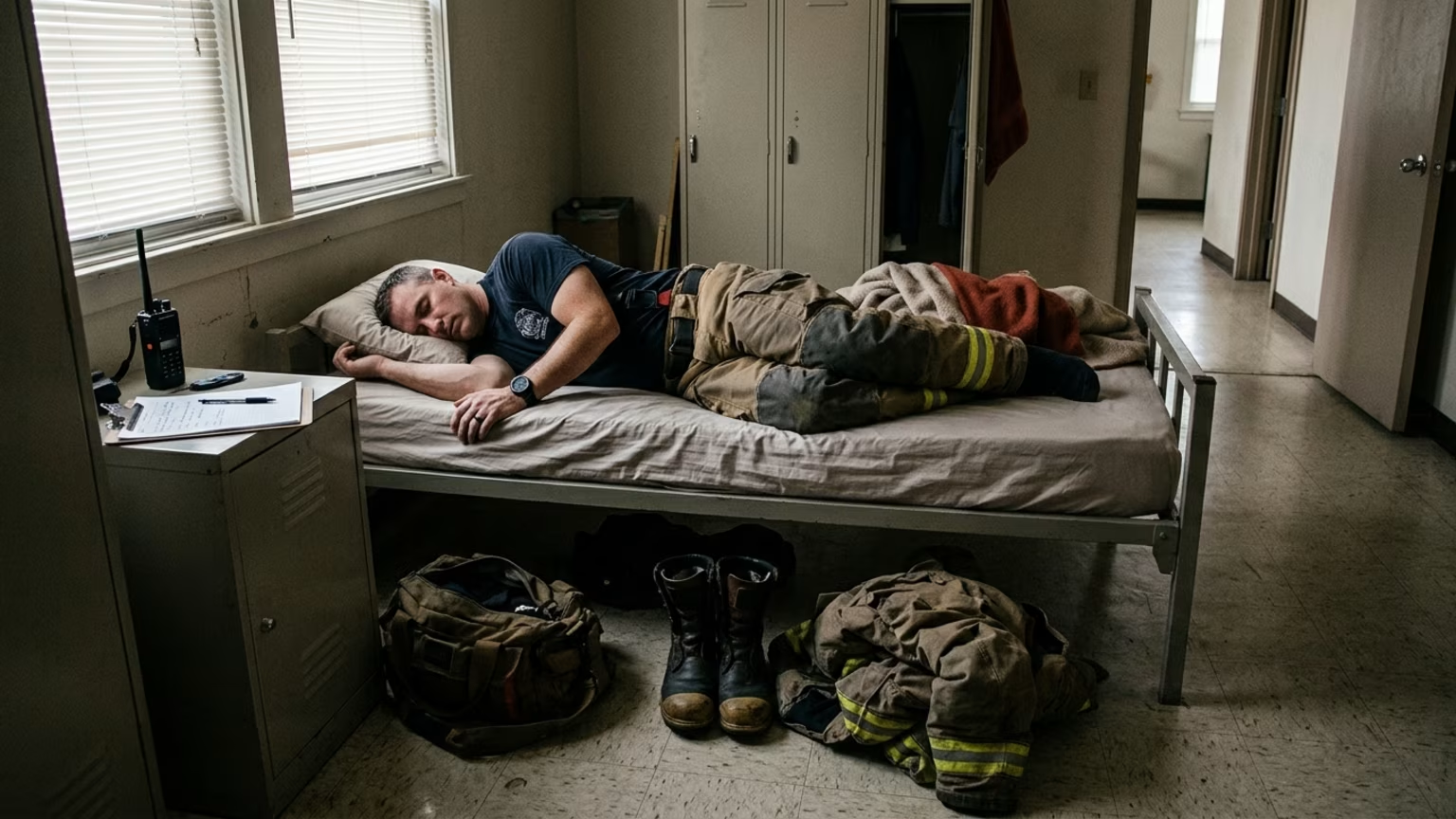

An Army training study reports better sleep and symptom scores. Learn why sleep opportunity matters when considering the findings for first responders.





On 6 October 2026, Sleep published “The effects of a multimodal intervention for optimising sleep and internalising symptoms in young adults during British Army Infantry Basic Training.” The study examined a combined sleep program during demanding military training.
Trainees receiving the program reported more sleep and better scores on several sleep and psychological measures than those following the usual schedule. The finding is encouraging. Understanding what the program included is more useful than reducing the result to a broad claim that sleep education works.
The Sleep study used a two-arm parallel design involving 83 British Army infantry trainees. There were 43 trainees in the intervention group and 40 in the control group. A baseline period came before the intervention period, while the control group continued with its usual basic-training sleep schedule and environment.
According to the researchers, the intervention combined:
That final component matters when interpreting the results. The researchers did not simply deliver information and leave the available time for sleep unchanged. They tested a package that included both behavioral elements and more opportunity to rest.
The study reports that sleep duration fell from about seven hours before training to about 5.5 hours during training in both groups. The authors linked that reduction to earlier wake times.
During the intervention period, trainees in the experimental group went to bed about 40 minutes earlier and obtained about 30 minutes more sleep than controls. They also reported better sleep quality. The improvement was therefore a modest gain within a schedule that remained sleep-restricted, not the removal of the underlying constraint.
The psychological and daytime findings also favored the intervention group. Reported insomnia scores were 4.7 ± 2.7 in the intervention group versus 9.1 ± 3.7 in controls. Daytime sleepiness scores were 6.2 ± 4.3 versus 13.0 ± 6.2.
The researchers also reported lower stress and depressive-symptom scores in the intervention group. These findings concern the measures collected in this study. They should not be translated into a claim that the program prevents or treats a diagnosed mental-health condition.
Participants had a mean age of 22 years, and no women enrolled during the study period. This was a study of young infantry trainees rather than emergency-service personnel. Applying its findings to first responders is therefore an extrapolation.
Outcomes were assessed through surveys. The article page does not report objective sleep measurements or state whether group allocation was randomized. The publication is also an accepted manuscript that may change before final typesetting.
The authors suggest that the psychological symptom changes may have been mediated by sleep because no mental-health intervention was delivered. That is their interpretation, not proof of the mechanism. The findings should also be read as evidence about the combined program rather than proof for any single component.
For first responder wellness, the most useful translation is about how the problem is framed. The Army intervention placed sleep education alongside changes intended to make sleep more achievable. It treated available sleep time as part of the intervention rather than as background information.
That distinction matters when considering nights or rotating duty. A pre-bedtime routine and a usable sleep window are different parts of a recovery plan. A review focused only on whether personnel received education would miss a central element of what the researchers tested.
This is a reason to examine schedules and routines together. In the study, earlier wake times were identified as the driver of reduced sleep during training. For an emergency-service organization considering similar ideas, a useful starting question is where the schedule permits rest and where operational demands constrain it.
That is an evaluation question rather than a documented policy change. It does not establish a preferred shift pattern or a universal bedtime. The operational lesson is narrower: when assessing a sleep program, include the time available for sleep in the discussion of how the program is meant to work.
Rescuris's discussion of sleep as a leadership and readiness issue provides a related editorial perspective. The relevant connection is the decision to consider recovery within the work system rather than judge it only as an individual habit.
A separate 2026 systematic review in BMC Public Health examined fatigue interventions across shift-working occupations. Workplace napping was the most consistently favorable intervention category among its included studies. The review nevertheless called for randomized trials to confirm that result.
That review provides context for evaluating fatigue programs. It is not evidence that napping should be added to the Army intervention as a proven combined approach. Findings from different programs should stay attached to the interventions and outcomes actually studied.
For departments comparing options, the practical question is which operational problem each approach addresses. Education, routines and opportunities for rest belong in that discussion without being treated as interchangeable solutions.
The Army study supports a structured discussion about sleep opportunity and feasible routines. It does not supply a responder-specific implementation plan. The following questions translate its components into topics for local evaluation rather than personal instructions or a ready-made department protocol.
A review could begin by separating the intended sleep window from the demands that compete with it. The relevant question is not simply whether an earlier bedtime appears on a plan. It is whether the work pattern leaves a realistic opportunity to use that time.
This keeps the discussion connected to the intervention's actual design. Extended sleep opportunity was part of the program, so any proposed adaptation should account for that element rather than retain only the educational material.
The study combined education with sleep-hygiene changes and pre-bedtime routines. A local discussion should therefore identify which components are being considered and what delivering them would require alongside duty demands.
That is different from selecting a single familiar sleep tip and attaching the study's results to it. Clear descriptions help distinguish an adaptation from a reproduction of the original program. They also make it easier to identify where practical constraints need attention.
For readers considering those questions across different duty patterns, this resource on planning recovery around night work offers a related starting point. It should be read as separate guidance rather than as a tested extension of the Army intervention.
The Army researchers assessed sleep duration and quality alongside insomnia and daytime sleepiness. They also examined stress and depressive symptoms. These are distinct outcomes rather than a single measure of whether a program has worked.
A local evaluation could keep those distinctions visible instead of relying only on attendance at an education session. The study provides examples of outcomes to consider, but it does not establish responder-specific thresholds for success.
For individual responders, the practical message is to consider routines and available sleep time together. A routine should not become another standard for judging personal discipline when the work pattern is the central issue. Persistent sleep difficulties or psychological symptoms warrant discussion with qualified care rather than self-treatment based on this report.
The next useful questions concern durability and delivery. Do the reported benefits persist after the intervention period? What staff time and schedule changes are needed to deliver the program? Which components contribute most to the observed differences?
Operational relevance also deserves direct examination. A useful next evidence test would ask whether changes in sleep and symptom scores are accompanied by changes in duty performance. Evaluations could also examine how a program functions when rest opportunities are interrupted rather than predictable.
These are questions for further investigation, not announced follow-up studies. For now, the clearest contribution of the Army report is its combined approach: behavior and sleep opportunity were addressed together. That provides a focused basis for evaluating recovery programs without turning a promising result into a universal prescription.
Putting this Army training report into a responder's recovery planning means looking beyond a bedtime routine; Rescuris covers that next step through research-led sleep guidance. Its editorial coverage helps emergency-service professionals consider rest around nights, rotating shifts and unpredictable calls while keeping physical capability and long-term health in view.
Rescuris publishes evidence-aware guidance for firefighters, police officers, paramedics and other first responders on fitness, recovery, sleep, nutrition, stress resilience and long-term capability.





Read practical guidance on first responder fitness, recovery, sleep, nutrition and resilience for demanding work and a long, active career.
read the blog
