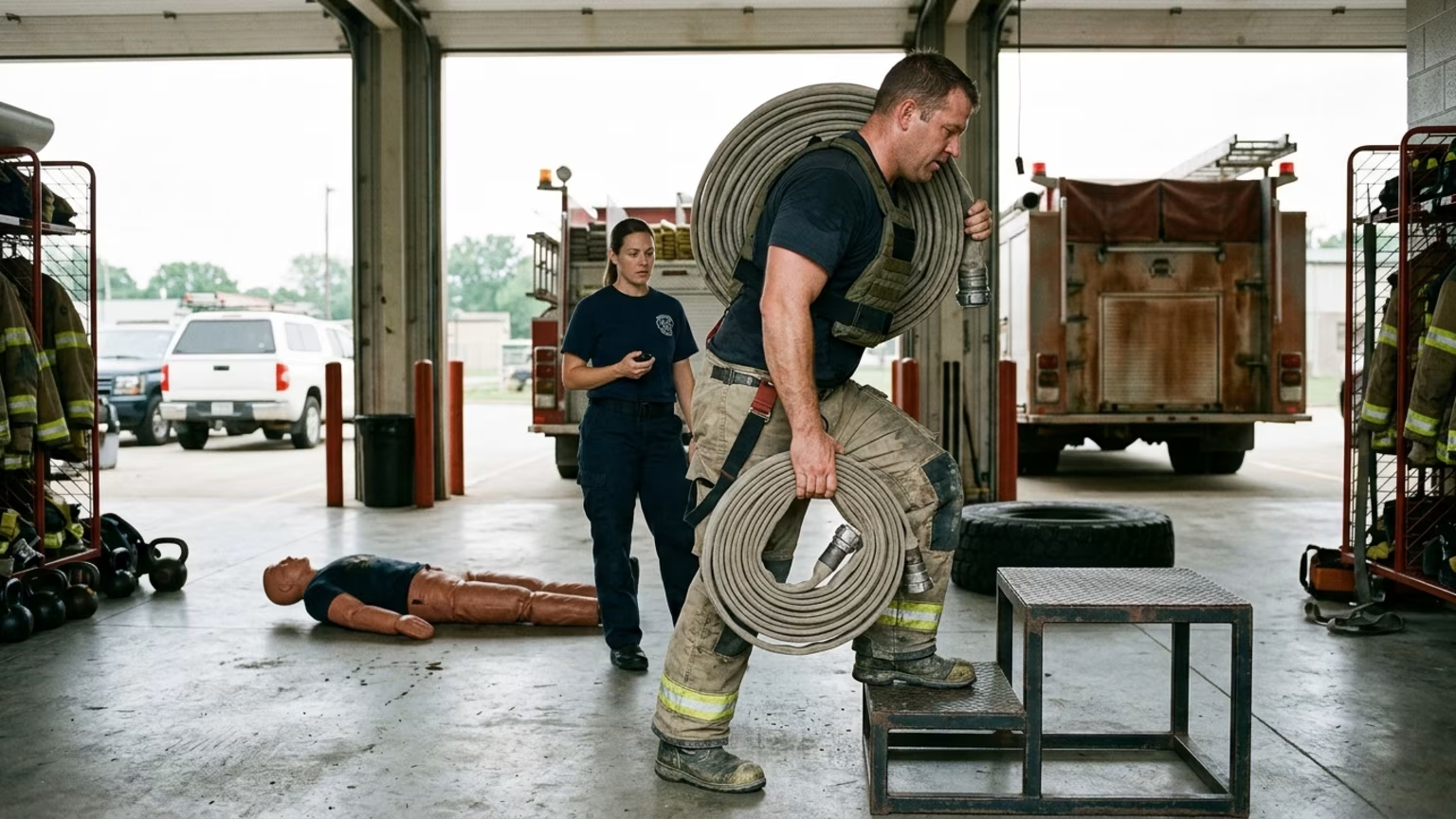

Map recurring duty demands to inform conditioning, recovery and conversations about persistent symptoms, without treating task tracking as an injury score.





Myth: If a physically demanding shift feels harder, the answer is to train harder. Correction: For first responders, conditioning advice needs to account for the work already being done rather than treating another workout as the complete solution.
The clinical concern is occupational injury and recurring physical symptoms, not a shortage of effort. EMS injury surveillance and a chapter on wildland firefighting describe demands involving lifting, equipment carriage and repetitive work. Those sources offer a more useful starting point than assuming every physical difficulty calls for greater fitness.
A secondary summary of NIOSH surveillance reports an estimated 16,900 to 21,900 EMS clinicians per year receiving emergency-department care for occupational injuries from 2016 through 2020. The population includes paid and volunteer EMS clinicians. Firefighters are included when injured while performing EMS work.
The summary identifies sprains and strains as the most common diagnosis and overexertion as the most common cause during those years. It reports that lifting accounted for roughly 40% or more of overexertion injuries in the cited years. This makes patient handling relevant to a discussion about physical demand rather than leaving the discussion at general fitness.
The wildland-firefighting chapter published by IntechOpen describes gear loads above 20 kg alongside steep-slope climbing and repetitive hand-tool use. It also describes sustained aerobic and anaerobic exertion. Its account includes overuse trauma affecting the knees and hips as well as the shoulders and back.
These are different occupational profiles. A patient transfer and sustained hand-tool work should not be treated as interchangeable entries under the heading of “a hard day.” For planning purposes, naming the task gives the discussion more substance than describing the whole shift as heavy or tiring.
The EMS figures are estimates of nonfatal injuries treated in emergency departments, reported through a secondary summary rather than independently checked here against the underlying surveillance publication. They do not measure every injury or career-long exposure. The wildland chapter describes a particular working environment rather than a universal firefighter workload.
Neither source establishes a biological mechanism explaining how extreme stress or irregular schedules change tissue recovery. Neither tests a protocol for autonomic nervous system regulation. They also do not validate a personal cumulative-load score or show that task tracking alone predicts or prevents injury.
The appropriate correction is therefore narrower than a physiological prescription: use the work itself to inform the conversation about conditioning and recovery. A task map is a reflection and communication aid, not a medical assessment.
Across an extended shift, the useful question is not simply whether the day was busy. It is what kinds of work made it demanding. The research supports distinguishing occupational tasks rather than assuming one description captures every responder's exposure.
For EMS personnel, patient transfers and related handling belong in that review. The surveillance summary identifies patient interaction in connection with sprains and strains as well as lifting within overexertion injuries. A review that records only exercise completed outside work would leave those occupational demands out of the picture.
For wildland crews, the chapter points toward a different description: equipment carriage and terrain alongside repetitive tool use. Its account makes the setting part of the physical-demand profile. Borrowing that profile for an unrelated role would be less useful than describing the actual duties involved.
Other responders can use the same principle without borrowing either service's task list wholesale. A role involving recurring kneeling should include kneeling in its description. A role involving prolonged equipment wear should name that demand rather than treating the equipment as background.
The map can also distinguish a particular task from a cluster of tasks. Was equipment carrying the main demand, or did it occur alongside climbing and repeated lifting? That question helps describe the shift without pretending that each activity has a known injury value.
This is where the harder-workout myth becomes a planning problem. Before deciding what additional training belongs in the week, the discussion needs an account of the work already present. Otherwise, the plan addresses the scheduled exercise while leaving the occupational task mix largely undescribed.
For a longer view, planning fitness around changing roles keeps the focus on the demands a responder actually needs to prepare for. The relevant map is the one that reflects the current job rather than an idealized version of it.
The evidence supports task awareness and individualized discussion rather than a universal recovery routine. A useful approach describes recurring demands and the recovery context before considering changes to conditioning. Persistent or worsening symptoms belong in a conversation with an appropriate clinician or workplace health resource.
This approach does not turn duty into a substitute for training. It puts duty into the planning discussion. The aim is to ask more specific questions about capability and recovery instead of answering every concern with “do more.”
A map can be a short written description rather than a spreadsheet. The research supports attention to tasks such as patient transfers and equipment carrying. Climbing, kneeling and repetitive tool use may also belong where they reflect the person's role.
Useful entries describe recognizable work:
These categories are prompts rather than a mandatory checklist. A responder whose role does not include a task has no reason to add it. The purpose is an accurate description of work, not a longer list.
Plain language also makes the map easier to discuss. “Equipment carrying followed by repeated patient transfers” gives a conversation a clearer starting point than “my shift was bad.” It identifies the work without assigning a diagnosis or declaring that one task caused a symptom.
The practical question is whether recurring symptoms seem to accompany particular tasks or clusters of demanding work. That observation can be recorded alongside the task description. It gives the responder something concrete to raise with a qualified professional.
A useful account separates the work performed from the symptoms noticed. It can describe which task was involved and whether the concern has persisted or worsened. There is no need to settle the cause before asking for help.
The research's practical implications support raising persistent or worsening symptoms early with an appropriate clinician or workplace health resource. That conversation is the place for personal assessment. A task map can contribute context while leaving clinical decisions to qualified care.
A task map gives conditioning discussions a more specific agenda. Which recurring duties does the current plan address? Which demands deserve discussion because they appear repeatedly in the work description?
Those questions do not prescribe a particular exercise or training dose. They help organize an individualized conversation around the person's role. For example, a discussion centred on patient handling should not automatically become the same discussion as one centred on steep terrain and hand-tool work.
This is also a practical way to frame duty and training within the same planning conversation. Scheduled exercise is visible on a calendar. The map gives occupational tasks a place beside it without converting them into invented workout equivalents.
Recovery planning can begin with a straightforward question: what opportunity for recovery was available around the demanding work? That question respects irregular schedules without assuming every responder has the same options after duty.
The task description and recovery context can be discussed together when considering the wider plan. The map does not need to produce a score or a verdict about whether someone has worked hard enough. Its value is in making the conversation more specific.
For readers considering that wider context, organizing recovery after physically demanding duty is a related planning topic. The central principle remains the same: start with the actual demands rather than forcing every shift into a standard fitness template.
The answer to a demanding shift is not automatically a harder workout; it is a clearer account of the work, recovery-aware planning and an early conversation when symptoms persist.
Treating accumulated physical wear as a reason to keep adding exercise leaves duty demands outside the plan, a gap Rescuris addresses through research-led fitness and recovery coverage. Its editorial guidance helps emergency-service professionals consider recovery without losing sight of readiness or long-term health while avoiding advice that treats exhaustion as a measure of commitment.
Rescuris publishes evidence-aware guidance for firefighters, police officers, paramedics and other first responders on fitness, recovery, sleep, nutrition, stress resilience and long-term capability.






Read practical guidance on first responder fitness, recovery, sleep, nutrition and resilience for demanding work and a long, active career.
read the blog
