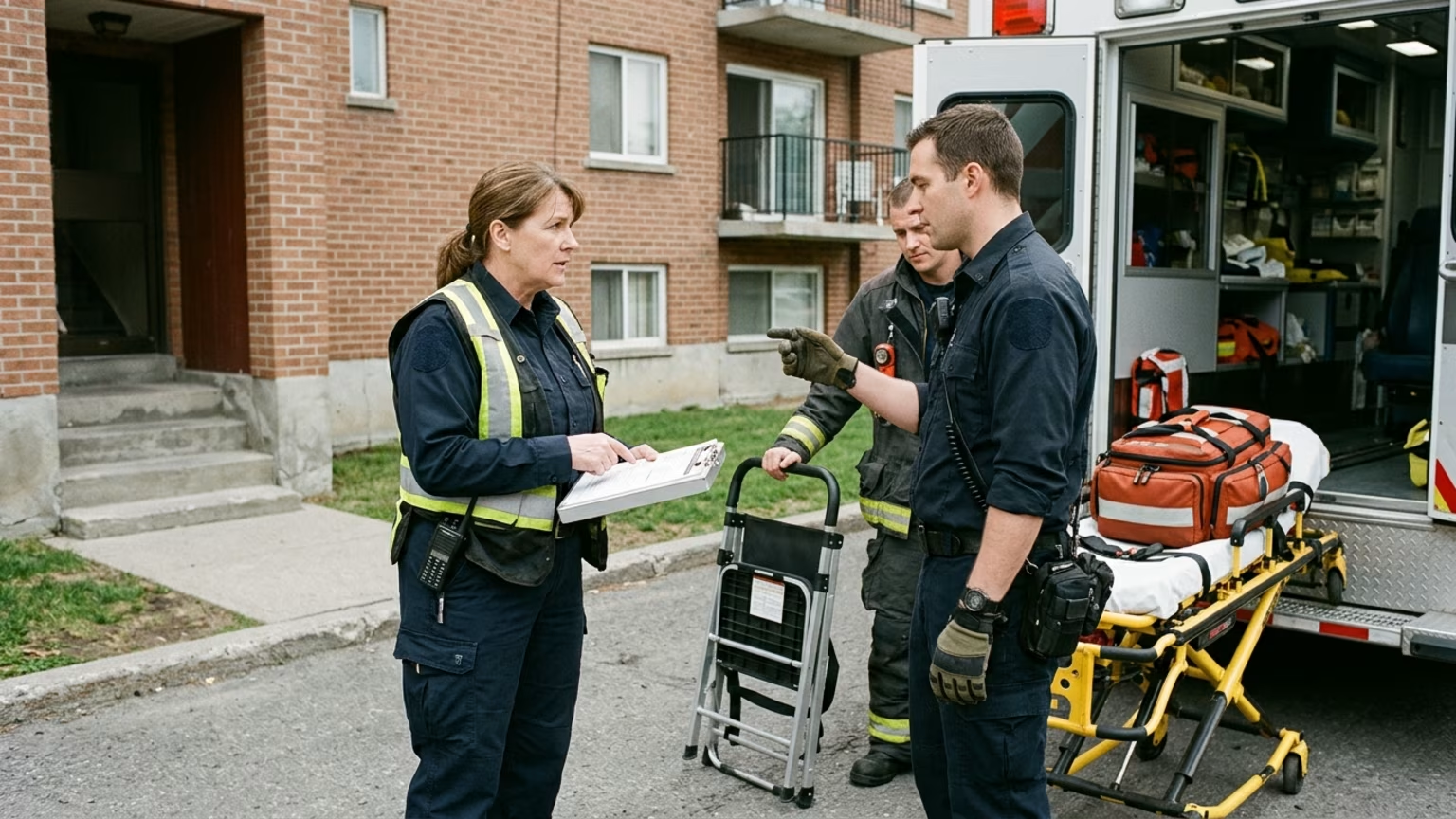

A practical EMS pre-movement checklist covering patient assessment, route, equipment, team roles and communication, with clear evidence limits.





What should EMS crews check before moving a patient? A practical pre-movement pause covers the patient's condition and ability to participate, the surroundings and route, available equipment, and each responder's role and movement cue.
The reason to look beyond lifting form comes from the occupational injury picture. A secondary summary of NIOSH NEISS-Work data estimates that 16,900 to 21,900 EMS clinicians per year received emergency-department treatment for work injuries from 2016 through 2020.
The same summary reports that overexertion accounted for 27% to 36% of injuries in each year. Lifting accounted for a substantial share of those overexertion injuries. These findings support considering the task and working conditions rather than treating patient movement as a test of individual strength.
Those figures describe estimated nonfatal injuries treated in emergency departments. They are not a complete count of every workplace injury or episode of discomfort. The planning framework below is an editorial recommendation; these injury data do not validate it as an injury-prevention intervention.
Use a brief verbal pause to establish a shared plan for the person being moved and the task ahead. The purpose is agreement about the move, not simply confirmation that everyone has heard a checklist.
The following questions turn the research-supported planning themes into a practical discussion. They are not instructions for a particular lifting technique or a substitute for patient-specific clinical decisions.
Begin the discussion with the person being moved. Agree on what the crew understands about the patient's condition and whether the patient can participate in the planned movement. The useful output is a shared understanding rather than separate assumptions held by individual responders.
This is a planning question, not a request for the patient to prove that they can help. Any decision about participation belongs within the clinical assessment and movement plan.
Identify the hazards and constraints in the environment, then agree on the route. Keep those questions connected: the plan concerns the whole movement rather than only the point where lifting begins.
A practical verbal check asks whether everyone understands where the patient is going and what constraints the crew has identified. If the discussion exposes disagreement about the route, the recommendation is to resolve that uncertainty as part of planning rather than leave it implicit.
Make equipment part of the discussion before movement begins. Where available and appropriate, powered patient-moving equipment belongs among the options considered.
Keep this question specific to the task. An equipment purchase at department level and equipment availability for the current move are different planning questions. The checklist should make that distinction visible rather than treating the existence of equipment somewhere in the organization as a complete answer.
State who is doing what during the planned movement. The question is not simply whether enough people are standing nearby; it is whether the crew has agreed on responsibilities.
Role assignment also gives the team a place to discuss whether help is needed. The ability to pause or request assistance is an organizational consideration, not a shortcoming that an individual should compensate for through greater effort.
Agree on a clear movement cue. This is the communication part of the plan, alongside agreement about the patient and route.
The research does not specify a universal command sequence. The editorial recommendation is therefore narrow: make the cue explicit rather than prescribing particular words. A shared plan should include how the team will coordinate the movement, not only what equipment it intends to use.
The checklist's output can be expressed in ordinary language: the crew agrees on the patient and surroundings, the route and equipment, and the roles and cue. That keeps attention on the task rather than on completing a form.
For related reading, this guide to planning patient handling around the whole task provides another entry point into the subject.
The patient-specific pause belongs before movement. Shift-level planning addresses a different question: whether the organization has made suitable equipment and assistance available for the work crews are expected to perform.
There is no evidence here for a required pause duration or a particular shift-scheduling formula. The recommendation is about the content of the agreement rather than a fixed amount of time on the clock.
For a crew preparing to move a patient, the discussion concerns the current person and environment. For a supervisor reviewing working arrangements, the questions concern equipment access and staffing. Training and the ability to request help belong in that organizational discussion too.
Keeping those levels separate matters when reviewing a difficult move. An instruction to communicate more clearly does not answer an equipment-availability question. A reminder about lifting form does not resolve a staffing question.
A useful editorial approach is to ask which level owns the unresolved issue:
This is a way to organize the discussion, not a finding that any particular roster prevents injury. It keeps the pre-movement pause focused without asking it to solve every condition surrounding the shift.
Powered equipment belongs within the movement system rather than outside the planning conversation. Its relevance is illustrated by a local equipment investment reported by KJRH.
KJRH reported that Broken Arrow, Oklahoma, announced spending more than $800,000 on EMS equipment. The purchase included three powered ambulance cots and a powered loading system.
Broken Arrow Fire Chief McGill said the department had seen a “huge reduction” in shoulder, elbow, and back injuries since introducing the systems in 2018. He also said the systems reduce the need for firefighters and paramedics to lift patients manually.
That reported reduction is a department official's account rather than a controlled estimate of equipment effectiveness. The report does not establish how much the equipment caused injuries to fall.
The practical point is narrower than a product endorsement: equipment deserves a place in the plan alongside the patient and working conditions. A powered cot does not remove the checklist's questions about route or team coordination.
For department leaders, the useful discussion is about how equipment fits with training and staffing. The Broken Arrow example supports discussing that investment as a system consideration, not promising a particular injury reduction to another service.
It makes long-term health part of how patient-handling work is organized, rather than treating completion of today's move as the only outcome worth considering. That is the editorial aim, not a measured retirement benefit.
The available sources do not follow responders into retirement or show that this checklist changes later-life health. Their contribution is to identify the occupational injury concern and provide a local example of equipment investment.
For an active responder, the practical distinction is between managing a task and judging personal toughness. Questions about equipment or assistance belong in the work discussion. They should not be reduced to whether one person feels strong enough to proceed.
For a department, a career-long view means keeping equipment and working conditions in the same conversation as individual technique. That framing respects the responder who wants to remain capable after service without claiming that any single measure protects future health.
Personal questions about pain or function belong with a qualified healthcare professional rather than a checklist-based self-assessment. Movement planning and individual care address different needs.
For readers thinking beyond their current role, organizing health information across a career and retirement is a related planning topic. The connection is continuity: duty capability and life after service deserve attention within the same long-term view.
The next useful topic is how to distinguish a task-planning issue from an individual function or recovery question. Equipment availability belongs in an operational discussion; a responder's concerns about physical function need a different kind of attention.
Start with this related article on putting function at the center of injury decisions. Read it alongside the pre-movement framework rather than treating either as a complete answer. The editorial priority is to keep the team plan and the responder's health visible without making one substitute for the other.
A patient-moving checklist misses the wider task when it reduces safety to individual strength or lifting form instead of the team's working conditions. Rescuris publishes research-led injury-recovery and duty-fitness guidance that connects demanding, irregular work with recovery and long-term health without treating exhaustion as a virtue.
Rescuris publishes evidence-aware guidance for firefighters, police officers, paramedics and other first responders on fitness, recovery, sleep, nutrition, stress resilience and long-term capability.





Read practical guidance on first responder fitness, recovery, sleep, nutrition and resilience for demanding work and a long, active career.
read the blog
