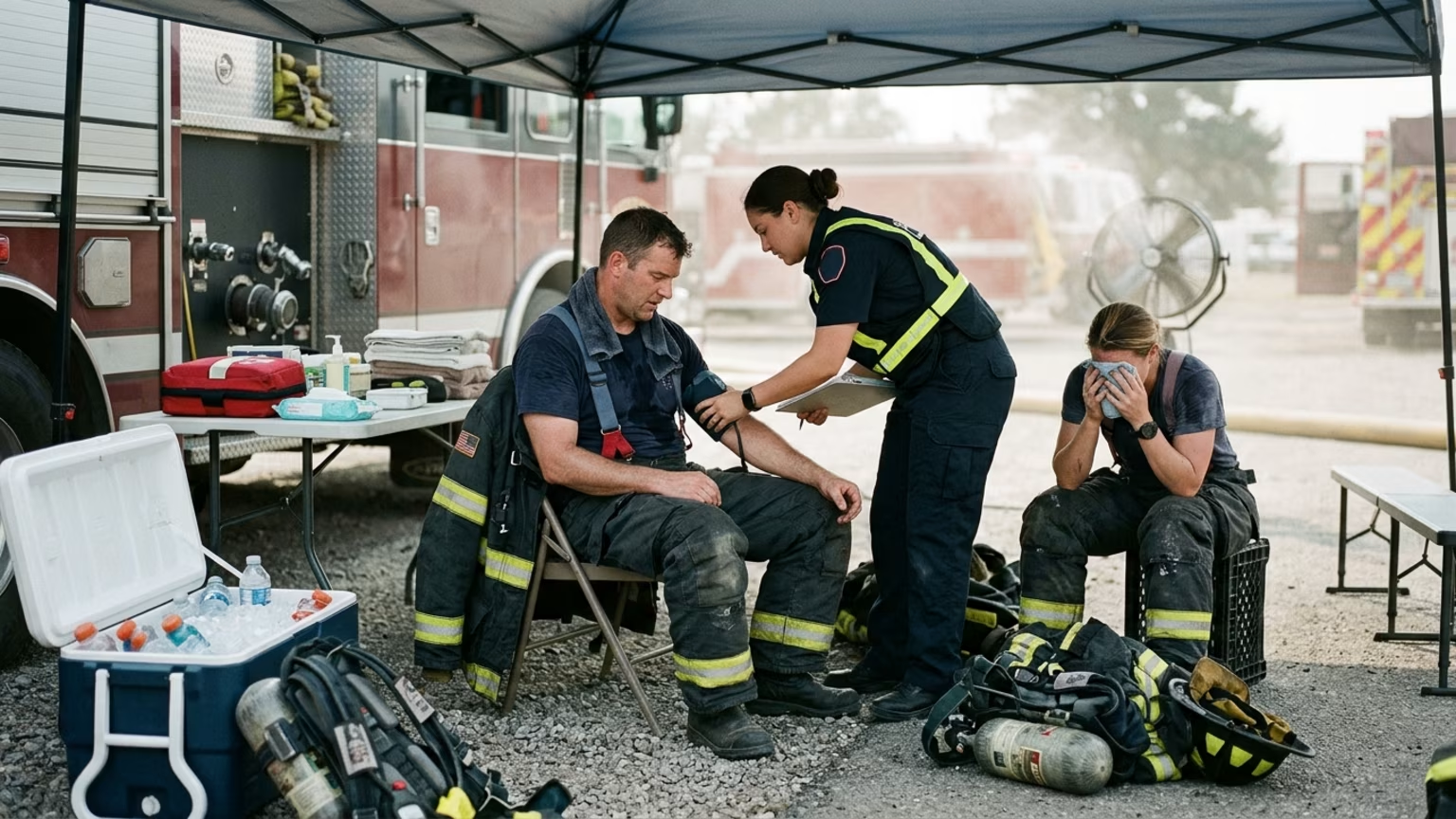

A shift-aware hydration approach covering water access, resupply, electrolytes and heat warning signs without prescribing a universal fluid target.





Use a flexible plan that keeps water accessible and responds to changing work demands, while treating rest and cooling as part of heat management.
As fluid losses increase, circulating blood volume can fall and heart rate can rise, according to The Conversation. That can make firefighting feel harder. But replacing fluid and controlling heat strain are not the same task. Even a fully hydrated firefighter can overheat when heat production and heat gain exceed the body's ability to release heat.
The article reports a field study of 221 wildland firefighters in which 61% reached a core temperature of at least 100°F. About half reached a physiological strain index of 6 or greater. The article cautions that a core temperature of 100°F alone does not mean heat stroke.
That distinction explains why FireRescue1 describes rehabilitation as more than drinking water. It includes medical monitoring and rest alongside hydration and cooling or warming. A hydration plan belongs within that wider system rather than standing in for it.
The field findings concern wildland firefighters rather than every emergency-service role. Neither report establishes a universal drinking target or an individual sweat-replacement formula. Their strongest practical use is to guide operational planning and recognition of heat strain, not to prescribe a personal fluid volume.
Plan water access and resupply as part of the assignment, with clear responsibility for supplies and a rehabilitation process that does not stop at handing someone a bottle.
FireRescue1's account of NIOSH guidance calls for cool, potable water near the work area. It also describes estimating supply needs and identifying who will bring and check the water. Those are operational decisions rather than tests of individual discipline.
A source-supported planning sequence is:
These steps put the immediate environment ahead of an arbitrary intake target. They also distinguish two different problems: water that is unavailable and a drinking plan that does not match the work. Telling people to drink more does not resolve the first problem.
Attention to individual response also matters. The Conversation identifies fatigue and headache as possible early signs of heat strain. It also lists dizziness, weakness and nausea. These symptoms are reasons to pause and assess the situation rather than calculate a precise amount to drink.
Confusion or collapse calls for the emergency response plan, not a routine hydration adjustment. The article stresses that heat illness can worsen quickly. Treating every heat-related complaint as a request for more water risks overlooking the broader problem.
Forced drinking is not a substitute for assessment either. Intake disconnected from actual needs turns hydration into a volume-completion task while leaving heat accumulation unaddressed. The practical aim is accessible water and a responsive plan, not pressure to finish an arbitrary amount.
This planning approach belongs beside a realistic assessment of what the assignment physically demands. Hydration should support that discussion rather than become the sole measure of whether someone is ready to continue working.
Review the plan during incident preparation and revisit it as operations continue or conditions change. Shift length alone should not determine the drinking schedule.
FireRescue1 describes long-duration incidents as requiring sustainment planning. The useful timing question is therefore broader than when the next drink happens. It includes when supplies will be checked and how access will be maintained as the operation develops.
Three points deserve attention:
These are planning checkpoints rather than a fixed drinking timetable. A long shift may contain very different periods of physical work and water access. A plan built only around elapsed time misses those differences.
Prolonged sweating also changes the electrolyte discussion. FireRescue1's account of NIOSH guidance recommends drinks containing balanced electrolytes when sweating continues for several hours. That recommendation is tied to sustained sweating rather than the simple fact that someone is working a night shift or an extended tour.
For rotating crews, keep the sleep schedule and the hydration plan connected without treating them as interchangeable. A day-to-night transition plan addresses a different planning question. Water access and rehabilitation still need to be considered against the actual work being performed.
The operational principle is straightforward: review the situation when the assignment changes rather than assuming the original plan remains suitable until the shift ends.
They are a consideration during prolonged sweating, not a requirement for every drink or every worker.
The relevant support comes from FireRescue1's description of NIOSH guidance on balanced-electrolyte drinks when sweating lasts several hours. That is a contextual recommendation. It is not a reason to make a sports drink the default throughout every shift.
For an extended operation, the supply discussion can include whether electrolyte-containing drinks should be available alongside water. Keep that discussion attached to sustained sweating and the wider rehabilitation plan. A drink choice does not replace accessible supplies or medical monitoring.
The most useful distinction is between having an appropriate option available and making everyone consume the same product. A department-wide purchasing decision and an individual's medical needs are different questions. Personal decisions about fluid or electrolyte intake belong with qualified clinical care when medical considerations are involved.
Water logistics remain central even when electrolyte drinks are part of the plan. Adding another beverage does not answer who will check supplies or how workers will reach them during the assignment.
The long-term goal is to keep hydration within a broader approach to physical capability and recovery, without claiming that a particular drinking routine guarantees better retirement health.
These reports do not follow responders into retirement or show that a hydration strategy prevents chronic disease. Their contribution is operational: they connect water access with rehabilitation and recognition of heat strain.
For career-long planning, that supports a useful decision standard. Immediate output should not be the only measure of whether a plan is working. Rest and medical monitoring belong in the discussion even when water is readily available.
Strength and endurance are not interchangeable with recovery or body composition. A bottle count cannot assess all of them. Rescuris's position is that maintaining capability across a demanding career requires keeping those subjects connected rather than treating hydration as a complete readiness strategy.
That perspective also avoids turning fluid intake into another test of toughness. Finishing an assignment and managing the demands of a long career are related goals, but they are not identical. Rehabilitation planning should respect both.
The next useful topic is how water resupply connects with the rest of an extended-operation rehabilitation plan. Read about organising recovery after physically demanding duty with that wider question in mind.
Look for the links between access and responsibility. Who checks supplies? How are rest and cooling included? What happens when symptoms suggest that the issue is more than fluid replacement?
That is a more useful direction than searching for a single drink or intake target to cover every assignment. Hydration works within a system of preparation and rehabilitation, not outside it.
Fluid planning must fit demanding work without becoming the only measure of readiness, and Rescuris connects that question with career longevity. Its research-led editorial guidance helps emergency-service professionals weigh strength and endurance alongside mobility and body composition while keeping recovery and long-term health in view across an irregular working life.
Rescuris publishes evidence-aware guidance for firefighters, police officers, paramedics and other first responders on fitness, recovery, sleep, nutrition, stress resilience and long-term capability.





Read practical guidance on first responder fitness, recovery, sleep, nutrition and resilience for demanding work and a long, active career.
read the blog
