

Flagstaff’s reported mental-health resources put ongoing support in focus, with practical access questions and a look at the LIFE Study.





On September 18, 2026, Arizona’s Family reported that Flagstaff fire, EMS and police personnel have access to recurring mental-health support. The reported resources include yearly check-ins and unlimited counseling for responders and their families alongside a critical-incident stress debriefing team.
The useful distinction in the Flagstaff report is between support after an event and support that remains available through a career. A yearly check-in provides a recurring point of contact. Counseling for responders and their families extends the offer beyond the incident-focused team. Together, these options frame support as an ongoing resource rather than a response reserved for one unusually severe call.
Arizona’s Family describes the services as measures introduced in recent years. Its coverage highlights a shift toward talking about mental health and offering support after incidents. The news is the visibility of those options, not the announcement of a newly tested treatment.
Flagstaff firefighters told Arizona’s Family that a responder may witness more than 700 traumatic incidents over a 20-year career, compared with about four for a member of the general public. That comparison gives the coverage its career-wide framing.
The exposure comparison is a local practitioner estimate. The coverage identifies no study or methodology behind it, so it should not be generalized to all first responders. The report also gives no utilization rates or measured mental-health or job-performance outcomes. It supplies no program budgets or staffing details.
For the debriefing team, the public account leaves the session format unspecified. It does not establish whether participation is voluntary or whether sessions involve structured recounting of an event. It also leaves confidentiality in practice and the connection to ongoing clinical care unanswered.
These boundaries matter because the report establishes an offer of support, not proof that a particular debriefing model prevents post-traumatic stress or improves long-term outcomes. The local effort should be described as available resources rather than a proven treatment or a guarantee of protection.
For current protocols, the operational translation is administrative rather than physiological: make support pathways visible within existing planning. Keep the decision to seek support separate from decisions about workload or duty readiness. A recurring check-in belongs in the support plan, not as an automatic pass or fail on a fitness assessment.
For an agency or training coordinator, that means explaining how a responder can reach the relevant service without turning the conversation into a performance judgment. Describe which option is a team contact and which option is counseling. Questions about an individual’s symptoms or suitability for demanding work should be addressed with qualified care.
The same separation applies to physical training. Keep planning exercise around duty demands alongside support access rather than asking one to stand in for the other. The Flagstaff approach is relevant to how agencies communicate available help, while personal training decisions still need their own basis.
A practical protocol review would therefore focus on the support information attached to existing routines. Is there a clear contact point? Does the description distinguish a post-incident conversation from ongoing counseling? Does it make recurring access visible rather than presenting help as something used only after an exceptional event?
The immediate adjustment is to make the available routes understandable before they are needed. The practical questions below follow from the service package reported by Arizona’s Family. They are questions for each agency to answer, not assumed features of every department.
These questions turn a general message about available help into concrete preparation. Before a shift, the useful preparation is knowing the contact route and the choices it offers. In a daily routine, recurring support can be treated as part of career planning rather than something that requires a single dramatic trigger.
For crew leaders, the corresponding task is to provide a usable explanation without pressuring people to disclose personal experiences. For responders looking beyond the next tour, these questions fit alongside maintaining physical capability across a career. Both belong in planning that treats recovery and long-term health as priorities.
The next reporting milestone should move from a list of resources to a clearer account of access and follow-through. Relevant measures would include service use over time and continuity of contact after an incident. Any claimed benefit would need an identified outcome and an appropriate evaluation, not just a description of the service.
A related research development came in September 2026, when the National Registry of Emergency Medical Technicians announced the LIFE Study. According to the registry, the collaborative project will follow firefighters and EMS clinicians over time to examine occupational exposures and health outcomes, including stress.
The collaboration includes the Emergency Medicine Network and Ohio State University College of Medicine. Other participants are National Development and Research Institutes and the University of Arizona alongside Uniformed Services University/NIDHC. Its focus is the relationship between occupational exposures and health across time.
The LIFE Study is a research initiative rather than a completed finding. Its eventual results should be read for the specific population and outcomes examined. Following occupational exposures across time is a different task from evaluating a local debriefing service, and the questions should stay distinct.
For Flagstaff, the editorial priority is to track what happens after support is offered. Clear access is a meaningful subject for reporting in its own right. Claims about lasting recovery or mental performance require a separate evidence step. That distinction keeps the conversation focused on useful support rather than treating participation as a badge of resilience.
Counting available services is a starting point for evaluating career-long support; Rescuris translates credible evidence into practical guidance for demanding, irregular work. For responders sorting useful stress-resilience advice from slogans or stigma, its editorial coverage connects duty capability with recovery and long-term health across a demanding career.
Rescuris publishes evidence-aware guidance for firefighters, police officers, paramedics and other first responders on fitness, recovery, sleep, nutrition, stress resilience and long-term capability.


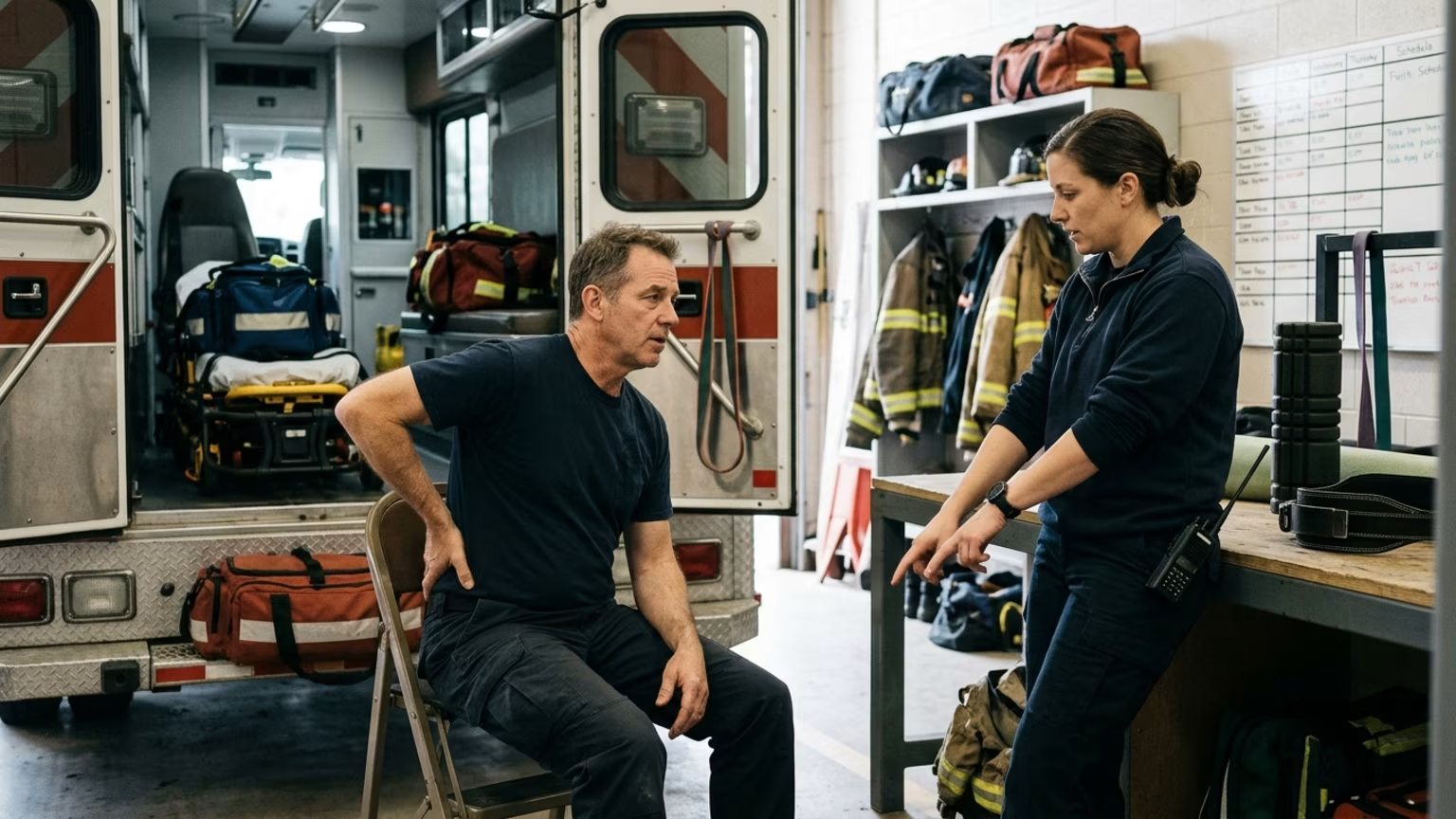



Read practical guidance on first responder fitness, recovery, sleep, nutrition and resilience for demanding work and a long, active career.
read the blog
