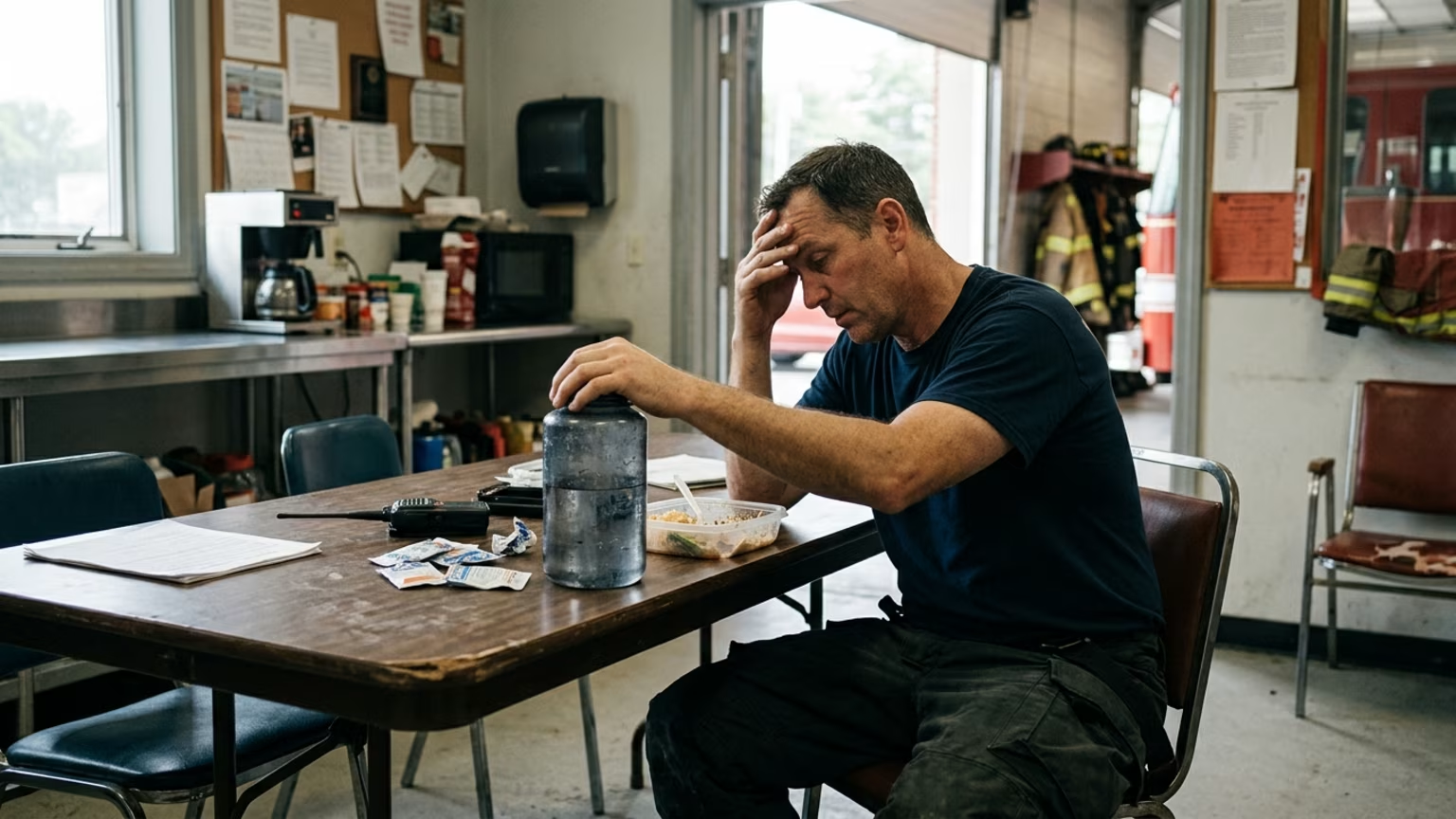

New GLP-1 coverage raises hydration and muscle-preservation questions for first responders, with no direct studies of firefighters on duty.





On October 14, 2026, MDLinx published a report examining GLP-1 medications in hot and physically demanding jobs such as firefighting. It focused on two occupational-health concerns: fluid balance and preservation of lean mass when work requires strength and endurance.
For first responders, the useful question is how treatment fits the demands of duty. Reduced intake or gastrointestinal symptoms deserve attention when a shift also involves heat and strenuous tasks. Muscle preservation belongs in that same conversation rather than being treated as a separate fitness goal.
The report's practical contribution is to connect medication discussions with the work a person actually performs. That calls for clinical context rather than assumptions about everyone taking a GLP-1 medication.
MDLinx reports that there are currently no studies evaluating how GLP-1 drugs or their side effects affect firefighters on the job. The concerns are therefore clinical considerations for demanding work, not demonstrated medication-related impairments or evidence that responders taking these medications are less capable.
Firehouse published related coverage on September 15, 2026, and updated it on October 13, 2026. That article also highlights hydration and electrolyte balance alongside resistance or weight training in its discussion of GLP-1 use in the fire service.
The shared focus is maintaining fluid balance and muscular capability. These are useful subjects for occupational-health conversations because they connect treatment with the demands of the job. The coverage does not document a department-wide medication policy or a standard protocol for all responders.
The distinction matters. An article identifying a plausible concern can help someone ask better questions. It is not the same as a study measuring symptoms and performance during actual duty.
MDLinx reports an International Association of Fire Fighters (IAFF) estimate of nearly 2 liters of sweat loss during 3 hours of firefighting under extreme heat. This is an extreme-heat firefighting estimate, not a GLP-1-specific measurement or a universal fluid-replacement target.
The report identifies reduced intake and possible gastrointestinal fluid loss as concerns for workers using GLP-1 medications. Bariatric surgeon Hector Perez, MD, identifies fluid balance and dose escalation as major issues for firefighters taking these medications.
The occupational question is about overlapping demands. A responder may be managing medication-related symptoms while working in conditions that also challenge fluid balance. Discussing only the medication or only the heat would leave part of that situation out of the conversation.
A secondary report summarizing medication labeling notes that gastrointestinal reactions can lead to dehydration and kidney problems. It reports that kidney-function monitoring is advised when adverse reactions could cause volume depletion, especially during initiation and dose escalation. Whether monitoring is appropriate for an individual belongs with the treating clinician.
This makes symptoms relevant information for a healthcare appointment rather than an inconvenience to work around without discussion. The clinician needs to understand both the symptoms and the physical setting in which they occur.
The same job-specific perspective applies to hydration planning for demanding shifts. The useful starting point is the actual work environment, not an assumption that one drinking plan fits every assignment.
MDLinx reports that a 2026 systematic review and meta-analysis of 32 firefighter studies found associations between strength and anaerobic capacity and occupational task performance. Tasks included stair climbing, equipment carrying, ladder raising and victim dragging.
Those associations do not establish that medication-related changes in lean mass cause poorer job performance. They explain why the strength question deserves attention without proving a medication effect.
Perez argues that preserving muscle can be a safety issue as well as a health issue for people whose duties involve climbing ladders or lifting heavy loads. His point connects the clinical discussion to capability rather than appearance alone.
For a responder, that shifts the conversation beyond a change on the scale. The relevant questions also include whether strength is being maintained and whether familiar work feels different. Body weight and the ability to complete demanding tasks are separate subjects that deserve separate attention.
This fits the broader discussion of physical workload and career-long recovery. Rescuris's editorial position is that maintaining capability should include recovery rather than turning every concern into a reason for more exertion.
The practical recommendations in this coverage are best used to structure a clinical conversation. They do not establish individual fluid requirements or protein targets. They also do not provide a training program suited to every responder.
MDLinx identifies reduced intake and gastrointestinal fluid loss as concerns. A useful discussion can therefore connect symptoms with the ability to eat and drink during demanding duty.
Relevant subjects include:
These are details for the prescriber to consider together. The purpose is to make the work demands visible during medical decision-making rather than treating the shift as background information.
Persistent or significant gastrointestinal symptoms, difficulty maintaining fluids or new weakness are reasons to contact a healthcare professional. A generic hydration target is not a substitute for evaluating those concerns.
Perez's advice reported by MDLinx includes drinking before thirst during work in heat. The article also says electrolyte-containing drinks may become relevant during prolonged sweating. Firehouse likewise highlights hydration and electrolyte balance in its fire-service coverage.
The practical question for the clinician is how those considerations apply to the responder's symptoms and duties. This is a discussion about an appropriate plan, not a direction to copy another worker's fluid intake.
The sweat-loss estimate provides occupational context. It should not be converted into a personal drinking schedule simply because the reader also works in emergency services.
According to MDLinx, Perez recommends adequate protein intake and progressive resistance training. These recommendations provide a basis for discussing nutrition and training with a clinician who understands the person's work.
A useful conversation keeps the purpose clear: preserving muscular capability while accounting for treatment and duty demands. It is not an instruction to add more training regardless of accumulated physical wear.
The question is how nutrition and resistance training fit together for that individual. A responder does not need a generic performance slogan when the actual issue is maintaining strength while managing symptoms and recovery.
Perez recommends monitoring for weakness or work that feels harder than usual. That gives responders a concrete subject to bring to a healthcare professional without requiring them to diagnose the cause themselves.
A description tied to familiar work is more useful than a broad judgment about toughness. Saying that equipment carrying feels noticeably harder communicates a functional concern. It leaves the clinical interpretation with someone qualified to assess it.
The aim is to bring a meaningful change into the conversation early, not to turn ordinary self-observation into a personal fitness-for-duty assessment.
The next useful evidence would connect medication exposure and symptoms with actual work outcomes. Changes in body weight alone would not answer the operational questions raised by these reports.
Several questions remain open:
Answering those questions would help separate a plausible concern from an observed occupational outcome. It would also help clarify which considerations apply broadly and which require individual assessment.
For now, the strongest contribution of the MDLinx and Firehouse coverage is the connection it makes between treatment and job demands. Fluid balance and muscular capability belong in the clinical discussion. Responders deserve that discussion without a presumption that medication use makes them unsafe or that working through symptoms demonstrates readiness.
Retaining strength for demanding work is the outcome in view; Rescuris translates research on fitness and recovery for irregular schedules. When accumulated physical wear complicates duty readiness, its evidence-led guidance helps readers weigh recovery options without treating exhaustion as a sign of commitment or placing short-term output above long-term health.
Rescuris publishes evidence-aware guidance for firefighters, police officers, paramedics and other first responders on fitness, recovery, sleep, nutrition, stress resilience and long-term capability.





Read practical guidance on first responder fitness, recovery, sleep, nutrition and resilience for demanding work and a long, active career.
read the blog
