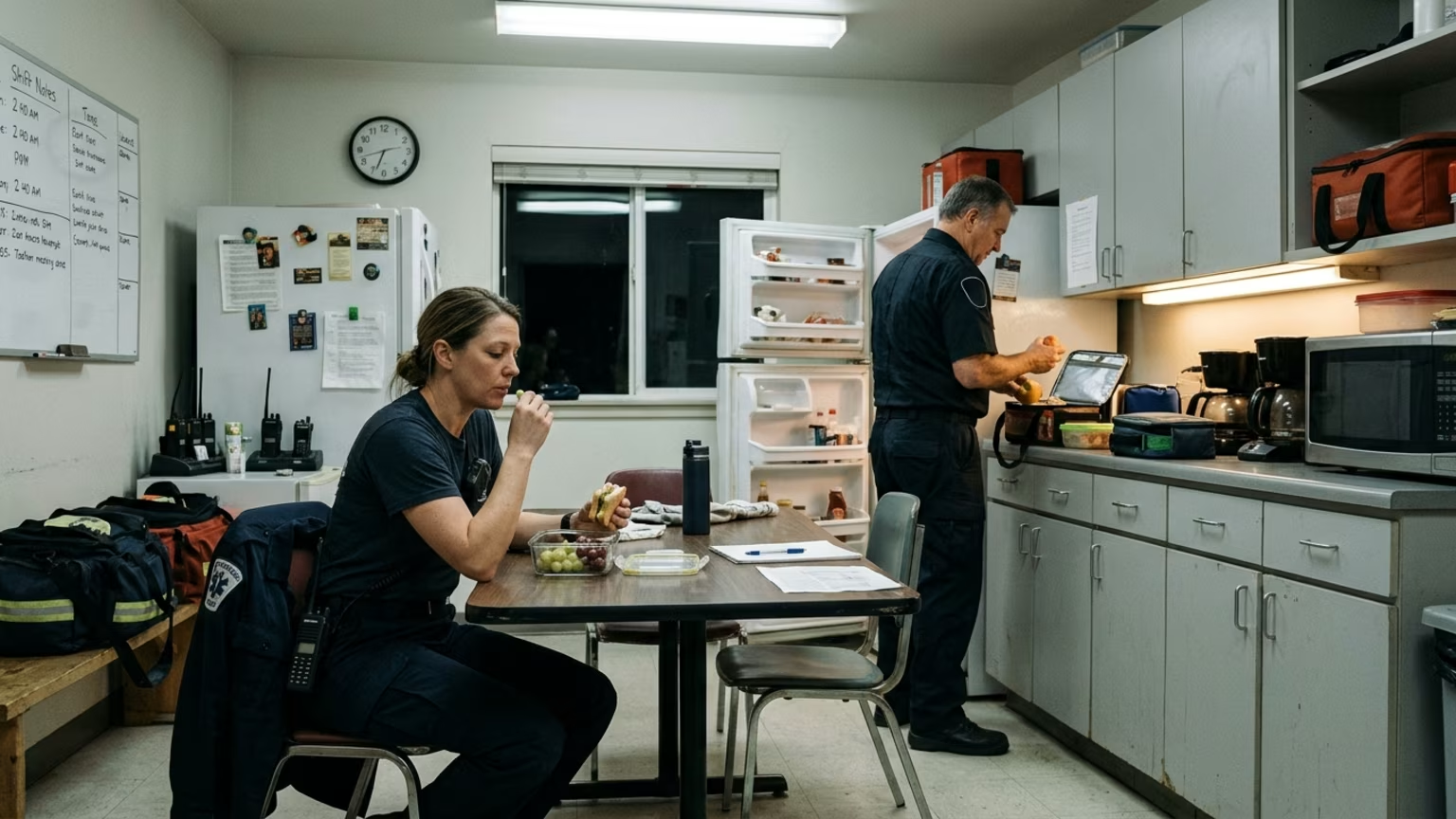

Meal-timing evidence does not justify universal overnight fasting. A practical look at meal size, alertness and food access for first responders.





Myth: The civilian weight-control rule of closing the kitchen overnight should apply even when your working day runs through the night. Correction: For first responders, evidence about large overnight meals does not justify a universal overnight fast. Meal size and realistic food access matter alongside hunger, alertness and individual clinical instructions.
The physiological argument for limiting nighttime food is narrower than a strict fasting rule suggests. The chrononutrition review describes findings in which fasting was associated with lower morning insulin and insulin resistance. However, participants also consumed more calories the following day.
Those findings concern different outcomes. A favorable morning metabolic measurement does not establish that the same eating pattern produces better operational performance or a more manageable overall food intake. The following day's eating belongs in the assessment too.
This distinction matters when advice moves from a controlled experiment into emergency work. The question is not simply whether avoiding food changes a laboratory measurement. It is whether a proposed eating pattern remains workable when someone needs to perform demanding tasks and cannot count on the next meal break.
The same chrononutrition review describes earlier studies in which a snack or meal was associated with less sleepiness and better cognitive performance than avoiding food. That does not support the claim that eating overnight is always necessary. It does show why fasting cannot automatically be treated as the better performance choice.
An American Academy of Sleep Medicine systematic review published in 2026 examined simulated night-shift studies. It reported that a snack or no food improved measures of alertness or cognitive performance compared with a full meal. Some findings had very low certainty because of imprecision and indirectness.
The comparison is the useful part: a full meal, a smaller snack and no food are not interchangeable conditions. Evidence against a full overnight meal is not automatically evidence against every form of nighttime eating.
The narrative review of chrononutrition and shift workers' health describes the practical tension. Limiting nighttime intake may benefit some metabolic outcomes, while food may still be needed to support alertness and performance. Neither consideration should erase the other.
A 2026 systematic review of nutrition interventions for shift workers concluded that the evidence was too limited and heterogeneous to support definitive nutrition guidelines. Studies used varied designs and populations. The first-responder subset was small, so general shift-worker findings should not be presented as established responder-specific outcomes.
Controlled and simulated shifts also do not reproduce every feature of emergency work. The available research does not establish one best eating schedule across day duty and overnight or rotating schedules. Nor does it provide medication-specific plans.
These findings should not be presented as proof that a particular eating window regulates the autonomic nervous system under extreme occupational stress. The defensible correction is about flexible nutrition planning, not a demonstrated method for controlling the body's stress response.
During a 24-hour shift, a daytime eating plan has to coexist with unpredictable calls and uncertain breaks. A window that looks straightforward on a calendar may depend on food access that the workplace cannot guarantee. That is an operational constraint, not a failure of discipline.
The relevant planning question changes with the situation. If a substantial meal is available before overnight work, the later decision may concern whether a smaller option is needed. If a planned meal is missed, the decision is no longer the same as choosing to skip food after eating as expected.
These are planning examples rather than tested meal schedules. They illustrate why the next realistic eating opportunity belongs beside the preferred eating window. A plan should describe what happens when access changes instead of assuming that every break will occur.
For overnight duty, separate the issues that a blanket fasting rule bundles together:
No single answer settles all four questions. A smaller option may be reasonable when hunger or alertness makes fasting unsuitable, without implying that a large meal is necessary to get through the night.
This is also why planning when a meal break is uncertain deserves attention before choosing a restrictive schedule. Food access is part of the plan itself. It should not become an afterthought once the eating window has already been selected.
The corrected approach is to distinguish meal size from the decision to eat at all. It also separates an optional eating pattern from a clinical requirement. The following options reflect the research and its practical implications rather than a validated protocol for every responder.
The chrononutrition review describes a trial involving 24-hour-shift firefighters that paired a self-selected daytime eating window with nutrition counseling. This provides an example of an approach that was feasible in that study. It is not evidence that every department or individual should adopt the same arrangement.
Both groups reduced energy intake. The time-restricted-eating group showed a significant reduction in weight and BMI, but the study reported no between-group differences in energy intake or BMI.
That distinction changes the interpretation. Improvement within one group is not the same as evidence that its approach was superior to the comparison group. The result supports considering feasibility without turning the eating window into the presumed cause of every improvement.
For day duty, a daytime eating pattern is therefore an option some people may discuss with a qualified professional. The useful question is whether it fits actual access to meals and the person's clinical needs. The study does not turn adherence to a clock into a measure of commitment.
For overnight shifts, the evidence supports comparing a full meal with a smaller snack or no food. It does not support treating every nighttime calorie as an equivalent exposure. A smaller planned option may be a reasonable consideration when hunger or alertness makes fasting unsuitable.
That is a planning option, not an instruction to eat whenever tired. The research does not establish an ideal snack or a universal meal composition. There is no basis here for adding a precise portion or a mandatory eating time.
The practical correction is to retain options. A plan can account for the possibility that food will be needed without making a large overnight meal the default. It can also allow for not eating when that is workable without presenting fasting as the superior choice for everyone.
Clinical food requirements sit outside this general comparison. Anyone who needs food with medication or follows a medical nutrition plan should follow their clinician's instructions rather than applying an overnight-fasting suggestion. Individual changes belong with the qualified professional responsible for that care.
For rotating schedules, realistic access to food is a more useful starting point than treating one daily window as mandatory. Planning can consider when a substantial meal is likely to be available and whether a smaller option will be accessible if that opportunity disappears.
That approach does not require pretending that every shift will follow the plan. Its purpose is to account for uncertainty before it occurs. A missed break should be treated as a change in circumstances rather than evidence that the responder has failed a nutrition rule.
The period after duty belongs in the discussion as well. The fasting finding that included greater calorie intake the following day is a reminder to assess the broader eating pattern rather than judging success solely by what happened overnight. Considering food after overnight duty keeps the next eating opportunity in view.
Across schedules, the practical priorities remain consistent: distinguish a full meal from a smaller option and account for real food access. Consider hunger and alertness without treating either as proof that one eating schedule is right for everyone. Keep medication instructions and clinical nutrition needs separate from general fitness advice.
Closing the kitchen is not the goal; the better correction for unpredictable duty is a flexible plan that considers meal size, hunger and alertness while respecting clinical needs and realistic food access.
Alertness across an overnight shift is a relevant outcome for judging eating advice, and Rescuris translates research into practical nutrition and recovery guidance. Its coverage helps emergency-service professionals assess food choices alongside sleep interrupted by nights and unpredictable calls without treating lasting physical capability or long-term health as expendable.
Rescuris publishes evidence-aware guidance for firefighters, police officers, paramedics and other first responders on fitness, recovery, sleep, nutrition, stress resilience and long-term capability.






Read practical guidance on first responder fitness, recovery, sleep, nutrition and resilience for demanding work and a long, active career.
read the blog
