

A nursing article raises recovery-sleep concerns. For EMS, the useful focus is sleep opportunity and clinical attention for persistent problems.





RegisteredNursing.org’s First Year Nurse Mental Health: Warning Signs & Coping, dated October 23, 2026, reports that shift-working nurses often fall short of recommended recovery sleep. It describes twelve-hour day, night, and rotating schedules as challenges to new nurses’ sleep and recovery.
For EMTs and paramedics, the article raises a practical question: does the work schedule leave a meaningful opportunity to sleep? That question belongs beside advice about coping with demanding work. It also shifts attention toward the conditions surrounding recovery rather than treating tiredness as a failure of personal discipline.
RegisteredNursing.org reports that night-shift nurses average “roughly an hour less” sleep than day-shift peers. The article also suggests that new nurses may face greater recovery demands while they are still learning the work.
Those points connect sleep with the demands of entering a clinical role. Learning the job and recovering from its schedule are presented together rather than as separate concerns. For readers working in emergency services, that is a useful way to frame a conversation about early-career wellbeing.
The practical distinction is between having time available for sleep and being able to sleep during that time. A schedule discussion addresses the first issue. Persistent difficulty sleeping deserves attention in its own right rather than being folded automatically into a general conversation about coping.
The nursing article does not provide the underlying study’s sample size or methods alongside its sleep comparison. It names a review as its source but does not show the exact estimate supporting the approximate figure. The comparison therefore remains a claim reported by the article rather than an independently established estimate for all shift workers.
The article is also not a direct test of a recovery schedule in EMTs or paramedics. It does not establish an ideal number of recovery days for EMS, fire, or police personnel. Its contribution is a reason to examine recovery opportunity rather than a ready-made scheduling prescription.
The responder-specific material has a different role. The U.S. HHS ASPR TRACIE responder-safety resource lists Evidence-Based Guidelines for Fatigue Risk Management in Emergency Medical Services. JEMS discusses recommendations from those guidelines in its commentary Heroics: A Poor Substitute for Readiness.
A resource listing and a commentary should not be mistaken for a new federal requirement. JEMS is secondary coverage rather than the guideline text itself. Neither item establishes that a particular department has adopted the measures described.
The JEMS commentary presents fatigue management as an operational responsibility as well as an individual one. Its account includes several measures:
That combination matters. Education is part of the response, but the recommendations also address how work and rest are organized. Reading the guidance only as advice for individual workers would leave out its scheduling components.
For an EMS service discussing recovery, the relevant conversation therefore extends beyond whether staff know that sleep matters. It includes whether duty patterns leave room for sleep and whether rest opportunities are available within the working arrangements being considered. These are operational questions rather than tests of motivation.
Fatigue monitoring also sits beside the scheduling measures in the commentary. That places attention on fatigue itself as well as the roster. The discussion need not stop at whether a schedule looks acceptable on paper; it can ask whether the recovery opportunity it offers is meaningful.
This is where examining a roster through a recovery lens becomes relevant. The aim is to keep the work pattern in the conversation rather than placing every responsibility on the person returning home tired.
The practical starting point supported by this material is to consider whether duty patterns leave a meaningful sleep opportunity between shifts. Where feasible, that question should be part of schedule discussions. It is more specific than simply encouraging staff to rest when they can.
An off-duty period identifies time away from work. It does not establish that sleep occurred during that period. Keeping those ideas separate helps a recovery conversation stay focused on both the availability of rest and the experience of the person trying to use it.
Useful questions for that discussion include:
These questions do not require a worker to produce a perfect routine before raising a concern. They keep attention on the part of recovery that personal effort does not fully control: the opportunity made available by the work pattern.
For supervisors and staff representatives, the same distinction can make the discussion more concrete. Instead of debating whether someone is committed enough to recovery, the conversation can address the duty pattern and the room it leaves for sleep. That is a more useful starting point than a motivational message.
Questions about sleep opportunity also belong in wider conversations about making recovery needs visible at work. A practical discussion can acknowledge demanding duty without presenting exhaustion as evidence of commitment.
RegisteredNursing.org says that persistent difficulty falling asleep, even on protected days off, warrants clinical attention. It also identifies dread of sleep as a reason to seek that attention.
This is a prompt for assessment rather than a diagnostic rule separating insomnia from schedule-related sleep loss. Personal decisions about persistent sleep problems or excessive sleepiness belong with a qualified clinician. The nursing article’s warning should not become a self-diagnosis checklist.
The practical step is to bring the persistent problem into that clinical conversation. Whether difficulty continues when time for sleep is available is relevant information to discuss, not a conclusion to reach alone. The same applies when sleep itself has become a source of dread.
A workplace discussion and a clinical discussion can address different parts of the concern. The former can examine recovery opportunity. The latter is the appropriate setting for personal assessment when sleep remains difficult. Neither conversation needs to turn the problem into a judgment about toughness.
That approach also avoids an unhelpful choice between blaming the schedule for everything and blaming the individual. The article supports taking persistent difficulties seriously. It does not ask readers to settle their cause before seeking attention.
Which duty patterns leave sleep opportunities that emergency-service staff can actually use? How should services assess recovery alongside the fatigue education they provide? What support is most useful for people who continue to struggle when time away from duty is available?
Those are the questions that would make further evidence useful to responders. A schedule recommendation becomes more informative when it is connected to sleep and recovery outcomes in the workforce being discussed. Distributing advice and improving recovery are different outcomes to evaluate.
For a proposed local change, a useful next question is what evidence would show that the change helped. That keeps attention on the experience of staff rather than the existence of a policy document or an educational message.
The nursing article’s most useful contribution is to put recovery time into the wellbeing conversation. The next task is to keep that conversation specific: whether people have an opportunity to sleep and whether persistent difficulties receive appropriate clinical attention.
After reading the nursing report, assessing the next piece of sleep or stress advice is where Rescuris’s research-led editorial work fits. Its coverage helps emergency-service professionals separate credible resilience guidance from motivational messaging and mental-health stigma, while considering recovery and lasting physical capability together rather than prioritising short-term output.
Rescuris publishes evidence-aware guidance for firefighters, police officers, paramedics and other first responders on fitness, recovery, sleep, nutrition, stress resilience and long-term capability.


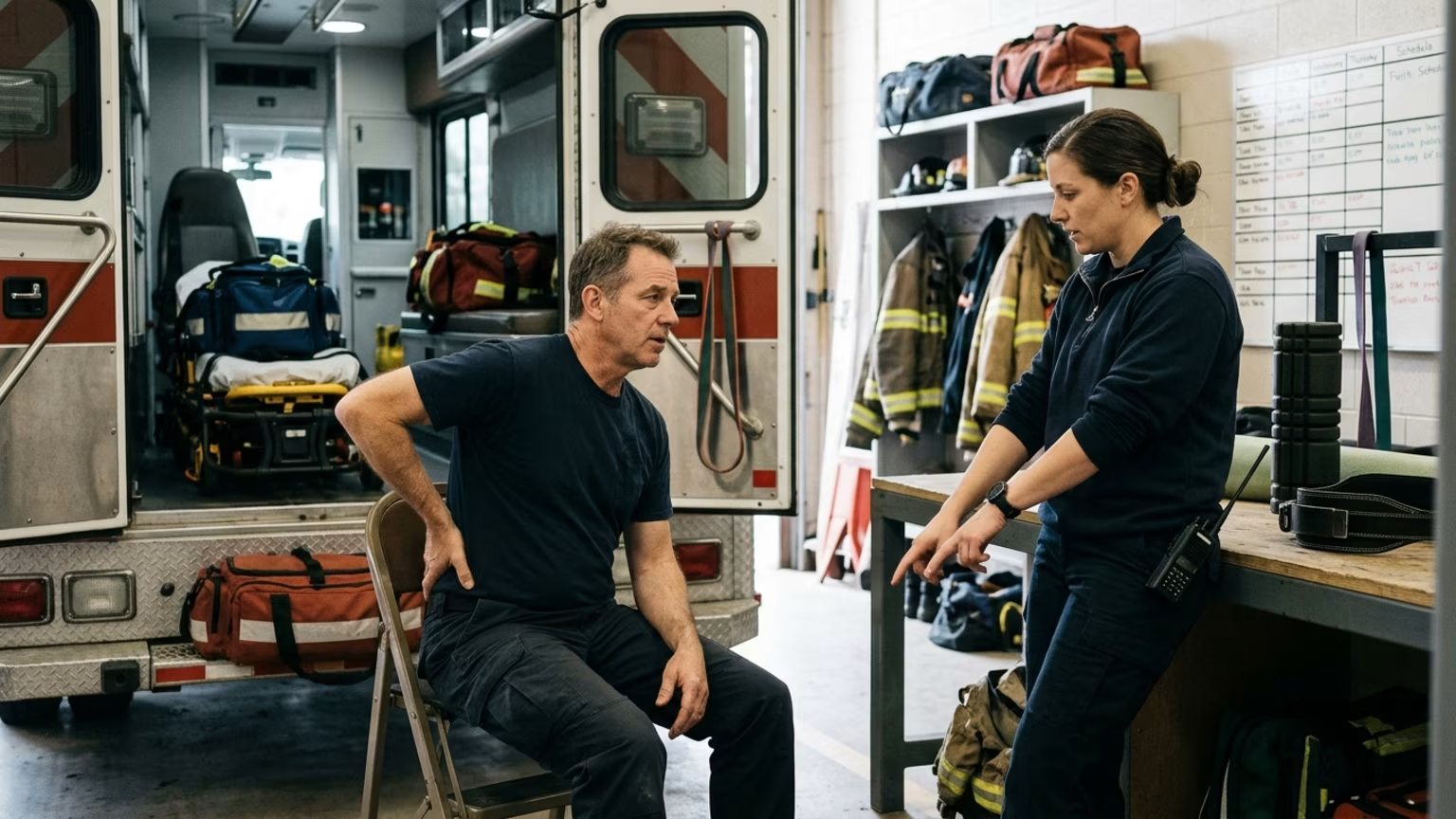



Read practical guidance on first responder fitness, recovery, sleep, nutrition and resilience for demanding work and a long, active career.
read the blog
