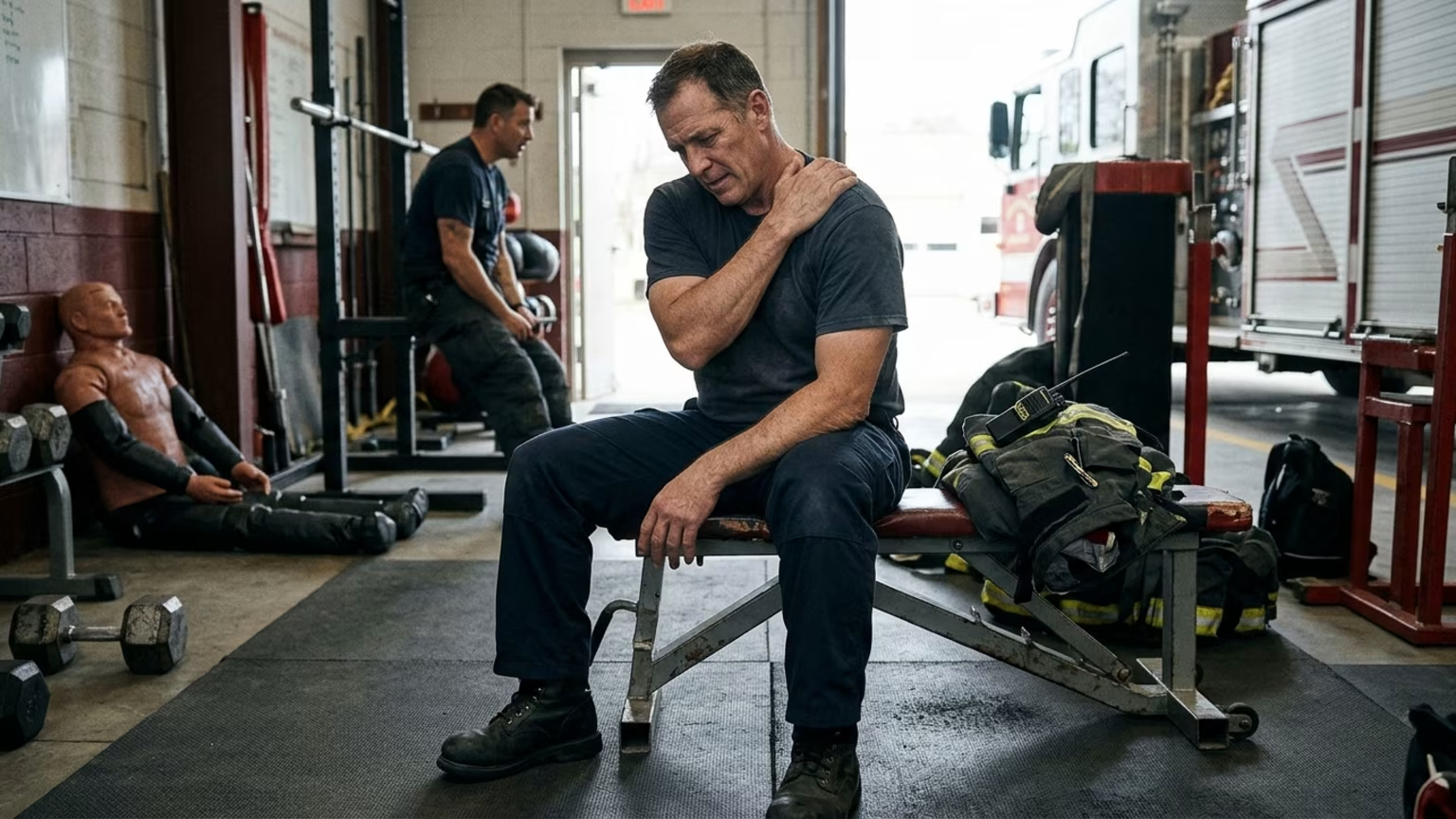

Recurring aches deserve a workload review, not automatic training increases. Examine fatigue evidence and when persistent symptoms warrant clinical assessment.





The useful distinction is between training demand and total demand. The tactical strength-and-conditioning chapter discusses equipment and job requirements alongside physical preparation. For a responder reviewing recurring discomfort, that supports looking beyond the most recent workout.
A training session can be considered alongside recent duty demands and sleep opportunity. Movement technique and recovery also belong in that review. The practical question is not simply whether the programme looks manageable on paper, but how it fits the work surrounding it.
The Chartered Institute of Ergonomics & Human Factors report adds a performance measure to that discussion. Its shipboard simulation findings connect prior exercise fatigue with longer task-completion times. The report also notes lower peak-force results in fatigued groups.
These are task-performance findings rather than injury statistics. They give a reason to consider fatigue when discussing readiness, without turning every difficult session into evidence of an injury.
The BMC Public Health review provides a broader shift-work perspective. Healthcare accounted for 46 of its 89 studies. Its authors called for confirmation of the scheduled-nap findings in randomized trials, and the review was not specific to first responders.
The practical reading is that recovery opportunities deserve consideration. It is not that a particular nap routine has been established as the answer for a firefighter, police officer or EMS professional.
The autonomic nervous system is a reasonable topic to ask about when fatigue and incomplete recovery overlap. However, these sources do not report autonomic measurements or establish that recurring aches indicate an autonomic disorder. Describing the symptoms as proof of nervous-system dysfunction would go beyond the evidence.
The supported physiological discussion is narrower. The tactical strength-and-conditioning chapter describes how equipment and occupational demands can affect movement and physiological strain. The firefighting simulation reports differences in task time and force output under fatigue conditions.
For daily function, the practical focus is therefore observable capacity. Is a familiar work task becoming harder? Does the same movement repeatedly bring discomfort back? Is the difficulty affecting ordinary activity as well as formal training?
Those questions help describe the problem without assigning its cause. They also keep the discussion connected to what matters outside the gym: the ability to perform necessary tasks and remain active beyond duty.
A responder does not need a nervous-system label before taking a change in function seriously. Reviewing workload and seeking appropriate assessment are more useful next steps than trying to identify a physiological mechanism from symptoms alone.
The simulation summarized by the Chartered Institute of Ergonomics & Human Factors compared task performance under different fatigue conditions. Participants who exercised to fatigue beforehand took 7.2% longer to complete the task than fully rested participants. The fatigued-plus-heat group took 8.5% longer.
The report also describes lower peak-force results in fatigued groups. Together, these outcomes make the study relevant to discussions about the relationship between prior exertion and subsequent physical work.
The boundary is specific: this was a laboratory-based shipboard firefighting simulation. The report notes operational differences that limit direct transfer to other firefighting settings. Its results should not become a forecast of how much slower any individual responder will be on duty.
The study also does not provide a pain-management schedule. Task-completion time is not a clinical assessment of persistent discomfort. A percentage difference in laboratory performance cannot be converted into a required rest interval or an acceptable pain threshold.
Its strongest practical contribution is a planning question: what physical demand comes before the task that matters? That question applies to reviewing the sequence of training and duty without pretending the simulation supplies a universal timetable.
For recurring aches, this shifts attention away from judging a workout in isolation. The surrounding demands deserve review before more exercise is added simply because familiar work has started to feel harder.
The research-supported starting point is a review of recent duty demands alongside training fatigue, movement technique and sleep. Recovery belongs in the same discussion rather than being treated as whatever time remains after everything else.
This review should describe what has changed. The issue may be recurring discomfort during a familiar task or a decline in usual capacity. Neither observation automatically establishes a diagnosis, but both provide a clear reason to reconsider the current approach.
Rescuris’s guide to making training decisions around actual readiness offers a related way to frame that discussion. The editorial priority is matching training decisions to the demands being carried, not treating completion of the planned session as the only successful outcome.
The tactical strength-and-conditioning chapter discusses ability-based training, periodization and minimum-effective-dose programming as possible approaches to managing training demands. These are programming principles, not guaranteed injury-prevention methods.
They provide useful topics for discussion with a qualified coach or conditioning professional. The question is how the programme accounts for current ability and fatigue, rather than whether the responder is willing to tolerate more work.
A review can include workload and movement technique without assuming that extra volume is the missing ingredient. The supplied research does not establish a universal reduction in training or a fixed recovery schedule. Those details should not be invented from a general principle about managing demand.
Broad adjustments to training workload or technique are reasonable self-management considerations only when symptoms are mild and improving. Persistent pain or worsening discomfort warrants assessment from a qualified clinician. The same applies when symptoms repeatedly return with a task or limit duty or daily function.
This is cautious general guidance rather than a validated first-responder triage rule. The reviewed sources do not provide a clinical cutoff that reliably separates manageable soreness from an injury requiring evaluation.
The commercial provider behind Musculoskeletal Injuries in Public Safety Workers also advocates early assessment. That is a vendor recommendation rather than independent clinical consensus. A clinician or qualified occupational-health professional is the appropriate person to assess an individual problem.
For related reading, Rescuris discusses how to approach discomfort that may need more than routine recovery. An article can help organize the questions, but it does not replace that assessment.
The shift-work review gives scheduled naps a place in fatigue discussions. It does not supply a first-responder nap prescription, and its findings should not become a promise that one recovery practice will restore capacity.
The practical issue is whether recovery is being considered at all when training demands are planned. Advice that assumes predictable nights and uninterrupted time off does not fit the audience Rescuris serves.
At team level, the discussion should distinguish decisions about exercise from constraints imposed by duty. A responder may have choices about a training session without having equivalent control over the demands that precede it. That distinction keeps the conversation practical rather than turning fatigue into a judgment about motivation.
A sustainable approach needs an outcome beyond completing more exercise. For this topic, the relevant outcomes are familiar work capacity and daily function, alongside the course of the symptoms.
If discomfort repeatedly returns with the same task, repeatedly changing the workout is not a substitute for assessment. If symptoms are mild and improving, the workload review still matters before returning to automatic progression.
The longer view is maintaining physical capability through a career and beyond it. Rescuris’s guidance on preparing for an active life after service places that goal beside present-day readiness. The editorial standard is not how much discomfort someone can tolerate, but whether training supports the life and work they want to sustain.
Recurring aches call for a review of total demand and function, with qualified assessment when symptoms persist or worsen, rather than an automatic increase in training effort.
Training leads and individual responders share the day-to-day challenge of weighing recurring aches against duty demands, a discussion Rescuris supports through evidence-focused editorial guidance. Rescuris covers duty fitness and recovery for emergency-service professionals without treating demanding schedules as a reason to sacrifice their long-term health and physical capability.
Rescuris publishes evidence-aware guidance for firefighters, police officers, paramedics and other first responders on fitness, recovery, sleep, nutrition, stress resilience and long-term capability.


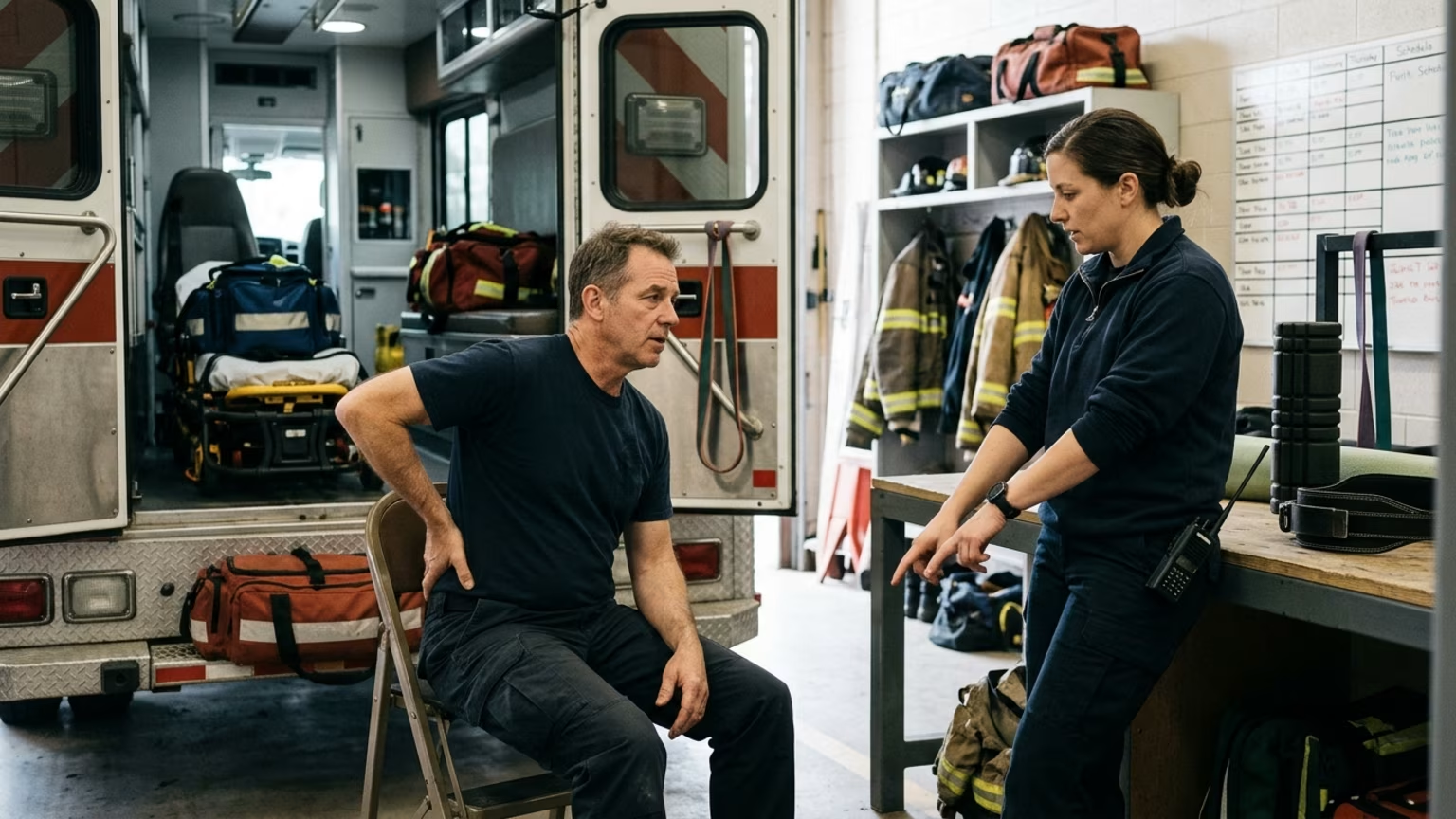



Read practical guidance on first responder fitness, recovery, sleep, nutrition and resilience for demanding work and a long, active career.
read the blog
