
Practical ways to reduce avoidable task switching and rebuild attention during driving, dispatch, patient care and scene management.





Attentional control is the ability to choose what needs your attention, shift it when priorities change and return to unfinished work without losing track. For first responders, protecting focus does not mean blocking out everything except one task. It means keeping the current priority clear while remaining available to new hazards and urgent information.
An interruption may be necessary. A radio update can change the immediate priority, while a patient change can require a different response. The useful skill is not refusing every interruption. It is recognizing the transition and knowing what needs to happen when attention returns.
Emergency driving makes this tension visible. An AOL report describes an 18-month initiative involving Devon and Cornwall Police and The Open University, funded by the Road Safety Trust. The project is examining cognitive workload during emergency police driving and is intended to inform a training manual for approximately 80,000 blue-light response drivers in the UK.
Applied-psychology professor Gemma Briggs said officers are highly trained but “not immune to cognitive distraction.” She identified simultaneous demands from speed, manoeuvring and radio use. Conversations and police equipment add further demands while the driving task continues.
Police driver-support manager Matt Butler described a limit on how much information drivers can process before they begin missing things. His point shifts the discussion away from whether a responder is trying hard enough. Training matters, but expertise does not remove the need to manage competing demands.
For duty readiness, the relevant question is which demands need attention now and which can wait. A necessary radio update and an avoidable conversation do not serve the same purpose. Treating both as equally urgent leaves less room to organize the primary task.
Rescuris's coverage of decision-making under operational strain addresses this broader readiness problem. Focus protection belongs in discussions about communication and equipment design as well as individual skill. It is not simply a request for the person at the wheel to concentrate harder.
A useful way to organize the problem is through these psychological demands:
The police-driving project is still investigating workload, and the attention review is not a tested emergency-service protocol. The field habits below are practical applications rather than validated procedures across dispatch, patient care and fireground operations. They belong alongside departmental procedures and clinical judgment, not in place of them.
The foundation is a clear account of the current task. When conditions allow, a brief resumption cue before switching can record where the work stopped. It can be spoken to a teammate or kept within the approved workflow rather than becoming another task to manage.
A useful cue identifies:
These points also organize the return. After the interruption, the question is whether the same priority still applies and whether the unfinished action still belongs next. Urgent changes take precedence; the cue is a way back to the work, not a reason to ignore new information.
Reducing avoidable switching is different from reducing every interruption. Changing hazards and patient deterioration belong in the immediate picture. The practical distinction is whether new information requires action now or can safely wait until the current step is complete.
A team discussion can identify which communications carry urgent updates and which are routine. The relevant question is how those updates relate to the current task. A clear priority still needs to be revised when new information changes the situation.
Neither silence nor continuous communication is the default goal. The operational aim is to keep essential updates available while limiting conversation or equipment interaction that has no immediate purpose. When the priority changes, the return cue should change with it rather than preserve an outdated task.
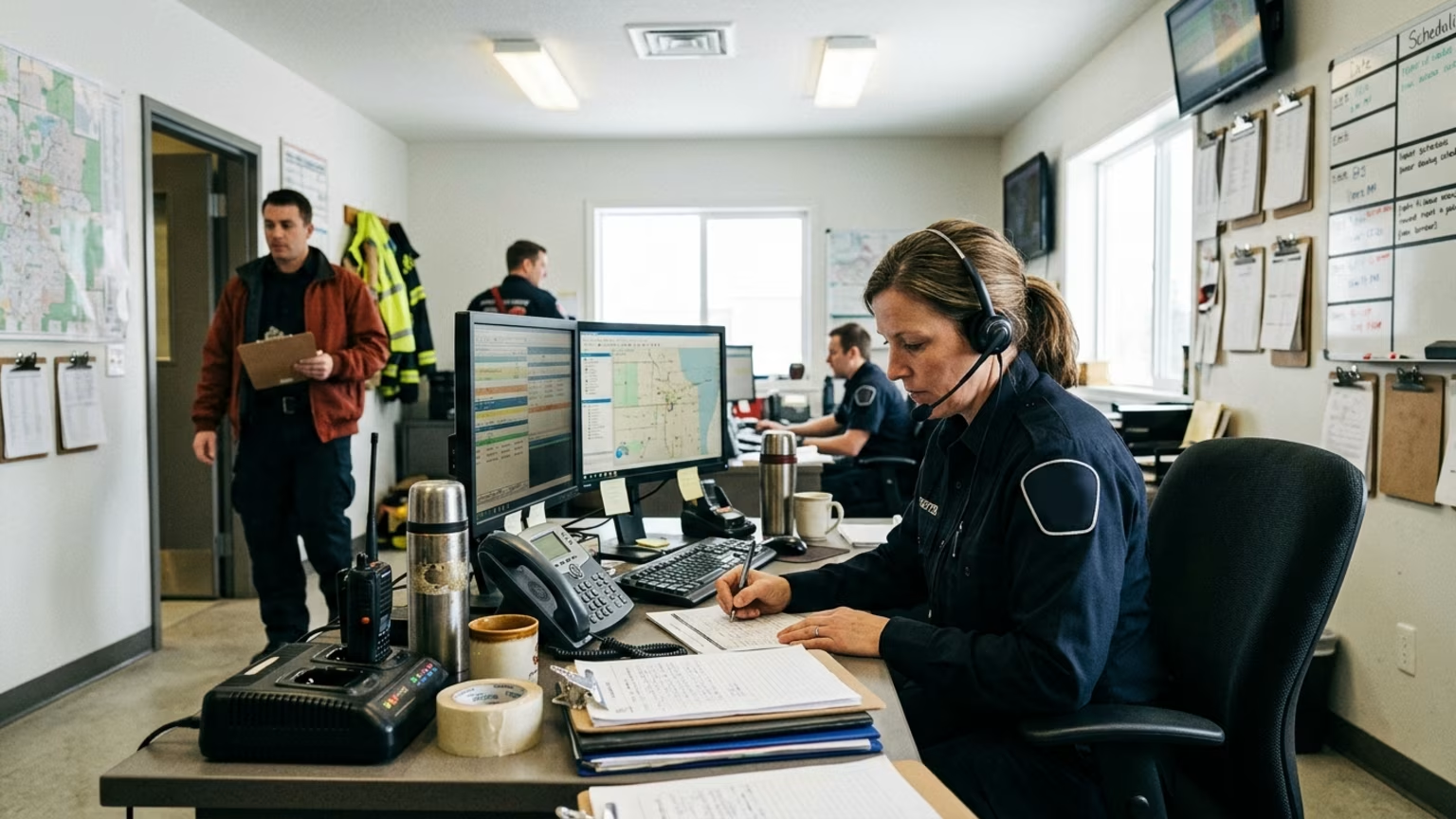
Dispatch work calls for separating information that requires immediate action from information that can safely wait for the current call-processing step. The distinction is about priority, not about treating incoming information as unimportant.
A brief “where was I?” check after a radio query or supervisor request can mark the return. At the end of a call segment, restating the priority and next required action makes the transition explicit. Including the unresolved risk keeps the cue connected to safety rather than just administrative completion.
The objective is to recover the interrupted processing step, not to judge dispatchers by how many demands they can carry at once.
For emergency driving, the driving task remains primary while operationally avoidable conversation and equipment interaction are reduced. Necessary communications still matter. The distinction is between responding to essential information and adding demands that do not need to compete at that moment.
Deliberate scan points can organize the return after a radio transmission or equipment interaction:
A short cue such as “road, route, risk” can make that return deliberate. Its purpose is to direct attention back to driving rather than assume that ending a transmission completes the switch. Hands-free communication should not be treated as attention-free communication.
In patient care, the same workload principle centers on the current care step and the next unfinished action. When a new request arrives, identifying those points helps define what is being interrupted. Information that changes treatment or transport decisions has a different priority from information that does not change the immediate plan.
After the interruption, the practical return is a recheck of the patient and equipment alongside the task sequence. This is not a call to delay a necessary response. It is a way to make the unfinished action visible while the current patient picture is reassessed.
Where work is handed between clinicians, a brief confirmation of who owns the next action can make the transition clearer without adding a new clinical protocol.
Scene management extends the return check beyond one task. A radio update or new arrival can require the operational picture to be rebuilt. Appropriate scan points include patient condition and hazards alongside team status. Egress and changing conditions also belong in that review.
When staffing allows, explicit roles can separate radio traffic from hazard monitoring or equipment coordination. Brief closed-loop statements can confirm which task was interrupted and who owns the next step. The aim is a shared current picture, not several people assuming someone else has retained the whole sequence.
Incoming information is part of the scan too. Refreshing the scene picture means checking whether the newest update changes the task or who should act next. Keeping that information with the hazard and team review avoids treating radio traffic as separate from the rest of the operation.
This fits with keeping scene awareness deliberate rather than assuming the previous view remains current. Recovery pauses belong in transitions when conditions permit, not in the path of an urgent response.
Individual cues are only part of the answer. The police-driving project is intended to inform support tools and training, which makes system design relevant to the discussion. Departments can consider whether equipment configuration and communication practices create unnecessary attentional competition.
Radios and cameras still have operational purposes. The useful question is whether their demands arrive in a way that supports the primary task or repeatedly competes with it. Better organization is not the removal of necessary information; it is reducing competition that does not serve the immediate operation.
A broader discussion of tracking duty and training demands can keep attention management connected to workload rather than treating it as an isolated personal trait. On shift, the basic editorial principle remains the same: protect necessary attention without making responsiveness the problem.
The useful unit of assessment is the transition, not a perfect stretch of uninterrupted concentration. Look at where the current task is named and where the next unfinished action is made clear. Consider whether responsibility stays visible when someone else takes over or a new priority arrives.
Before your next shift, where do your current habits make the return from an interruption explicit, and where do they leave the next action dependent on memory alone?
Protecting attention means staying responsive to urgent changes without letting avoidable switching consume the capacity needed for the current task during an unpredictable shift. Rescuris publishes evidence-aware articles for first responders and emergency-service professionals on stress resilience and shift-work recovery, connecting duty demands with physical capability and long-term health.
Rescuris publishes evidence-aware guidance for firefighters, police officers, paramedics and other first responders on fitness, recovery, sleep, nutrition, stress resilience and long-term capability.





Read practical guidance on first responder fitness, recovery, sleep, nutrition and resilience for demanding work and a long, active career.
read the blog
