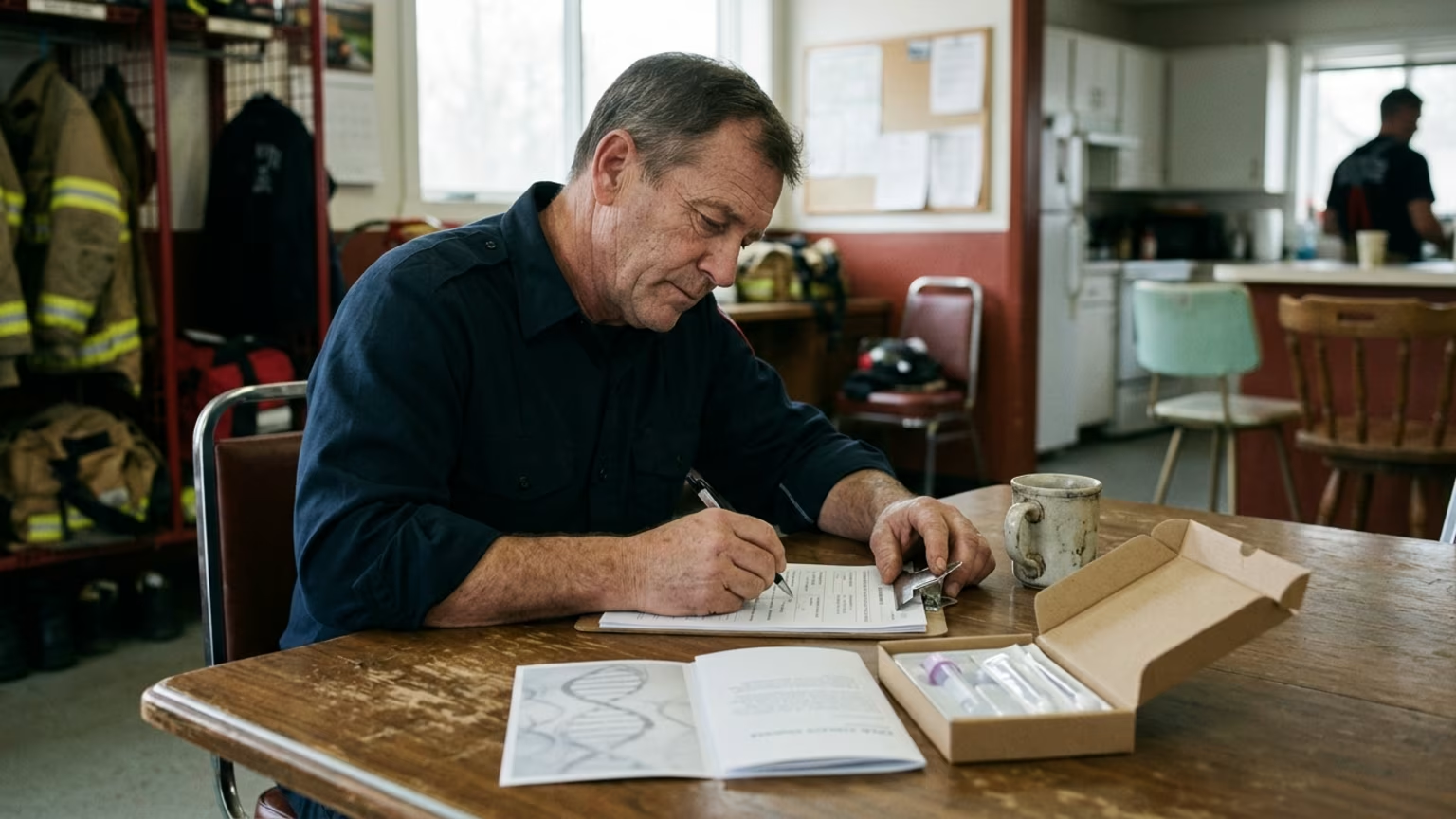

A PTSD genetics study found differences by trauma type. For first responders, the practical focus is accessible support, not genetic readiness labels.





On 2026-09-18, Technology Networks reported that researchers from King’s College London found genetic associations with posttraumatic stress disorder (PTSD) symptoms differed across trauma types. The research was published in the European Journal of Psychotraumatology in 2026.
The paper, Identifying differential interactions of potentially traumatic experiences with genetic risk for posttraumatic stress disorder, examined genetic and mental-health data from 144,702 participants. According to Technology Networks, those participants came from UK Biobank and three National Institute for Health and Care Research studies: GLAD, EDGI UK and COPING.
Researchers assessed PTSD symptoms and asked participants about 11 trauma types. These included five childhood categories and six adult-life categories. Adult-life experiences included serious accidents and serious illness, alongside experiences such as violent crime and witnessing death.
The team examined relationships between genetics and trauma at three levels:
Technology Networks reported that childhood traumas tended to have stronger associations with PTSD symptoms than adult-life traumas. They also tended to show greater interactions with genetic factors. These were average patterns in the analysed data, rather than statements about every person with a childhood trauma history.
The childhood findings contained another distinction. According to the report, childhood abuse had a stronger association with symptoms than childhood neglect. Neglect showed a more moderate association that was more likely to be influenced by genetic factors.
The report also highlighted FAM120A. This gene interacted significantly more strongly with childhood emotional neglect than with the other trauma types examined. That finding gives researchers a specific relationship to investigate alongside the broader patterns across trauma categories.
Taken together, the results suggest that the relationship between genetic risk and PTSD symptoms varies with the type of experience being considered. Treating all trauma categories as interchangeable would miss part of the pattern described in this study.
The evidence has several limits that belong together. The findings describe associations and interactions, not a gene determining an individual’s outcome. Technology Networks notes that both genetic and environmental factors matter and that not everyone exposed to trauma develops PTSD.
The study report does not identify a first-responder sample or provide responder-specific results. Its childhood and adult-life comparisons should not be treated as a ranking of occupational incidents. It also does not establish routine genetic testing or a validated tool for predicting an individual’s PTSD risk.
Newsweek’s account adds a measurement limitation: participants answered relatively simple questions about traumatic experiences. Some accounts involved recollections from many years earlier. Those answers do not provide a detailed record of every experience’s timing and circumstances.
For first responders, the practical translation concerns support around demanding work rather than a new physical training formula. The supplied findings do not support a new fatigue threshold, training volume or recovery interval. Existing discussions about those subjects should remain tied to evidence that directly addresses them.
Rescuris’s editorial interpretation is that mental-health support belongs alongside readiness planning, rather than being treated as a separate concern that appears only after a major incident. A genetics finding should not become a shortcut for deciding who needs support. Nor should a history of strong duty performance substitute for an accessible support pathway.
This distinction matters when physical capability becomes the main language of readiness. A training session can serve a fitness purpose without answering a separate question about someone’s need for mental-health care. Keeping those decisions separate avoids asking a performance measure to carry a meaning this research did not give it.
The same approach applies to fatigue planning around irregular shifts. Sleep planning and physical preparation remain relevant parts of responder health. The useful addition here is a clearer place for support access and continued check-ins within the wider discussion of readiness.
Separate occupational commentary supports that direction. In Psychiatric Times, psychiatrist Katz argued for occupational mental-health programs established before a disaster rather than introduced only afterward. That is an argument about the availability of services, distinct from the genetics study’s findings.
For a department or training lead, a reasonable operational response is therefore to review the connection between daily preparation and available support. The question is whether personnel know how to reach help before circumstances become difficult. It is not whether a genetic result can sort a crew into presumed levels of resilience.
The immediate adjustments supported by this research packet are modest. They concern making support accessible and keeping contact open over time. They do not require turning shift preparation into a clinical assessment or building a new screening system from a news report.
Shift preparation can include a clear route to existing occupational mental-health support. Teams can review where that information lives and whether it is easy to find. Where the pathway is unclear, identifying that gap is a practical preparation task.
This follows the direction of Katz’s argument for services that exist before a disaster. It moves the discussion away from waiting for an incident before considering how personnel would reach support. The adjustment is organisational visibility, not a claim that a particular program prevents PTSD.
The research packet’s defensible responder takeaway is that a serious incident may be a reason to make support accessible and check in over time. In routine practice, that can mean keeping the support conversation available beyond the immediate aftermath. A check-in can focus on whether help is available and wanted.
The purpose is access rather than prediction. It need not become an attempt to reconstruct someone’s childhood or assign them a vulnerability label. For readers considering support after repeated demanding calls, this distinction keeps the focus on current needs rather than presumed risk.
Questions about symptoms or individual care belong with a qualified mental-health professional. A workplace conversation can make that route easier to reach without trying to provide a diagnosis. The practical role of a colleague or supervisor is narrower than the role of a clinician.
That separation also helps keep training discussions focused. Physical preparation can address physical capability while clinical conversations address personal mental-health concerns. Neither needs to become a substitute for the other.
Long-term support belongs in the picture too. PBS reporting on 9/11 survivors and first responders says health consequences can evolve with age. It calls for coordinated mental and cognitive support alongside physical and social support decades later.
This is separate occupational context, but it broadens the planning horizon. Support access should be considered across a career and into life after service. Related coverage of post-incident recovery and peer support sits within that longer view of responder health.
Technology Networks identifies Jacob Knyspel as the study lead and Jonathan Coleman as the senior author. Its report says the findings could inform future work on screening and early support. The next useful development is research that tests how these associations translate into practical decisions.
One question is whether later studies reproduce the differences between trauma categories. Another is whether more detailed accounts of traumatic experiences change the observed patterns. Following those questions would help clarify how much weight to place on the current findings.
For responder audiences, research involving occupational populations deserves particular attention. Such work could examine whether these patterns apply to emergency-service personnel and whether they contribute anything useful to support decisions. Those are questions for future studies, not conclusions to attach to this announcement.
Any proposed screening approach also needs evaluation on its own terms. A statistical association and a useful clinical tool are different achievements. The editorial question is whether a future tool improves access to appropriate support without turning a probability into a fixed label.
For now, the direction is clear enough for a measured response: keep support accessible and allow check-ins to continue over time. Follow the science on trauma-specific genetic associations while keeping daily readiness decisions grounded in the evidence relevant to those decisions. Short-term performance should not become the only measure of how well someone is doing across a demanding career.
Turning a genetics headline into a readiness label puts immediate performance judgments ahead of long-term health, a trade-off Rescuris rejects in its research-led coverage. For emergency-service professionals facing competing advice about stress and fitness, its editorial guidance connects recovery with career longevity while keeping evidence limits visible and respecting irregular work.
Rescuris publishes evidence-aware guidance for firefighters, police officers, paramedics and other first responders on fitness, recovery, sleep, nutrition, stress resilience and long-term capability.






Read practical guidance on first responder fitness, recovery, sleep, nutrition and resilience for demanding work and a long, active career.
read the blog
