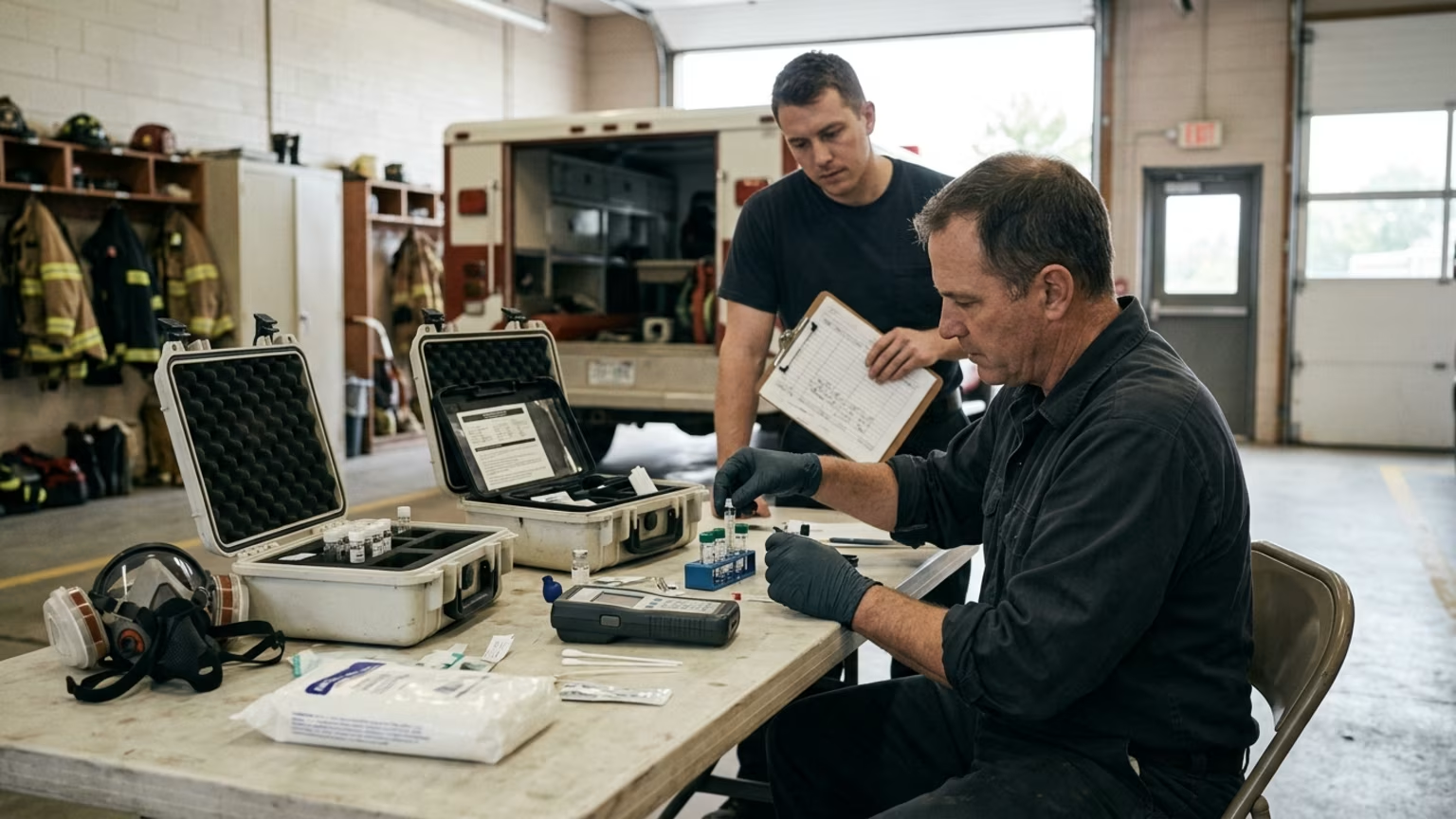

Public Health Wales warns retrospective blood tests cannot reliably establish past chemical exposures, highlighting the need for immediate incident logging.





On September 21, 2026, Public Health Wales formally declined a request to conduct retrospective blood testing for firefighters who attended a 1980 toxic dump blaze. The decision highlights the scientific limitations of investigating occupational chemical exposures decades after an incident occurs. More than 60 firefighters took about 18 hours to extinguish the August 1980 fire at Llwyneinion near Wrexham. A recent documentary titled Buried with Michael Sheen renewed attention on historic chemical dumping in Wales and prompted the new request.
Plaid Cymru Senedd Members Marc Jones and Carrie Harper recently met with veterans of the incident. Following that meeting, Jones wrote to Public Health Wales on their behalf to request polychlorinated biphenyl testing. He asked for screening for all surviving firefighters who attended the massive blaze. Public Health Wales declined the request entirely, according to reports from Nation.Cymru.
The debate over this screening request reveals a common tension in post-career medical care. Retired personnel understandably want clear answers about the hazardous conditions they faced during their active service years. Medical authorities often find that late biological markers cannot provide the specific historical evidence that veterans seek. This gap between patient expectations and clinical reality frequently complicates discussions about long-term duty impact.
Public Health Wales stated that polychlorinated biphenyl blood testing is not recommended as a public-health action. The agency concluded that a retrospective blood test cannot reliably assess an individual’s exposure to contamination. Furthermore, such screening cannot accurately determine a person's potential health impacts decades later. This medical reality directly conflicts with a responder’s understandable wish for definitive answers about past hazardous calls.
Jones argued that testing could help build a picture of these chemicals in local communities. He also suggested it might identify specific chemical types and give firefighters long-sought information. However, Public Health Wales warns that testing could simply cause worry without resolving the exposure source. The agency specifically noted there is no way to treat or manage a particular chemical blood level.
Polychlorinated biphenyls are a group of human-made hazardous chemicals that vary in type, toxicity and health effects. Their production was banned in 2001, but they remain highly persistent in the natural environment today. Because of this persistence, people generally have some level of these compounds retained in their bodies. This unavoidable background presence complicates any effort to link a specific blood result to a single historical event.
Public Health Wales notes that blood results cannot identify how or where an exposure occurred. These chemicals might easily come from everyday food sources like fish, dairy and meat. They can also originate from materials used in homes and other commercial buildings. Science does not currently have a good understanding of how different variations of these chemicals interact inside the human body.
The refusal to test the Llwyneinion veterans highlights a critical vulnerability in occupational health tracking. If a blood test cannot prove where or how an exposure happened, retrospective medical screening is an inadequate strategy. Emergency personnel must document hazards as they occur rather than hoping future science will fill the gaps. Tracking these events accurately is a necessary part of career longevity and physical capability planning.
When responders wait decades for answers, biological markers lose their direct connection to the original incident. Public Health Wales explicitly states that finding retained chemicals in the body does not pinpoint their origin. This makes tracking toxic metals and chemical exposure in wildfire smoke and industrial fires an immediate operational requirement. Immediate logging serves as the primary mechanism for establishing an occupational risk profile over a long career.
By logging shift details and specific environmental conditions immediately, responders build a reliable career timeline. This timeline does not have to rely solely on ambiguous medical tests in the distant future. Accurate reporting also helps departments recognize patterns in protective equipment failures across multiple hazardous calls. Consistent documentation provides a far stronger foundation for long-term health tracking than late-stage biomarker screening ever could.
Modern reporting systems offer better tools for creating these permanent records than paper logs provided in the past. Agencies now encourage personnel to input exposure data directly into centralized occupational health databases after significant incidents. Maintaining detailed records allows medical providers to understand a responder's cumulative risk over time. Without these records, aging veterans face an uphill battle trying to explain their unique health histories to civilian doctors.
The burden of proof in occupational health always rests heavily on the individual responder. Without a clear paper trail, proving that a specific duty assignment caused a long-term health issue becomes nearly impossible. Relying on biological retention rates to tell a story years later simply does not work in a clinical setting. Taking ownership of your exposure history provides the necessary documentation when you eventually leave the service.
Many emergency professionals assume that biological testing will eventually provide definitive proof of an occupational injury. This incident directly challenges the heavy reliance on retrospective biomarkers to answer historical health questions. A responder with health concerns should not treat a late blood result as a reliable medical diagnosis. They also should not view it as an accurate prediction of future illness or physical decline.
The emotional toll of past exposures frequently surfaces long after a career ends. According to the two politicians who met with the veterans, six of the seven firefighters said their wives had miscarriages within a year of the fire. However, the report explicitly notes that no causal link between those miscarriages and the blaze has been established. The lack of a proven link demonstrates how difficult it is to trace specific medical outcomes back to isolated historical events.
The realization that elevated chemical levels offer no actionable treatment path fundamentally shifts how we view post-incident testing. Instead of waiting for a test to validate the danger of a past call, responders must focus on present-day monitoring. Acknowledging these limitations helps align our expectations with actual clinical capabilities available today. Understanding long-term health risks and support for California firefighters and other personnel requires looking beyond single retroactive tests.
This situation also highlights a persistent misunderstanding about how hazardous substances interact with the body over time. Many people view the human body as a rigid historical archive that perfectly preserves evidence of past trauma. In reality, physiological processes constantly alter, dilute and process foreign compounds over decades of life. Expecting a single blood draw to serve as a perfect historical record ignores the complex realities of human biology.
First responders must actively adjust their administrative routines following hazardous calls today. Start logging specific exposures immediately after returning to the station instead of trusting your memory. Record the duration of the incident, the specific materials involved and any known environmental hazards present on the scene. Maintaining these detailed personal logs protects you if department records are misplaced over several decades.
Beyond documentation, managing the stress that comes with unknown exposures requires proactive physical effort. Shift workers should focus heavily on controllable health metrics and daily recovery practices. Consider implementing active post-incident transition strategies to clear residual tension and restore readiness after a difficult call. Focusing on actionable recovery steps provides a tangible way to manage occupational wear without relying on future medical diagnoses.
Consistent communication with a primary care doctor about your occupation is also absolutely essential. While specific chemical blood levels might not be directly treatable, proactive health monitoring remains critical for aging personnel. Discuss your known occupational hazards during regular medical checkups to establish a physical baseline for your overall health. Tracking these baseline metrics over time provides a much clearer picture of your actual physical condition.
It is equally important to manage the psychological burden of hazardous duty realistically. Testing for untreatable chemicals often causes unnecessary worry without providing any clinical resolution for the patient. Responders should prioritize practical load management for first responders tracking calls, shifts, and training stress over seeking retroactive medical validation. A structured approach to daily readiness yields far better results for your long-term career longevity.
The severe limitations of backward-looking medical tests demonstrate the need for forward-looking occupational research. A recent example of this shift is the National Registry of Emergency Medical Technicians launching the LIFE Study. Announced in September 2026, this program is designed to follow firefighters and emergency medical clinicians over time. It represents a significant change in how the entire industry approaches occupational health tracking.
The LIFE Study stands for "Longitudinal Inquiry into Fire and EMS Health" and focuses on gathering concurrent information. By tracking occupational exposures and health outcomes as they happen, longitudinal studies bypass the ambiguity of retrospective testing. Emergency service professionals should closely watch how these prospective registries handle chemical tracking data in the coming years. This proactive methodology offers a stark contrast to investigating single incidents decades after the fact.
Meanwhile, Public Health Wales says it supports addressing historically contaminated land as a public priority. The agency is currently working with partners, including the Welsh Government, to manage this ongoing environmental issue. However, the broader lesson for emergency workers around the world remains entirely clear today. Prospective tracking will likely become the standard for truly understanding the physical cost of first response work.
Relying on contemporaneous exposure records rather than retrospective testing allows emergency personnel to better manage long-term health. Because generic fitness advice that assumes a predictable nine-to-five schedule ignores the physical wear of hazardous incidents, Rescuris delivers practical, evidence-led guidance built around demanding work. We support firefighters, police officers and paramedics who want to maintain physical capability and manage shift-work stress without grind-culture rhetoric.
Rescuris publishes evidence-aware guidance for firefighters, police officers, paramedics and other first responders on fitness, recovery, sleep, nutrition, stress resilience and long-term capability.






Read practical guidance on first responder fitness, recovery, sleep, nutrition and resilience for demanding work and a long, active career.
read the blog
