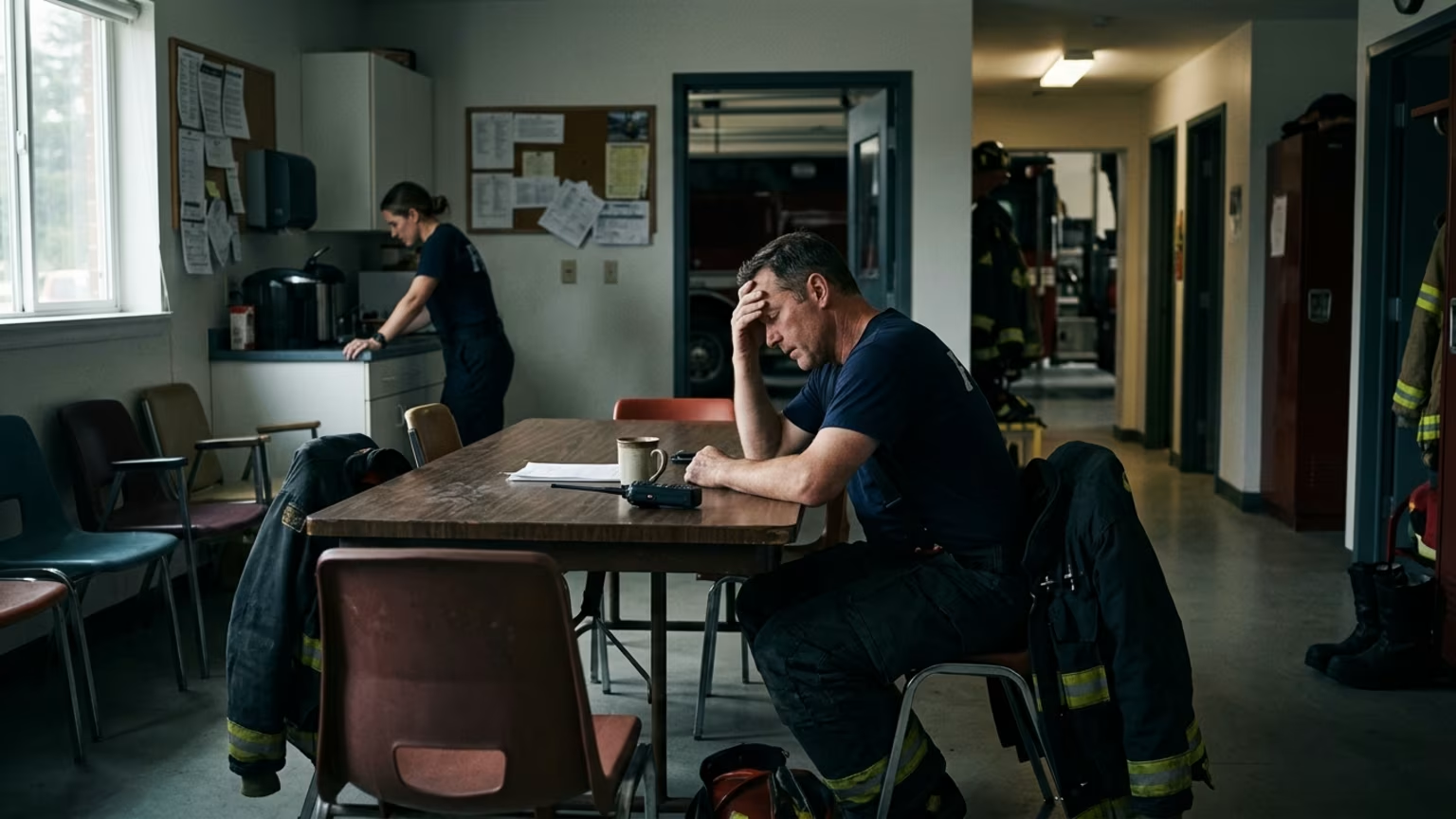

South Placer's fire chief links vacancies to long workweeks and health strain. The staffing debate puts workload and recovery in focus.





CBS Sacramento reported on 2026-10-14 that South Placer Fire District Chief Darin Snedeker linked vacancies to firefighters working an average of 72 or more hours weekly. He said that workload wears on employees' mental and physical health over time.
His account places workforce recovery inside a local funding dispute. Measure B would go before voters in Granite Bay and Loomis on November 3, 2026 to support fire and emergency services. For first responders following the debate, the relevant question extends beyond whether crews can keep covering vacancies. It also concerns the working conditions behind that coverage and the opportunity to recover between demands.
According to CBS Sacramento, Snedeker said the district has struggled to retain firefighters and paramedics. He identified wages and working conditions as contributors to that difficulty.
CBS also reported that two of the district's six fire stations had closed amid staffing shortages and funding challenges. Snedeker warned that a third could close if Measure B fails. That is a conditional warning from the chief rather than an announced closure.
The evidence boundary matters here. The weekly-hours figure comes from Snedeker's account rather than a payroll analysis presented in the reporting. The coverage provides no defined measurement period or breakdown by role. It also includes no medical assessments or employee health survey measuring the reported strain.
The report therefore establishes that district leadership has publicly connected vacancies with extended hours and concerns about employee health. It does not establish diagnosed illness among personnel or isolate working hours from other job conditions. Its value is as an organizational warning that warrants attention rather than a clinical assessment of the workforce.
Measure B proposes a uniform $375 parcel tax to replace existing annual taxes. It requires approval from at least two-thirds of voters.
Separate local reporting describes existing annual charges of $406 in Loomis and $70 in Granite Bay. Replacing those charges with a uniform residential parcel tax would therefore affect the two communities differently. That distribution of costs is part of the dispute rather than a minor detail outside it.
Supporters say the measure could help recruit and retain personnel and reopen stations. Opponents question financial management and tax fairness. CBS Sacramento reported that Jeff Moss, a former district board member and volunteer, urged voters to reject the measure and questioned how district funds are spent.
Those positions should remain distinct from demonstrated results. The reporting does not quantify how approval would affect vacancies or weekly working hours. Funding would provide an input; recruitment and retention would be outcomes to examine separately.
For a wellness discussion, that distinction keeps attention on implementation. A revenue proposal deserves financial scrutiny. Any claim that it will improve working conditions also needs evidence about what changes after resources become available.
A 2026 Firehouse research brief provides occupational context. Its survey analysis of career firefighters and officers reported a positive relationship between mandatory overtime and absenteeism. Mandatory overtime had the strongest positive relationship with absenteeism in that analysis.
The brief also reported higher absenteeism in departments describing chronic staffing shortages than in adequately staffed organizations. It discussed overtime alongside fatigue and recovery concerns.
The available summary does not provide enough detail about the sample or methods for an independent appraisal. Its findings are reported associations rather than proof that overtime causes absence. The distinction between the sources also matters: Firehouse examined mandatory overtime while Snedeker described extended weekly hours.
For agencies, the useful implication is to consider attendance and workload together rather than treating absence only as an individual commitment issue. That is an organizational question, not a judgment about a particular employee.
For personnel, the South Placer account supports taking recurring workload concerns seriously without turning them into a test of toughness. Rescuris's coverage of staffing constraints and recovery opportunities addresses that broader editorial concern. Recovery should remain part of the discussion about how work gets covered rather than an unrelated responsibility added after the schedule is set.
A 2026 systematic review in BMC Public Health reported lower fatigue in 15 of 16 studies evaluating scheduled workplace napping. The authors called for confirmation in randomized trials.
The same review described schedule redesign as a system-level approach. It characterized the empirical evidence around that approach as only moderately rigorous. These findings concern shift workers across sectors rather than an intervention tested in South Placer Fire District.
The practical interpretation is narrower than a universal nap recommendation. The review supports considering organizational scheduling alongside individual recovery measures. It does not identify a particular rotation or rest arrangement for this district.
That distinction keeps a promising recovery measure from becoming an excuse to leave workload unexamined. A discussion focused entirely on personal habits would leave the reported staffing shortage outside its scope. A discussion focused entirely on hiring would leave the immediate recovery question unresolved.
Both belong in the same review. The point is not to choose between organizational responsibility and personal support. It is to examine how each fits the actual work pattern. Readers considering that relationship can also review the broader issue of sleep risks during irregular work.
The approved reporting does not describe South Placer's shift rotations or overtime controls. Agencies considering the story as a prompt for their own review should therefore avoid assuming that they share the same schedule or have the same operational options.
A useful starting point is to bring working-time records and recovery opportunities into the same discussion. The research identifies several reasonable review topics:
These are topics for a workforce review rather than a prescribed measurement protocol. Their purpose is to make the workload discussion more specific than a general statement that crews are busy.
For example, a recruitment goal and a reduction in employees' actual working hours are different things to evaluate. A review can ask whether staffing changes alter the hours being covered and the recovery time available. That keeps the discussion tied to working conditions rather than stopping at an announced initiative.
The same approach avoids using a single weekly-hours figure as a complete description of duty. The relevant review includes how work and recovery are arranged as well as the total time recorded.
For personnel facing recurring fatigue or sleep disruption, the evidence supports raising workload concerns through available channels. Depending on the organization, those may include supervisors or occupational-health services. Union representatives and peer-support channels may also provide a route for raising concerns where available.
The emphasis should be on communicating the recurring work pattern and its effect on recovery rather than treating endurance as the expected answer. General shift-work findings are not a substitute for individualized medical or mental-health care. Personal health concerns belong with qualified professionals who can assess the individual's circumstances.
These conversations serve different purposes. A personal care discussion addresses the employee's needs. An organizational review addresses the conditions under which employees work.
Neither should be presented as a replacement for the other. Offering support does not itself answer a staffing question. Reviewing staffing does not remove the need to take an individual's health concerns seriously.
The unresolved questions extend beyond the ballot result. If additional funding becomes available, what recruitment and retention results follow? Do vacancies decrease in a way that changes the hours existing personnel work? Do employees gain more dependable recovery opportunities?
Those questions separate financial capacity from workforce experience. They also provide a more meaningful basis for evaluating a response than the existence of a new funding source alone.
A further question concerns how employee health and fatigue would be assessed alongside operational changes. Tracking staffing without considering recovery would answer only part of the concern Snedeker raised. Treating a change in hours as automatic proof of better health would go too far in the other direction.
The South Placer account brings a legitimate wellness issue into a contested public decision. The next useful evidence would connect any response to the working conditions employees actually experience. That is where a staffing proposal becomes accountable to the recovery concern behind it.
Extended workweeks put the balance between duty readiness and physical recovery in view, a tension Rescuris addresses without turning exhaustion into a virtue. For responders managing accumulated wear, its evidence-led coverage helps sort conflicting performance advice while treating long-term health as part of staying capable rather than a competing goal.
Rescuris publishes evidence-aware guidance for firefighters, police officers, paramedics and other first responders on fitness, recovery, sleep, nutrition, stress resilience and long-term capability.





Read practical guidance on first responder fitness, recovery, sleep, nutrition and resilience for demanding work and a long, active career.
read the blog
