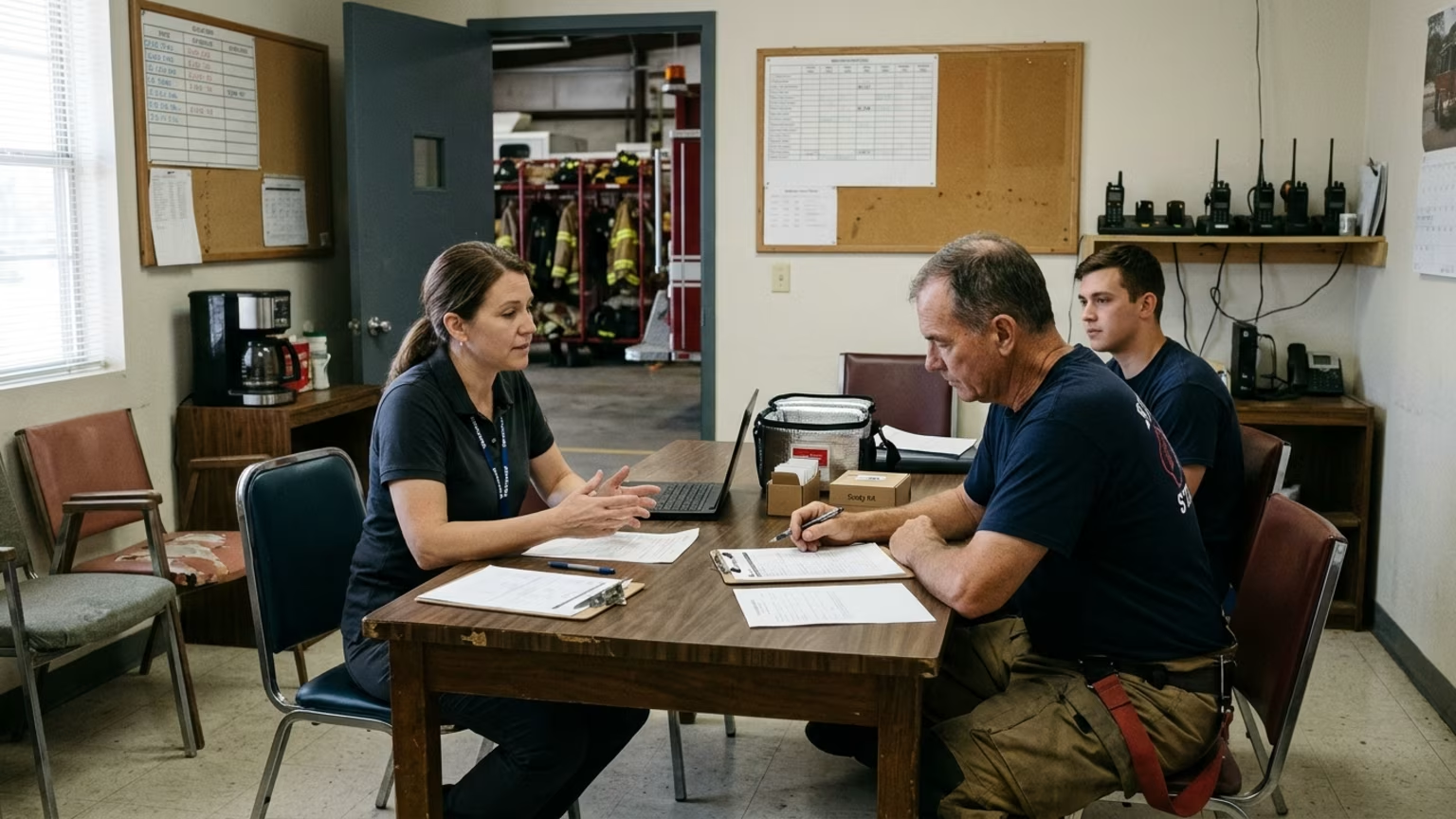

The Texas Firefighter Cancer Study marked a year of research. Read what the update establishes and how to approach its early-detection goals.





In an October 21, 2026 report, UTHealth Houston School of Public Health reported that the Texas Firefighter Cancer Study held its first-anniversary research symposium on October 8. The event marked a year since the state-funded initiative launched and brought firefighters together with researchers and public officials to discuss occupational cancer risk.
The $5 million initiative is led by Jooyeon Hwang, PhD, an associate professor at UTHealth Houston School of Public Health. Its stated aims are to better understand cancer risks among firefighters and advance prevention and early-detection strategies.
According to UTHealth Houston, the project includes specimen collection and exposure measurement. Researchers said they would continue working with firefighters and their communities in the study's second year. These activities describe the work underway and the questions the initiative is pursuing.
The university described a collaboration involving state and municipal organizations alongside academic partners. Fire-service and labor organizations were also involved. It listed more than 13 fire departments and local associations across Texas.
The symposium brought together firefighters from across the state with fire-service leaders and state representatives. Researchers, community advocates and study supporters also took part. The account described an exchange of findings and testimony alongside perspectives on occupational risk.
UTHealth Houston said the symposium highlighted published research but did not identify the papers or their specific conclusions. The anniversary account also omitted sample size and detailed methods. It provided no quantitative cancer-incidence estimates, reported exposure measurements, comparison groups or screening-performance data. Without those details, the announcement does not establish a new risk estimate or a screening guideline.
The $5 million figure describes the initiative's funding, not a measured health benefit. The prevention and early-detection aims describe what the researchers hope to advance. Reading those categories separately keeps the milestone meaningful without assigning it results that the announcement did not demonstrate.
Hwang described firefighters as routinely exposed to cancer-causing chemicals during fires and said effects may emerge after the fire has ended. That was her explanation of the occupational context, not a finding reported from the Texas study.
That time horizon matters to how the announcement is read. A wellness discussion focused only on today's physical output would miss the longer-term question the project is intended to address. Occupational cancer research belongs in a conversation about health across a career rather than only readiness for the next shift.
This does not put physical capability and long-term health in competition. Questions about conditioning that reflects duty demands can sit alongside questions about prevention and screening. They serve different parts of the same aim: remaining capable without treating health after service as a separate concern.
UTHealth Houston president Melina R. Kibbe described the project as bringing science and firsthand experience together to understand and reduce risks. That pairing helps explain the symposium's purpose: a place for occupational experience and research to inform the discussion.
For a department wellness discussion, the useful translation is to give long-term occupational health its own place alongside fitness and recovery. The editorial priority is not to turn every research update into another task for a responder to complete. It is to ask which health questions deserve sustained attention.
Retirement also belongs in that frame. The concern in a career-longevity discussion is not only whether a firefighter remains ready to work today. It is how prevention and health decisions fit into a life that extends beyond service. That is why a research update can matter without changing a workout.
UTHealth Houston reported that firefighter cancer survivor Joe Schumacher described three separate cancer diagnoses, all detected at Stage 1. He encouraged firefighters to pursue available screenings and follow their physicians' recommendations.
His experience gives the discussion a personal dimension. It is testimony from one firefighter, not evidence that a particular screening approach works for firefighters generally or that every cancer will be found early. Keeping that distinction intact respects his account without asking it to settle a broader clinical question.
The practical message conveyed through his account is to use available screening opportunities within physician guidance. For an individual firefighter, deciding which tests are appropriate belongs in a conversation with a qualified clinician. The symposium story is a reason to have that conversation, not a personal screening plan.
Early detection is one of the Texas project's stated goals. A test promoted around early detection is a separate subject that needs its own supporting evidence. Shared language does not make a product part of the study or turn the symposium into an endorsement.
In its September 23, 2026 report, Fire and Safety Journal Americas said the International Association of Fire Fighters cautioned firefighters about multi-cancer detection tests. The report said none was FDA-approved for cancer screening and conveyed the warning that these tests should not replace established screening or medical advice.
The distinction is between supporting research into early detection and endorsing a particular way of testing. A firefighter can take the research seriously without treating every offer of additional testing as the next required step. Personal decisions still belong with qualified care.
Researchers said they planned to continue working with firefighters and their communities in the study's second year. That verified follow-up provides a direction to watch. The useful question for each update is what it adds to understanding occupational risk or to evaluating prevention and early detection.
Several questions can guide that reading:
Readers considering other firefighter health-screening research can use these questions as well. They separate the purpose of a project from the decisions its evidence supports. The point is not to demand that every progress report settle every clinical question. It is to identify what evidence would move the discussion forward.
The long-term question is whether this work will produce evidence that changes prevention or screening decisions in a way that benefits firefighters. Answering that question will matter more than the anniversary itself.
An anniversary in cancer research can be mistaken for permission to choose a new test, a shortcut Rescuris avoids by separating research goals from demonstrated findings. Its research-led coverage helps emergency-service professionals assess conflicting health advice with career longevity in view rather than letting short-term readiness define every decision.
Rescuris publishes evidence-aware guidance for firefighters, police officers, paramedics and other first responders on fitness, recovery, sleep, nutrition, stress resilience and long-term capability.





Read practical guidance on first responder fitness, recovery, sleep, nutrition and resilience for demanding work and a long, active career.
read the blog
