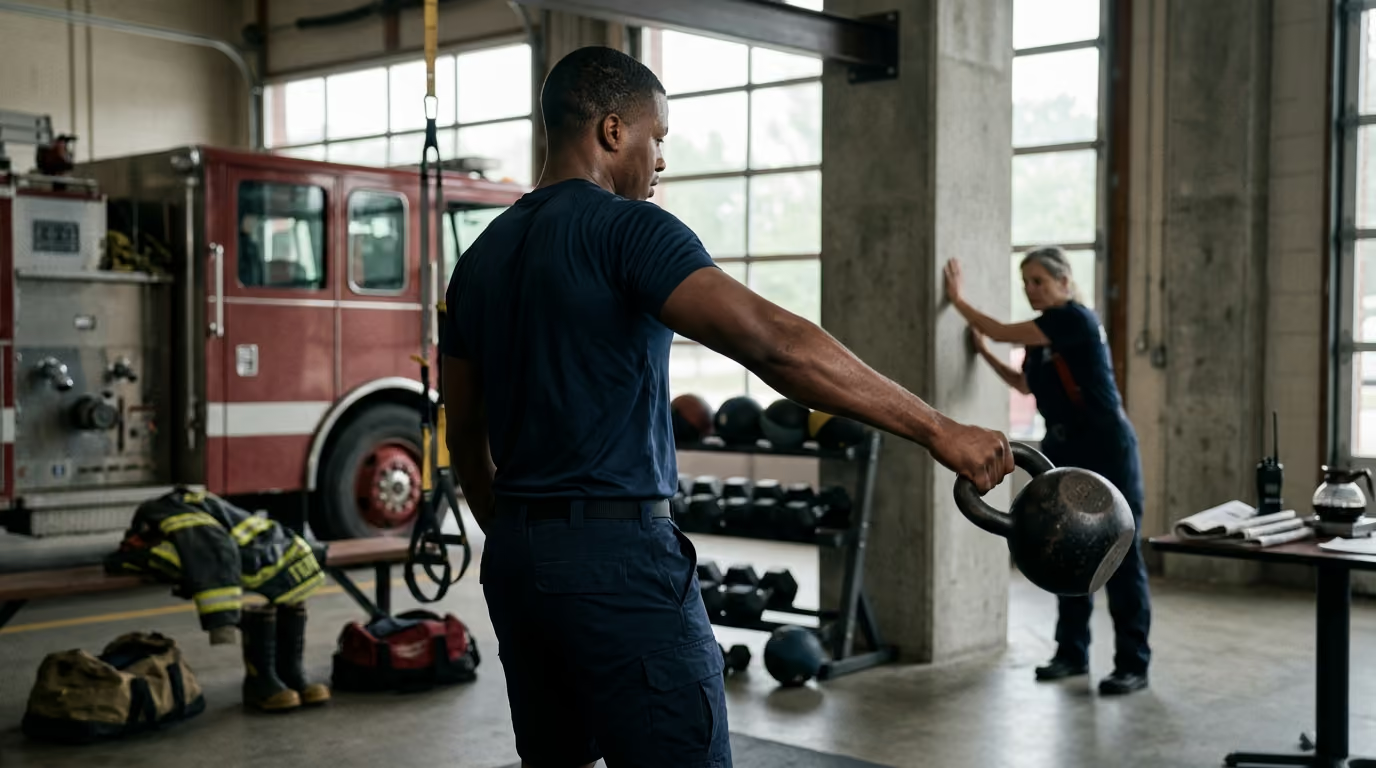

Fully equipped gyms are not necessary for operational readiness when first responders master key functional movement patterns tailored to emergency field demands.





Most physical training advice assumes access to a commercial facility, consistent ninety-minute workout blocks, and predictable rest cycles. First responders rarely experience any of these conditions. When emergency calls interrupt station workouts, gear bags crowd the apparatus bay, or remote deployments limit resources, complex barbell setups and fixed machines become impossible to use.
Minimal equipment training is not a temporary compromise or a watered-down backup plan. When programmed with intention, compact tools like kettlebells, dumbbells, sandbags, bands, stairs, and bodyweight build superior occupational capability. Emergency tasks require moving awkward, asymmetrical loads across uneven terrain under high cardiovascular strain. By focusing on foundational human movement patterns instead of specialized machinery, you can build duty-ready strength, endurance, and power in any station, bay, or living quarters.
This guide provides an evidence-based manual for building physical capability with limited tools and unpredictable schedules. You will learn how to match minimal equipment to occupational demands, autoregulate your effort around shift fatigue, and apply field-tested training templates that protect your career longevity.
Physical readiness for emergency service relies on multiple physiological systems working together under acute stress. Research on tactical athletes and emergency responders consistently shows that performance depends on movement quality, force transfer, and aerobic capacity rather than isolated muscle size.
The World Health Organization physical activity guidelines establish a baseline for adult health of 150 to 300 minutes of moderate aerobic activity, or 75 to 150 minutes of vigorous activity each week, alongside resistance training on two or more days. For emergency personnel, these baselines represent general health preservation rather than complete operational readiness. Firefighters, law enforcement officers, and paramedics routinely operate at elevated heart rates while carrying external loads exceeding fifty pounds.
Research examining occupational fitness indicators shows that specific physical attributes correlate directly with duty performance. A review of firefighter physical capabilities noted that grip strength serves as a reliable predictor of hose drag performance, while lower body force production strongly influences loaded stair-climb efficiency. When personnel lack lower-body strength or upper-body grip endurance, simulated fireground tasks take significantly longer and place higher demand on the cardiovascular system.
Aerobic capacity also plays a documented role in occupational safety. In firefighter cohort studies, individuals with an aerobic capacity below 43 milliliters per kilogram per minute demonstrated 2.2 times the injury risk of peers with capacities above 48 milliliters per kilogram per minute. Systematic reviews evaluating fitness test scores caution that no single physical metric guarantees total protection against injury on duty. However, maintaining high baseline cardiovascular efficiency helps clear metabolic byproducts faster and improves recovery between repeated emergency calls.
Resistance training literature from the American College of Sports Medicine demonstrates that strength and hypertrophy adaptations occur across varied loading ranges. Novice and intermediate trainees achieve reliable strength gains using loads corresponding to an 8 to 12 repetition range trained two to three times per week. When a trainee can complete one or two repetitions past the designated target with solid form, increasing the resistance by 2 to 10 percent provides continuous adaptation. Power development requires moving lighter loads, typically 0 to 60 percent of maximum for lower body and 30 to 60 percent for upper body, at high contraction velocities with adequate rest.
These principles do not require a dedicated strength facility. A sandbag, a pair of kettlebells, or a flight of stairs can deliver the required force velocity, metabolic conditioning, and structural loading when structured correctly.
Generic gym routines isolate muscles across fixed planes of motion. Occupational emergency tasks require multi-joint stability, awkward posture tolerance, and rapid force distribution through the trunk.
Structural firefighting combines intense cardiovascular load with severe external resistance. Primary physical tasks include:
These tasks demand high anaerobic capacity, grip endurance, and rotational trunk stability. Firefighters must frequently transition between high-output pulling, crawling, and loaded climbing without structured recovery windows.
Police patrol, tactical response, and corrections duties present a different physical profile characterized by sudden transitions. Officers spend prolonged periods seated in vehicles or walking low-intensity patrols before encountering instantaneous physical conflict. Key requirements include:
Specialist tactical teams face additional upper-body endurance requirements to maintain weapon discipline, handle heavy shields, and complete rapid breaching operations. Unilateral strength and ground-to-standing agility are essential for officer safety.
Paramedics, emergency medical technicians, and wilderness search teams experience heavy biomechanical strain from manual handling. Common tasks include:
The challenge in EMS is often not the absolute weight of an object, but its awkward geometry and shifting center of mass. Developing positional strength, hip hinge integrity, and unilateral leg control directly mitigates the lower back and shoulder strains common in emergency medical care.
Rather than categorizing workouts by body parts, minimal equipment programming must organize around functional movement patterns. This pattern-based method allows you to substitute implements based on what is available at your station, vehicle, or home.
Squatting develops bilateral and unilateral knee-dominant strength needed for lifting equipment, rising from low positions, and carrying loads.
The hip hinge builds the posterior chain, strengthening the hamstrings, glutes, and spinal erectors while teaching safe lifting mechanics.
Pushing develops upper-body pressing force in both horizontal and vertical planes.
Pulling builds back, rear shoulder, and grip strength necessary to counterbalance forward-slumped driving postures and stabilize heavy gear.
Loaded carries build whole-body structural integrity, dynamic trunk stability, and work capacity under tension.
Locomotion involves moving the body efficiently through space across various cadences and resistances.
Ground transfers develop the mobility and force required to rise quickly from the floor while wearing equipment.
Power training trains the nervous system to recruit motor units rapidly.
Trunk training should emphasize resisting unwanted spinal movement rather than high-repetition spinal bending.
Every training tool offers distinct mechanical advantages. Understanding these properties helps you select the right implement for your space, budget, and physical goals.
Kettlebells feature a displaced center of mass that hangs below the handle. This design makes them exceptional for ballistic hip movements and offset loading.
Dumbbells provide symmetrical balance and allow incremental micro-loading. They are ideal for addressing side-to-side muscular imbalances.
Sandbags represent the most occupationally specific tool available for emergency responders. The filler material shifts continuously, demanding constant stabilization from the grip, arms, and core.
Heavy-duty looped resistance bands provide lightweight, quiet, and highly portable resistance that requires zero floor footprint.
Your own body mass combined with environmental fixtures provides sufficient stimulus for building relative strength and muscular endurance.
Stairwells provide an outstanding vertical conditioning tool that directly mimics high-rise response demands.
When standard weights are missing, tools like filled water jugs, loaded backpacks, toolboxes, or hose bundles can serve as functional resistance.
The following templates translate these principles into practical, repeatable routines. You can scale each workout up or down depending on shift tempo, call volume, and available space.
This density-based micro-session maintains physical readiness when call volume is high or time is scarce. It emphasizes movement quality across fundamental patterns without inducing deep fatigue. For those balancing high shift loads, balancing structured physical training and short readiness sessions helps maintain output without causing burnout.
Perform 2 to 3 continuous rounds with controlled form:
Rest for 60 seconds between complete rounds. Stop immediately if an emergency tones drop.
This routine delivers a balanced combination of muscular strength, stability, and work capacity. It requires only a single kettlebell or dumbbell and a resistance band.
Warm-up (3 minutes): Complete 10 arm circles, 10 hip hinges, 10 bodyweight squats, and 5 inchworms.
Perform 4 total rounds of the following circuit, resting 45 to 60 seconds after completing each full sequence:
Focus on maintaining steady breathing through your nose during the strength movements.
This conditioning session trains the specific movement sequences, pulling forces, and metabolic tolerance required for structural firefighting.
Perform 3 to 4 rounds with 90 seconds of structured rest between rounds:
Scale the resistance to keep movement crisp. If your technique degrades significantly during round three, reduce the load or conclude the session.
Designed for patrol and tactical personnel, this session prioritizes unilateral stability, anti-rotational trunk strength, and rapid ground transitions.
Perform 3 to 4 sets, resting 60 seconds between complexes:
Maintain total core tension during the renegade rows and offset carries to prevent hip rotation.
This weekly structure provides a balanced stimulus while leaving ample physiological reserves for shift work. Integrating training around shift work ensures adequate recovery across varied tour schedules.
Day 1: Strength and Power Focus
Day 2: Aerobic Base and Structural Mobility
Day 3: Occupational Work Capacity and Grip
Days 4 through 7: Active recovery, light movement, and scheduled duty shifts. When schedules shift rapidly, applying reliable sleep strategies across demanding tours ensures that physical gains are not lost to exhaustion.
Emergency responders encounter erratic sleep patterns, extreme thermal stress, and unpredictable physical workloads. A rigid training program that dictates fixed sets, reps, and weights regardless of current fatigue is inappropriate and potentially dangerous.
Autoregulation is a structured method of adjusting your daily training intensity and volume based on your real-time physiological and psychological readiness. Learning to practice daily readiness and autoregulation strategies keeps you capable on shift without accumulating dangerous fatigue debt.
Use a simple three-tier assessment before picking up a weight:
A common misconception in emergency service fitness culture is that a workout is only effective if it leaves the responder collapsed on the bay floor. True occupational fitness represents the ability to do hard physical work and still have capacity left to handle an emergency call ten minutes later.
Lactic acid accumulation and extreme breathlessness are easy to produce, but constantly training to failure exhausts the central nervous system, elevates cortisol, and degrades connective tissues. Use conditioning circuits to build work capacity, not to test mental toughness. Keep high-intensity intervals controlled and prioritize full biomechanical recovery between explosive efforts.
Training in station bays, dorms, and emergency environments introduces unique hazards that do not exist in commercial gyms. Establishing firm safety boundaries protects you, your crew, and your equipment.
First responders face high occupational heat exposure from structural fires, wildland deployments, and heavy protective gear. Combining extreme training in unventilated areas with heat from calls can lead to rapid heat illness.
Working through rotating shifts and extended overtime causes chronic circadian disruption. Managing this cumulative shift fatigue requires realistic adjustments to your daily physical loading.
While minimal equipment training accommodates many physical constraints, self-directed fitness programs cannot address underlying medical pathology or acute musculoskeletal injuries.
You must stop training and seek immediate clinical evaluation from a qualified healthcare professional if you experience:
For chronic pain, past joint surgeries, or structural limitations, work with a licensed physical therapist or an occupational strength specialist. These professionals can identify specific movement compensations, provide safe individual exercise modifications, and design structured rehabilitation progressions that support a safe return to unrestricted operational duty.
Consistent, progressive training with basic tools protects your health, preserves your operational capability, and builds the physical durability required for a long and productive career in emergency service.
Stay connected for research-led guidance on duty fitness, shift-work sleep, injury recovery, stress, nutrition and career longevity. Practical ideas for first responders who want to stay capable on the job, recover well and protect their health for the long run.



Read practical guidance on first responder fitness, recovery, sleep, nutrition and resilience for demanding work and a long, active career.
read the blog



