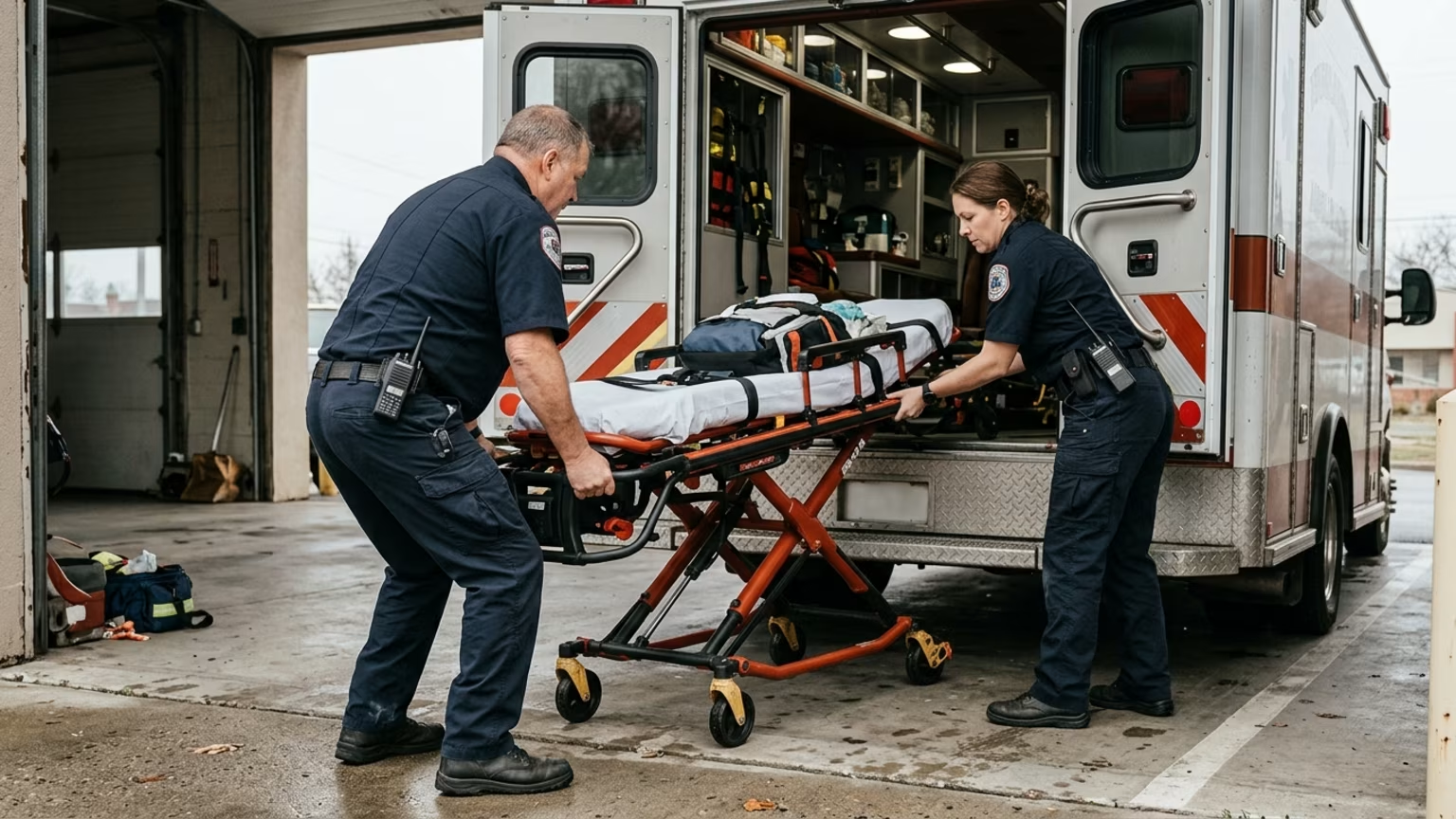

Task-specific guidance on patient transfers, fire-service loads and police equipment, with clear evidence limits around back strain and long-term health.





How can first responders reduce avoidable back strain on the job? The evidence supports task-specific planning, coordinated patient movement and appropriate equipment rather than relying on one ideal lifting posture.
The Canadian Centre for Occupational Health and Safety (CCOHS) describes patient-handling injuries as arising from cumulative physical effort or an incident during a transfer. Its patient-handling guidance also warns that a planned transfer can suddenly become a lift. That makes the patient's participation and the team's preparation part of the physical demand, not details separate from it.
The injury data support looking beyond a single movement cue. A secondary summary of NIOSH data reports that sprains and strains were the most common diagnosis among emergency-department-treated EMS work injuries from 2016 through 2020. In 2017, lifting accounted for about 40% of overexertion injuries. Those categories describe different parts of the problem: the diagnosis and the activity associated with injury.
The EMS findings are sample-based estimates with wide confidence intervals and are not back-injury figures alone. The fire-service evidence describes demands rather than measured prevention effects. The police finding comes through a vendor summary and does not establish that prolonged vehicle sitting causes spinal degeneration. Together, these sources support a work-system approach rather than a promise that one posture or equipment change prevents every injury.
Start by identifying what the task actually requires. Patient movement calls for assessment and coordination, while fire-service work involves distinct combinations of carried gear and physical effort. Police equipment questions also deserve a policy review rather than an automatic instruction to change lifting form.
CCOHS distinguishes a transfer from a lift by the patient's ability to bear weight. In its guidance, a transfer involves someone who can bear weight on at least one leg. A lift involves someone who cannot, and CCOHS says lifts should involve mechanical lifting devices.
Its recommendations can be organised into a practical preparation sequence:
This is more complete than telling a responder to “lift with your legs.” It addresses who is participating and what equipment is available. It also makes the destination and team timing explicit instead of treating the movement as an individual strength test.
An IntechOpen chapter describes firefighters carrying more than 20 kg of gear. It also identifies steep-slope climbing and repetitive hand-tool use alongside sustained aerobic and anaerobic effort. Back overuse appears among the possible hazards it discusses.
For task review, those demands should remain distinct. Carrying equipment is not the same exposure as repeatedly working a hand tool, even when both occur during the same operation. A useful discussion identifies what is being carried and what terrain must be crossed. It then considers the tool work and sustained effort involved.
This framing gives equipment and operational planning a place beside movement technique. Rescuris's guide to reviewing physical workload across an operation is a related resource for keeping the whole task in view rather than reducing it to one lift.
Olight's vendor summary of a NIOSH evaluation reports communication gaps between officers and management about required versus optional equipment. According to that account, investigators recommended clearer equipment policies and examples of configurations.
The practical question is therefore not simply whether an officer should carry less. It is whether the organisation has clearly defined what must be carried and what is optional. A review of carried weight should resolve that uncertainty through equipment policy, not through an individual decision to omit required items.
For police vehicle concerns, this evidence supports equipment-policy questions rather than a specific seat-adjustment protocol. Keep the review tied to what is required and how that requirement is communicated. Do not turn a limited equipment finding into a diagnosis of the spine.
Because CCOHS recommends assessing the patient before each transfer and warns that a transfer can unexpectedly become a lift. A shift-start discussion does not replace that task-specific assessment.
There are two timing decisions in its guidance. The first is when to reassess the patient and prepare the movement. The second is when the patient and coworkers begin together. These are different checks: a prepared route does not establish that everyone is ready to move.
Communication also continues during the transfer. The practical focus is not a rigid countdown formula but an agreed start and ongoing coordination. If the patient's participation changes, the original classification of the movement needs reassessment rather than an assumption that the initial plan still fits.
For irregular shifts, the useful principle is to attach the check to the task. Patient assessment belongs before each transfer, while coordination belongs both before and during movement. That keeps the process tied to the work being performed rather than to a particular hour on the roster.
Begin with the function the equipment must serve. CCOHS specifies mechanical lifting devices for patient lifts and recommends inspecting lifting equipment and accessories. This places equipment selection within the handling plan rather than treating equipment as a substitute for planning.
Three separate questions help organise an equipment review:
The fire-service chapter also reports uneven implementation of ergonomic improvements across agencies and regions. That makes availability part of the discussion. A general reference to lighter tools is not a specification for a particular purchase or a reason to disregard operational requirements.
For a closer look at this topic, Rescuris's resource on equipment fit and load distribution provides a related editorial starting point. Keep the central question specific: which part of the task is the equipment intended to address?
The retirement-health relevance is the goal of maintaining capability beyond service, not a demonstrated long-term result from these sources. They do not measure retirement outcomes, so they support workplace planning rather than a claim of proven lifelong protection.
CCOHS's recognition of cumulative effort gives career planning a broader frame than whether one transfer was completed successfully. The editorial implication is to consider recurring work demands alongside immediate incidents. That keeps the conversation focused on how work is organised across a career rather than judging success only by task completion.
For first responders balancing strength and endurance with mobility and body composition, occupational planning belongs in that discussion. It should not be replaced by pressure to become strong enough to absorb every demand. Equipment readiness and coordinated movement remain relevant questions regardless of how fitness is organised.
Personal decisions about persistent symptoms or fitness for duty belong with qualified care. A task guide can help describe the work involved, but it is not an individual clinical assessment.
The next topic to examine is how operational workload and training are considered together. Rescuris's guide to tracking calls, shifts and training stress is a useful follow-on. Read it with this question in mind: does the workload discussion capture patient movement and carried equipment as well as formal exercise? That keeps the focus on the work actually performed.
Treating every back-load problem as a lifting-form problem overlooks task setup, a gap Rescuris addresses through research-led performance and recovery coverage. For responders balancing strength with endurance and mobility, its reporting places body composition and career longevity in the same discussion while respecting irregular schedules and the need for recovery.
Rescuris publishes evidence-aware guidance for firefighters, police officers, paramedics and other first responders on fitness, recovery, sleep, nutrition, stress resilience and long-term capability.


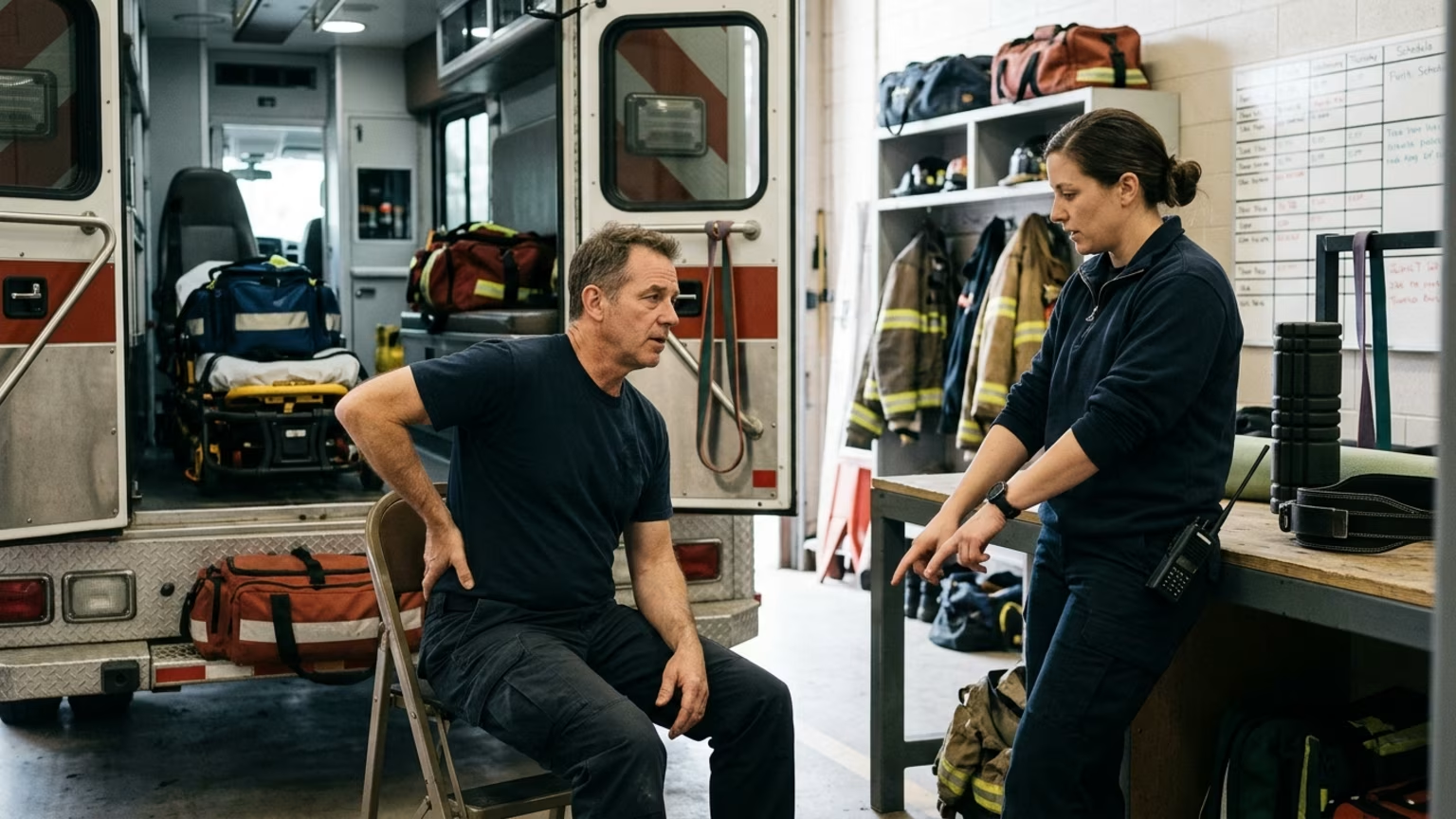



Read practical guidance on first responder fitness, recovery, sleep, nutrition and resilience for demanding work and a long, active career.
read the blog
