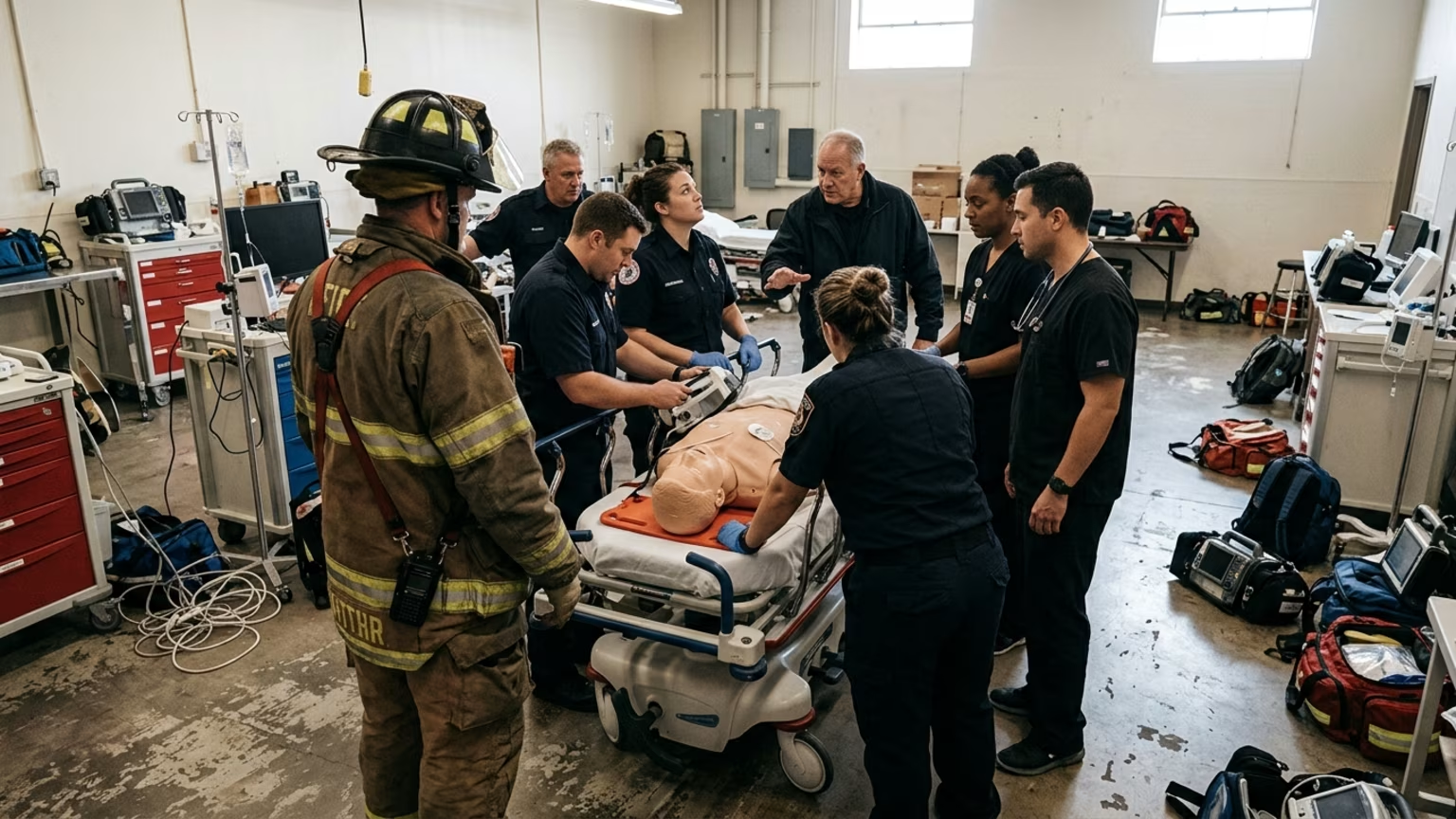

Frimley Health's Code Red includes stress skills and psychological safety in trauma simulation. Here's how to assess the design and its evidence.





In its report dated 2026-10-20, Frimley Health NHS Foundation Trust described Code Red as a multidisciplinary major-trauma simulation programme that includes stress management and psychological safety alongside clinical practice. The trust says it brings doctors and nurses together with paramedics, pre-hospital clinicians, police and other emergency responders.
The announcement is relevant to responder wellness because managing pressure is part of the training design rather than a separate topic. Participants practise structured communication and controlled breathing. They also reflect on how they felt and worked together during a scenario.
According to the trust, the programme grew from complex trauma cases at Wexham Park Hospital. Its account places a key recognition in 2022: Emergency Medicine Consultant Dr Anna Galley identified the importance of teamwork when a patient was too unstable to transfer to a major trauma centre. That origin puts coordination across professional boundaries at the centre of the programme's rationale.
Frimley Health describes training that combines realistic scenarios with advanced simulation technology, life-like mannequins and cadaveric training. Participants practise under pressure in what the trust calls a “safe learning environment.” Its stated human-factors content includes communication and leadership, teamwork and decision-making, plus stress management and psychological safety.
Those details establish the programme's design. They show that its organisers have deliberately included how people communicate and respond to pressure alongside clinical tasks.
The trust also reports growth from 80 participants in its first year to more than 160 attendees over two days in 2026. Separately, it says its wider simulation service supports around 5,000 staff each year and accounts for approximately 28,000 hours of simulation-based learning. Those service-wide figures do not describe Code Red alone.
Attendance documents participation, not effectiveness. The report provides no completed evaluation showing improvements in patient outcomes or workforce wellbeing. Its practitioners' accounts explain why the programme was developed, but they are not independent evidence that its aims have been achieved.
For readers assessing the announcement, the useful distinction is between several different questions:
The report gives concrete information about the first two. Keeping those questions separate allows the programme's design to receive attention without turning a description of training into a claim about health or clinical outcomes.
Dr Anna Galley describes the challenge of bringing large multidisciplinary teams together under pressure. Some participants may not have worked together before. Co-founder Vasant Mohandas describes trauma as “a team sport” and points to communication, collaboration and joint decision-making.
That rationale connects responder wellness with the way a team operates. Code Red does not frame stress management solely as something an individual must handle privately. Its exercises also address leadership and the ability to raise concerns regardless of seniority.
For first responders, this creates a useful way to assess training: does the programme rehearse only the task, or does it also rehearse how people work together while completing it? In Code Red's reported design, both receive explicit attention.
The distinction matters when discussing psychological safety. A responder's ability to regulate their own reaction is a different issue from whether they can question a decision or flag a concern. Code Red names both stress-management practice and speaking up across hierarchy as training content.
Rescuris's wider coverage of speaking up as a workplace issue provides a related editorial perspective. The point is to keep individual skills and team conditions in the same discussion rather than treating one as a substitute for the other.
For readers working nights or unpredictable schedules, the broader decision also includes how training fits alongside duty demands. Rescuris approaches that question through considering training stress together with work demands. The editorial priority is capability over a working life, not simply a strong performance during the next exercise.
Code Red offers a specific example of what a programme can put on its training agenda. Its reported components support practical questions about similar courses without creating a new breathing routine or departmental protocol.
Frimley Health says participants practise structured communication and leadership skills. It also describes ways to raise concerns safely regardless of seniority.
When considering similar training, a useful question is whether communication is something participants actually rehearse or merely a topic mentioned in the course description. Another is whether that practice involves the professional groups expected to work together.
Code Red's multidisciplinary format makes these questions concrete. Its stated purpose includes bringing different responders and clinical staff into shared scenarios. The relevant feature is not simply the number of professions represented, but the opportunity to practise coordination between them.
For a training discussion, that keeps attention on the interaction: who communicates, how decisions are shared and whether concerns can be voiced. These questions follow directly from the programme's stated content rather than assuming a particular communication system has been tested.
The trust identifies controlled breathing as one skill participants practise. It places that exercise beside structured communication and leadership rather than presenting it as the whole response to pressure.
A practical assessment should retain that context. The useful question is how the exercise fits within the scenario and the wider team practice. A technique's inclusion in a course is a description of content, not a reason to attach additional medical claims to it.
The report does not specify a breathing pattern or timing sequence. It therefore provides no basis for turning this announcement into an individual breathing prescription. The supported takeaway is narrower: Code Red gives participants a setting in which to rehearse a named stress-management skill alongside their other responsibilities.
Consultant Clinical Psychologists Dr Zoe Chevalier and Dr Jane Birrell help participants reflect on the scenario. According to Frimley Health, that includes what happened and how participants felt, communicated and worked together.
This makes the reflection broader than a review of procedural completion. It explicitly includes the participants' experience and the team's interaction.
The setting needs to stay clear. This is reflection within a planned simulation exercise. It is not an evaluation of routine mandatory psychological debriefing after real traumatic events and should not be presented as support for that separate practice.
For readers comparing programmes, useful questions include what the reflection covers and who guides it. Another is how discussion of feelings connects with the review of communication and teamwork. Code Red's report names both the psychological input and the subjects of reflection.
These are programme-assessment questions rather than instructions for managing an individual's distress. Personal mental-health decisions belong with qualified care rather than being inferred from a training announcement.
Frimley Health says it is researching confidence, cognitive workload and team performance to better understand simulation's impact on patient safety and workforce wellbeing. Those areas give readers a concrete set of questions to follow as evaluation develops.
Confidence concerns how participants judge their readiness. Cognitive workload concerns the demands of the exercise. Team performance concerns what participants do together. For this programme, the meaningful follow-up is how those different measures relate to one another rather than treating them as interchangeable signs of success.
The trust also describes planned in-situ simulations in Emergency Departments. These would test systems and processes alongside teamwork in teams' own clinical environments. That is a relevant next step because it brings the stated focus beyond an exercise's individual participants to the setting in which the team works.
Questions worth following include:
For first responders and training leaders, judging simulation against operational readiness remains the central issue. Code Red supplies a reported example of putting communication and stress skills into multidisciplinary practice. Its continuing evaluation will need to address the separate question of what that practice changes for teams and the people within them.
Choosing trauma training involves deciding whether communication and stress skills receive space alongside procedures; Rescuris brings research-led editorial context to that choice. For responders sorting through advice focused on immediate performance, its coverage connects stress resilience with recovery and career longevity so long-term health remains part of the decision.
Rescuris publishes evidence-aware guidance for firefighters, police officers, paramedics and other first responders on fitness, recovery, sleep, nutrition, stress resilience and long-term capability.





Read practical guidance on first responder fitness, recovery, sleep, nutrition and resilience for demanding work and a long, active career.
read the blog
