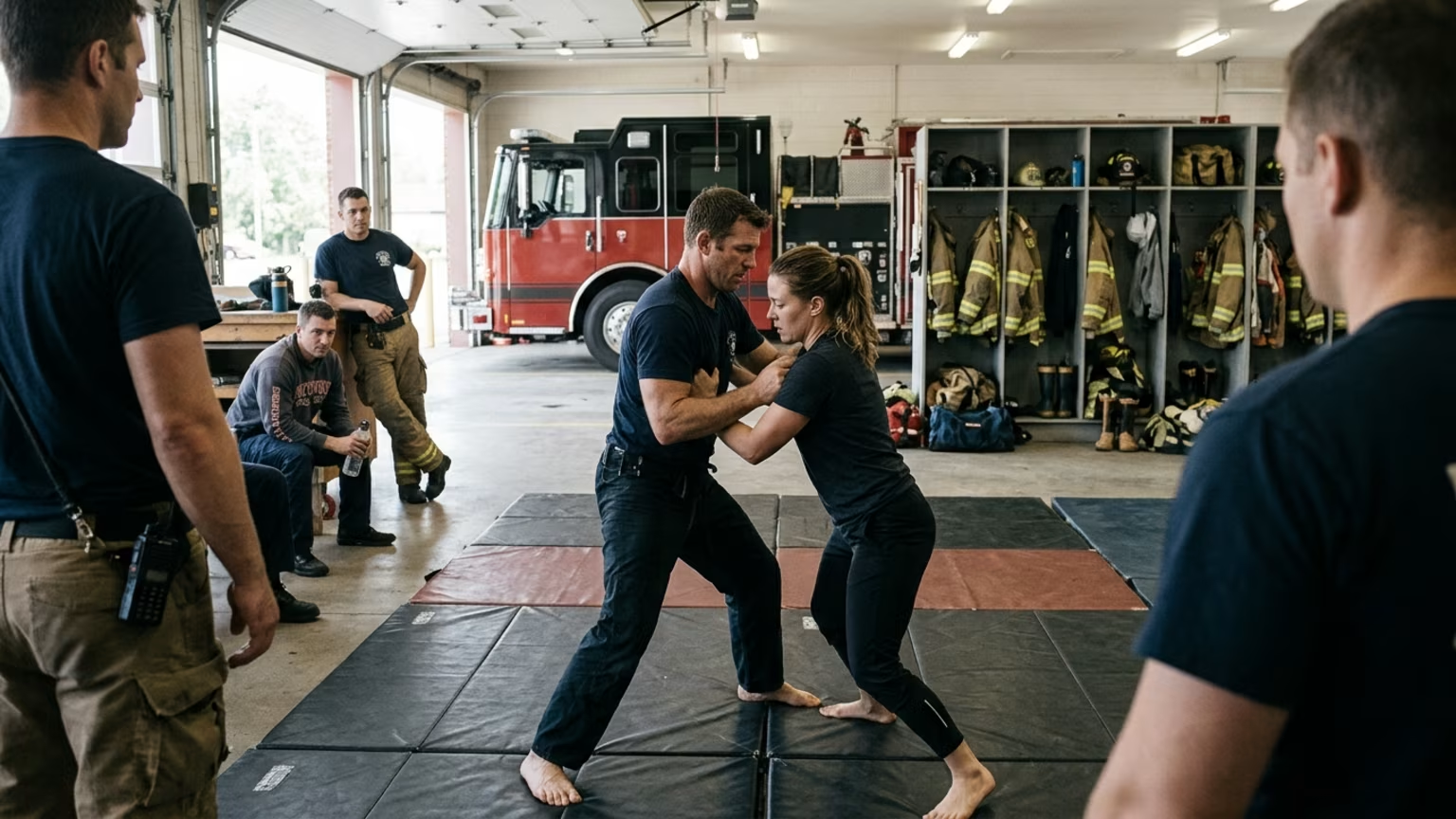

A specialist jiu-jitsu article calls for shift-aligned classes and careful coaching for tired first responders. Here is how to assess its advice.





On October 23, 2026, Stephen Oliver’s Martial Arts Professional article “Beyond Competition: How Jiu-Jitsu Builds First-Responder Communities” called for programs designed around responders’ working lives. Rather than relying on a discount, Oliver urged martial-arts school operators to consider shift patterns and job-relevant instruction.
His scheduling advice was concrete: consider early-morning, midday or rotating classes instead of assuming a conventional evening slot will fit long shifts. For tired participants, he advised instructors to control intensity and partner pairings. The useful takeaway is a set of questions for a provider, not a new department training requirement.
Oliver’s article is aimed mainly at martial-arts businesses. It argues that serving first responders involves agency relationships and a suitable curriculum as well as accessible class times. A lower price is only part of that proposal.
His curriculum suggestions include positional control and escapes. He also recommends getting up safely and training while fatigued. Alongside those suggestions, he places responsibility on instructors to manage the intensity of training and the pairing of participants when people are tired.
The source note identifies the views as the author’s own. His warning that tired people on rotating shifts “get hurt more easily” comes without underlying injury data or a cited study. The article gives no quantified risk estimate or intensity scale, and it does not evaluate whether the suggested changes reduce injuries or improve recovery.
There is another useful boundary around the recommendations. The article’s reference to “conditioning and grappling fundamentals” describes a proposed agency workshop. It does not establish an optional-conditioning schedule or provide a detailed fatigue-management protocol.
Read together, these points make the article a practitioner proposal worth discussing with an instructor. They do not make it a tested prescription for preventing injuries among shift-working responders.
Oliver’s article centered on Heroes on the Mat 9, listed for October 24, 2026, in Staten Island. The Brazilian jiu-jitsu and grappling event was described as having proceeds intended to support the Tunnel to Towers Foundation.
The New York Post’s coverage described Heroes on the Mat as bringing together firefighters and police officers alongside EMTs and other public-service workers. Organizer Joe Peteroy said its aims included encouraging first responders to train in jiu-jitsu for physical and mental wellness.
That wellness rationale is an organizer’s stated aim rather than a measured health outcome. The distinction matters when a community event becomes the starting point for a wider conversation about training.
A charitable purpose and a welcoming community can explain why an event attracts interest. Evaluating an ongoing class requires a different discussion: when sessions are available, how coaching responds to fatigue and what the instruction is intended to provide. Those are the operational questions at the center of Oliver’s recommendations.
For someone working rotating shifts, the relevant question is not simply whether a school offers a first-responder program. It is whether the available sessions match the person’s actual roster. A program label says little about that fit without a timetable behind it.
Oliver’s early-morning and midday suggestions are options to consider rather than preferred times for every responder. An early class should not be treated as automatically suitable merely because it falls outside conventional working hours. The practical issue is how the class relates to duty and the opportunity for recovery.
This moves the discussion away from commitment or motivation. A responder asking about a different class time is asking whether the service is usable. A provider’s answer should address the working pattern rather than assume that a standard evening class solves the scheduling problem.
The same reasoning applies to how training fits into the rest of the week. Rescuris’s discussion of planning sessions around an irregular roster provides a broader editorial framework for that decision. The question is where a session belongs within working life, not simply whether another session can be added.
Scheduling and coaching also need to be considered together. A school might offer a convenient time while leaving its approach to tired participants unclear. Oliver’s proposal asks providers to address both access and the way a session is run.
The recommendations support a practical conversation before joining a program. The most useful questions ask providers to explain what they offer and how their coaching works. They do not require responders to invent their own fatigue thresholds or training rules.
A useful starting question is: “Which sessions fit the shift patterns used by local responders?” Oliver specifically recommends considering early-morning and midday classes as well as rotating slots. Asking about those options is more informative than asking only whether a first-responder discount exists.
The follow-up is how the timetable works across a changing roster. Does the advertised arrangement remain usable when someone moves to another shift? That question tests whether the scheduling offer reflects the group it is intended to serve.
For readers considering the wider recovery picture, Rescuris also covers sleep planning for different duty patterns. Class availability and sleep planning are related decisions rather than interchangeable ones.
Oliver advises instructors to control intensity and participant pairings. A provider discussion can therefore ask: “What would you change in a session when someone arrives tired after duty or poor sleep?” The answer should explain the coaching approach behind the general reassurance.
Another relevant question is what the provider means by “training while fatigued.” That phrase appears among Oliver’s curriculum suggestions. It deserves explanation alongside his separate recommendation to manage intensity when participants are already tired.
The distinction is worth making explicit. A curriculum that includes fatigue-related practice and a participant arriving with fatigue are different parts of the conversation. Asking how the instructor handles each avoids treating the phrase as permission to push through every session unchanged.
A broader discussion of duty demands and training stress can help frame those questions without reducing the decision to gym effort alone.
Oliver cautions instructors not to present a martial-arts workshop as a substitute for certified use-of-force training. That boundary should remain clear even when a class is promoted specifically to emergency-service personnel.
A useful question is: “Is this general grappling and conditioning instruction, or are you describing something with a department-certified role?” The provider’s explanation should keep those categories separate rather than rely on occupational branding.
This is also where personal health questions belong outside the marketing discussion. Decisions about an existing injury or an individual medical concern should involve a qualified healthcare professional rather than depend on a general class description.
The next evidence questions concern delivery and outcomes. Do shift-aligned options reach responders across their changing rosters? Are the suggested coaching adjustments applied consistently when participants arrive tired? Those questions would help establish whether a provider has put the proposal into practice.
Evaluating injury prevention would require a separate assessment. An assessment would need to distinguish improved access from improved recovery and record injuries rather than infer safety from attendance or enthusiasm. Those are questions for evaluation, not results reported by the article.
There is also a useful question about the participant experience: does the program’s advertised flexibility match what happens during ordinary classes? A timetable and a coaching philosophy are promises about how a service will operate. Their value depends on delivery.
For now, Oliver’s contribution is a more specific provider conversation. Class times should be discussed against actual shifts. Fatigue should prompt questions about coaching rather than assumptions about toughness. General martial-arts instruction should remain distinct from certified occupational training.
A shift-aware class offer can still miss the point if it treats exhausted attendance as commitment rather than a recovery concern. Rescuris connects research-led sleep coverage with practical performance guidance for emergency-service professionals, helping readers weigh training advice against nights and unpredictable calls without treating short-term output as more valuable than long-term health.
Rescuris publishes evidence-aware guidance for firefighters, police officers, paramedics and other first responders on fitness, recovery, sleep, nutrition, stress resilience and long-term capability.





Read practical guidance on first responder fitness, recovery, sleep, nutrition and resilience for demanding work and a long, active career.
read the blog
