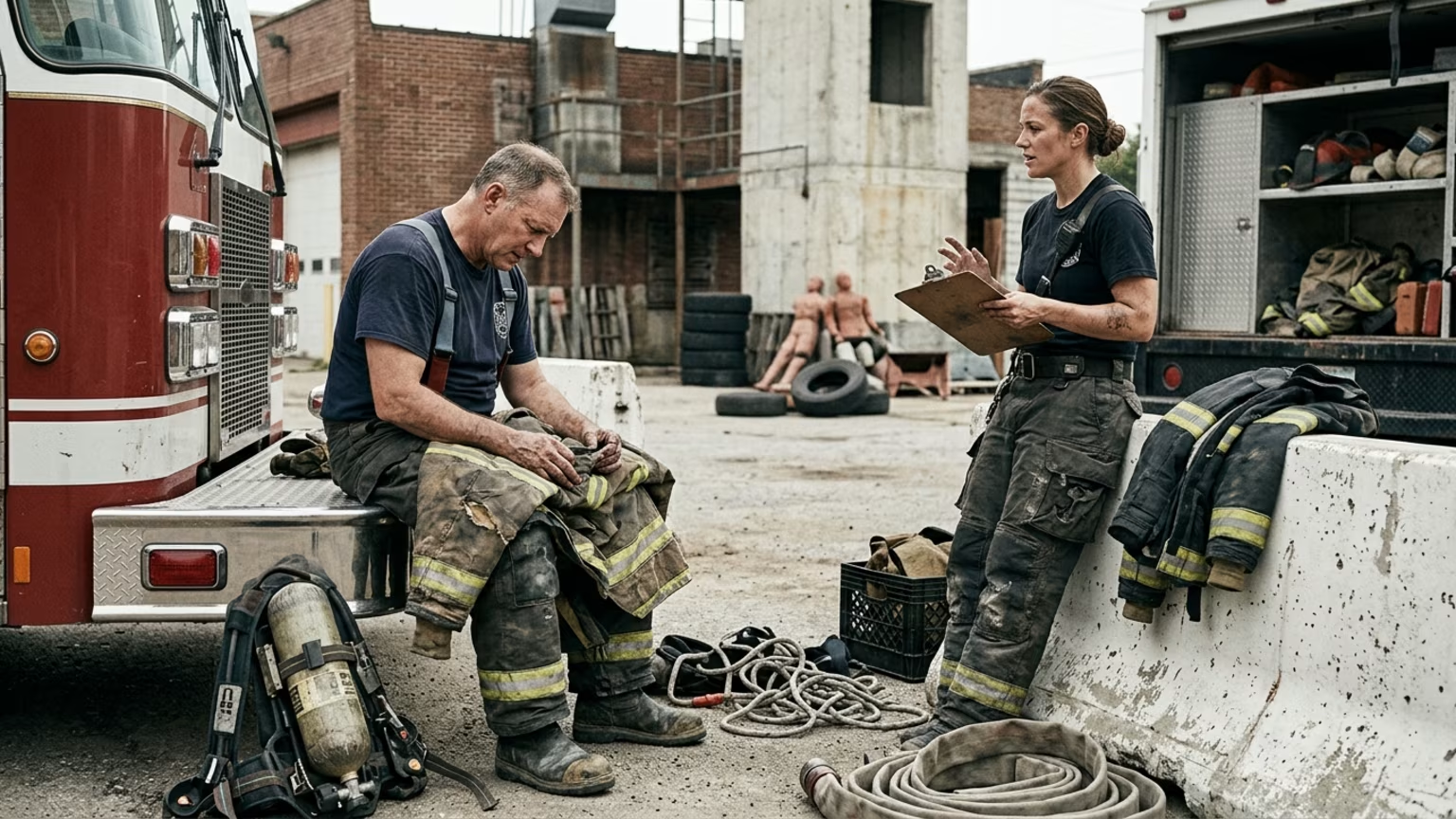

A green-amber-red decision guide for first responders managing soreness, shift fatigue and warning signs that warrant medical evaluation.





Should first responders train through wear and tear? Familiar soreness with normal movement may allow a reduced session, meaningful fatigue calls for lower-risk activity or postponement, and major functional loss or systemic symptoms call for medical evaluation.
The useful distinction is not simply whether something hurts. It is whether discomfort remains familiar and controllable, readiness has fallen, or movement and general health have changed. Those differences help separate a training adjustment from a problem that needs professional attention.
The National Registry of Emergency Medical Technicians describes firefighters and EMS clinicians as encountering job-related injuries and harmful substances alongside substantial physical and psychological stress. That occupational context supports considering recent duty demands when judging a workout. The gym session is not the only physical load that matters.
Some symptoms also reflect a different medical process from ordinary soreness. Clinical guidance describes rhabdomyolysis as muscle breakdown that can threaten kidney function. A fire-and-EMS safety bulletin addresses this condition specifically in emergency-response and training settings.
Use the framework below as a decision aid rather than a diagnosis or fitness-for-duty clearance. Pain intensity alone is unreliable, and dark urine is not specific to one condition. The regional survey and individual sleep reports discussed below do not establish universal prevalence or the best shift schedule. This evidence also provides no universal readiness score or precise sleep cutoff.
Use green for familiar discomfort with preserved function, amber for meaningfully reduced readiness, and red for concerning symptoms or substantial loss of function. Choose the category from the whole pattern rather than pain intensity alone.
This category fits ordinary muscle soreness or manageable stiffness when walking and other normal tasks remain controlled. Discomfort may involve recently trained muscles or feel similar to previous post-training soreness. Improvement with gentle movement or reduced loading supports a lower-demand approach.
The practical options supported by the research summary include:
Complete rest is not automatically required for familiar soreness that leaves function intact. The aim of modification is to retain useful activity without practicing a limp or another compensatory movement pattern. A session becomes a different decision when normal control is lost.
Our guide to interpreting discomfort through movement and function provides related context. That distinction is more useful than treating either discomfort or temporary relief as permission to train harder.
Amber applies when there is no obvious injury but the planned session no longer matches current capacity. Persistent heaviness or an unusual decline in work capacity can fit this category. So can poor concentration or coordination after an extended operational period.
The research summary supports postponing demanding or technically complex training in this situation. Examples include maximal lifting and hard intervals. Loaded stair work or fatigue-based testing also belongs outside a low-risk recovery session.
A replacement can involve easy aerobic activity, simple technique practice or recovery rather than a performance test. Reduced enthusiasm alone is different from an inability to control a movement. Loss of coordination or joint stability moves the decision away from simply scaling the workout.
The operational question also matters. A department may need to consider whether fatigue affects safe duty performance rather than focusing only on whether someone can finish a workout.
Red includes symptoms that should not be managed by making the workout easier. Clinical guidance identifies severe muscle pain and weakness alongside dark tea- or cola-colored urine as warning signs associated with rhabdomyolysis. It advises urgent hospital assessment without waiting for the entire warning pattern to appear.
After intense exertion or operational heat exposure, concerning signs include:
Stop exertion and obtain urgent medical evaluation when these signs occur. Do not try to sweat the problem out or use aggressive hydration as a reason to continue. The responder-focused safety bulletin makes rhabdomyolysis awareness relevant to both emergency operations and physical training.
Other stop signs in this decision aid include a new injury with deformity or inability to bear weight. Inability to use a limb normally also warrants prompt evaluation. New numbness or weakness deserves attention rather than repeated testing under load.
Chest pain or fainting should not be treated as routine muscular discomfort. Severe shortness of breath and severe heat-related symptoms also belong outside a training-modification decision. Follow local emergency guidance for these symptoms.
Not every concern begins with a dramatic episode. Progressive pain or symptoms spreading beyond the original area warrant professional review. Recurring pain and repeated low-readiness days also deserve attention when the pattern is not improving.
The research summary supports clear department-level routes to occupational medicine and other qualified services. Depending on the concern, those routes may involve physical therapy or a fitness-for-duty assessment. Deciding which route fits an individual problem belongs with qualified care rather than an online training framework.
Base the next session on recent operational load and restorative sleep rather than the calendar alone. A scheduled hard workout can become a lower-demand session when the preceding shift has substantially reduced readiness.
A report summarizing a 2025 field study found that wildland firefighters averaged 13.8-hour shifts on active fire days and about 6.7 hours of sleep. The report also associated longer shifts and shorter or poorer-quality sleep with reduced cognitive performance during wildfire operations.
Structural-firefighter scheduling reports also show why sleep belongs in the discussion. A Firehouse report on a 48/96 schedule described tracker-measured mean sleep increasing from 6.7 to 7.0 hours per night. The useful point for an individual training decision is to consider actual recovery opportunity rather than assuming a schedule label describes readiness.
Before training, use the same questions each time:
This check makes the shift part of the training decision without treating every demanding tour as a reason to abandon activity. Familiar soreness with stable movement can still fit green. Substantial fatigue belongs in amber even when there is no painful body part.
For the broader planning question, our discussion of organizing training around changing work demands provides a useful companion. The immediate choice remains whether the intended session matches the responder’s present capacity.
It brings recurring symptoms and recovery problems into long-term planning rather than leaving them to be addressed only when they interrupt duty. The retirement question is how to maintain useful activity while giving persistent problems an appropriate clinical review.
A study of more than 1,000 firefighters in Estonia and Latvia was summarized by the Proceedings of the Estonian Academy of Sciences. More than half reported back pain, and about one in ten consistently felt well-rested. Those findings give context for discussing pain and sleep together rather than treating each workout as an isolated event.
For career planning, the most useful record is the pattern. Recurring pain in the same area deserves more attention than a single familiar sore session. Repeated amber days or declining performance also raise a different question from whether today’s workout can be completed.
The research summary recommends professional review of recurring pain and persistent sleep problems. That review does not require waiting for one episode to feel dramatic. Its purpose is to bring the ongoing problem into an individualized assessment.
Rescuris’s coverage of adapting physical capability across a career connects this daily decision with longer-term planning. An editorial goal is to keep both duty requirements and preferred activities after service in view. Training choices should serve that broader purpose rather than become repeated tests of tolerance.
The next useful topic is the interaction between shift-related sleep disruption and training readiness. It connects the amber category with a practical question: whether an easier workout addresses the immediate fatigue while a recurring sleep problem needs separate attention.
Start with our guide to understanding sleep disruption across shift patterns. Read it alongside the operational-load check above. The aim is to connect sleep opportunity with training choices rather than treating each low-readiness day as an isolated failure.
A lighter workout and professional evaluation answer different readiness problems, and Rescuris connects those decisions with its editorial focus on performance and recovery. For emergency-service professionals facing accumulated physical wear, its evidence-led coverage of duty fitness and injury recovery helps clarify practical options within irregular work rather than treating continued training as the only acceptable outcome.
Rescuris publishes evidence-aware guidance for firefighters, police officers, paramedics and other first responders on fitness, recovery, sleep, nutrition, stress resilience and long-term capability.





Read practical guidance on first responder fitness, recovery, sleep, nutrition and resilience for demanding work and a long, active career.
read the blog
