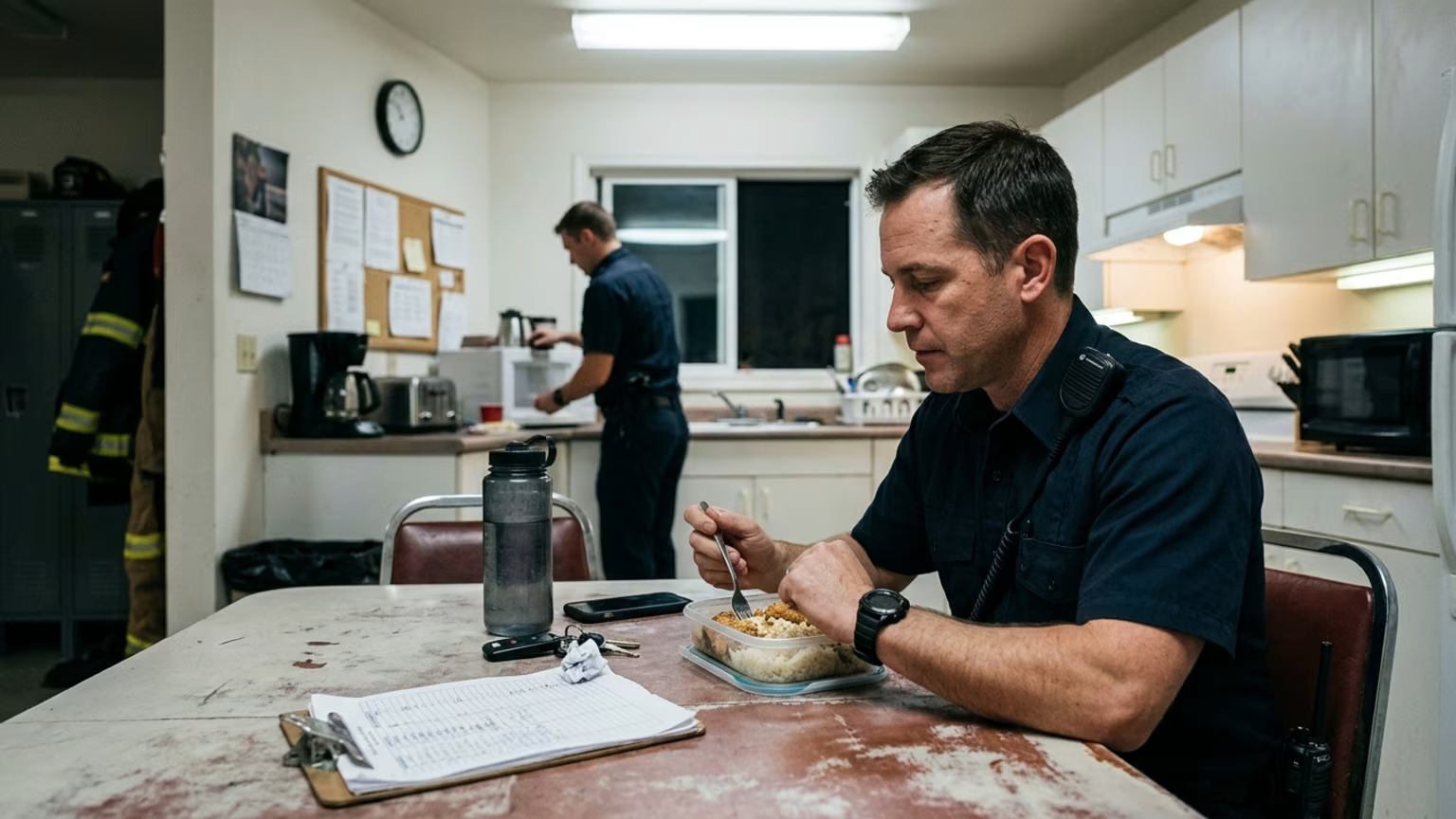

Plan meals around rotating shifts with flexible anchors and backups, while understanding the evidence on circadian timing and eating windows.





Plan meals around expected sleep and realistic chances to eat, using a flexible meal anchor and a backup rather than one fixed schedule for every rotation.
The science behind that answer concerns how eating fits with the body's daily rhythms. A 2026 systematic review describes how eating, sleeping and activity at times misaligned with circadian rhythms can impair glucose tolerance and alter appetite-regulating hormones such as leptin and ghrelin. This provides a reason to consider meal timing alongside sleep rather than treating the clock as irrelevant.
Appetite also deserves attention without assuming that night work always increases hunger. A 2026 study in npj Biological Timing and Sleep reported lower subjective appetite, fewer meals and more irregular mealtimes during night shifts than during day shifts. It also reported changes in when food and drink were consumed. This was not a first-responder study, so it offers background rather than findings measured specifically in emergency services.
The systematic review covered 43 shift-work nutrition studies but found only four involving first responders: one firefighter study and three police-officer studies. It reported small samples and short interventions alongside substantial differences in methods. Risk-of-bias concerns affected 68% of included papers, and the authors could not conduct a meta-analysis to combine the results.
The review authors concluded that current evidence is insufficient to formulate definitive dietary guidelines for shift workers. The small and varied responder evidence base also did not establish the best nutrition strategy for emergency-service occupations. That is the boundary for the practical framework below: it is a planning approach informed by the review's findings and operational barriers, not a tested prescription.
Use an earlier meal as a dependable anchor when circumstances allow, then keep an alternative available for a delayed or interrupted break.
The systematic review identifies unpredictable callouts, limited control over breaks and rotating shifts as barriers to fixed eating windows. Planning should account for those conditions from the beginning. A schedule that only works when every break happens on time does not address the problem the review describes.
Begin the planning process with expected sleep and likely opportunities to eat. These are more useful reference points than copying yesterday's meal times onto a different shift. The practical question is where a meal could reasonably fit within the coming work and sleep pattern.
A simple planning outline can record:
This outline does not require an identical answer on every rotation. Its purpose is to make the assumptions behind the plan visible. If a break is uncertain, the meal plan should describe it as uncertain rather than treating it as guaranteed.
An anchor is a default opportunity to eat, not a deadline. An earlier meal may serve that role when circumstances permit. The important distinction is between having a dependable starting point and declaring a fixed window that every shift must obey.
Keep the timing question separate from the food-selection question. First identify the likely opportunity to eat. Then consider what meal can fit that opportunity. For that second task, Rescuris's guide to putting a balanced meal together on shift is related reading.
An interrupted meal does not need to turn the whole plan into a failure. Within this framework, the anchor provides a starting point while the backup accounts for the possibility that duty takes priority.
A backup should answer a practical question: what remains available if the intended meal is delayed or missed? The research supports recognizing that problem, but it does not specify one ideal backup food or meal size. Those details should not be presented as if the review tested them.
The planning task is therefore modest. Identify an option that remains practical under the expected working conditions, and allow its timing to change. A backup is not a separate metabolic intervention. It is part of designing a plan around interrupted breaks rather than around an uninterrupted day.
When reviewing the plan afterward, distinguish between an unrealistic assumption and an unavoidable callout. Ask whether the expected opportunity existed and whether the backup was usable. Those questions assess the plan's fit with duty rather than assigning blame for a meal that moved.
Reconsider meal timing when expected sleep or realistic eating opportunities change, rather than preserving the same clock times across every rotation.
The systematic review found that some studies linked avoiding nocturnal eating or concentrating food intake in daytime with better glucose-related outcomes. Results were mixed across different study designs and interventions. The review also reported inconsistent findings on cognitive and occupational performance, so metabolic findings should not be turned into promises about readiness.
These findings make earlier eating a reasonable consideration when the shift permits it. They do not turn a delayed meal into a reason to impose an unplanned fast. The practical framework is to consider circadian timing while retaining room for the operational conditions documented in the review.
For a rotation change, return to the same planning questions: when is sleep expected, and when is eating realistically possible? The answer may differ from the previous shift. Moving the meal anchor is part of adapting the plan, not evidence that the framework has stopped working.
There is no precise clock time in this framework that applies to every firefighter, police officer, paramedic or EMT. The relevant decision is whether an earlier opportunity can serve as the default without making the plan dependent on perfect breaks. Where it cannot, the backup remains part of the plan rather than an exception to it.
The review's account of the Healthy Heroes randomized trial provides a useful example. In that trial, 137 firefighters working 24-hour shifts were assigned a self-selected 10-hour eating window or standard care. The review reports favorable changes in selected outcomes, including fasting glucose and VLDL particle size.
That trial shows that a defined window was studied in a directly relevant occupational setting. It does not establish that 10 hours is necessary or optimal for every responder. A studied option should not become a rule that takes precedence over operational needs.
For practical planning, ask what the proposed window requires of the shift. Does it depend on a break that calls may interrupt? Does it remain workable when the rotation changes? These questions assess feasibility without assuming that the trial's schedule must be copied.
Meal timing can belong in long-term health planning, but these studies do not establish that a particular eating schedule improves health after retirement.
Selected glucose-related outcomes are not the same as evidence about health across the years after service. The useful long-term principle is therefore about priorities: do not make adherence to a clock-based rule more important than a workable routine and individual health needs. Rescuris's position is to keep career longevity alongside duty capability rather than treating short-term compliance as the goal.
For retirement planning, consider whether a routine remains useful when the work pattern changes. A meal anchor developed around overnight duty need not become a permanent obligation after that duty ends. The framework is a way to organize decisions, not an identity that has to be preserved.
Personal decisions involving glucose management or medically directed eating belong with a qualified clinician. Meal-timing research can inform that conversation without replacing individual care.
Long-term capability also deserves attention beyond eating schedules. For a related perspective, read about conditioning choices that account for accumulated physical wear.
The next useful topic is how to coordinate meal planning with changing sleep opportunities. Rather than adding a stricter eating rule, examine whether the expected sleep period and the meal anchor still fit the next rotation.
Rescuris's discussion of food timing around a changing shift pattern is a relevant next read. Keep the editorial question practical: does the plan acknowledge interrupted sleep and uncertain breaks, or does it only work on a predictable day? That distinction is more useful than treating a particular window as the only acceptable answer.
Choosing a meal anchor that can move with the rota is where Rescuris connects nutrition decisions with research-led coverage of shift-work sleep. For emergency-service professionals facing interrupted nights and unpredictable calls, its editorial guidance puts food planning in the context of recovery and career longevity rather than treating a strict eating window as the goal.
Rescuris publishes evidence-aware guidance for firefighters, police officers, paramedics and other first responders on fitness, recovery, sleep, nutrition, stress resilience and long-term capability.


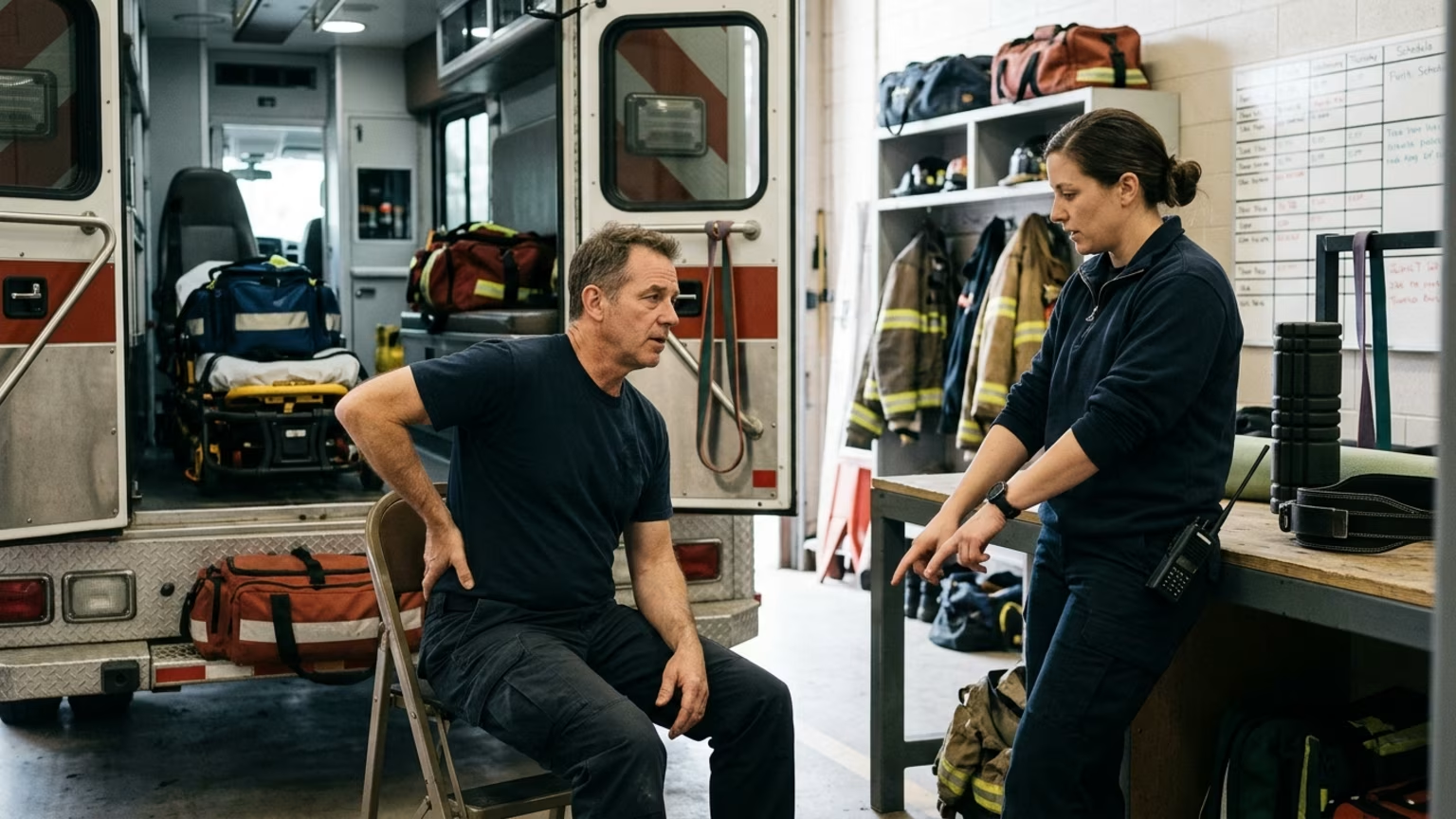



Read practical guidance on first responder fitness, recovery, sleep, nutrition and resilience for demanding work and a long, active career.
read the blog
