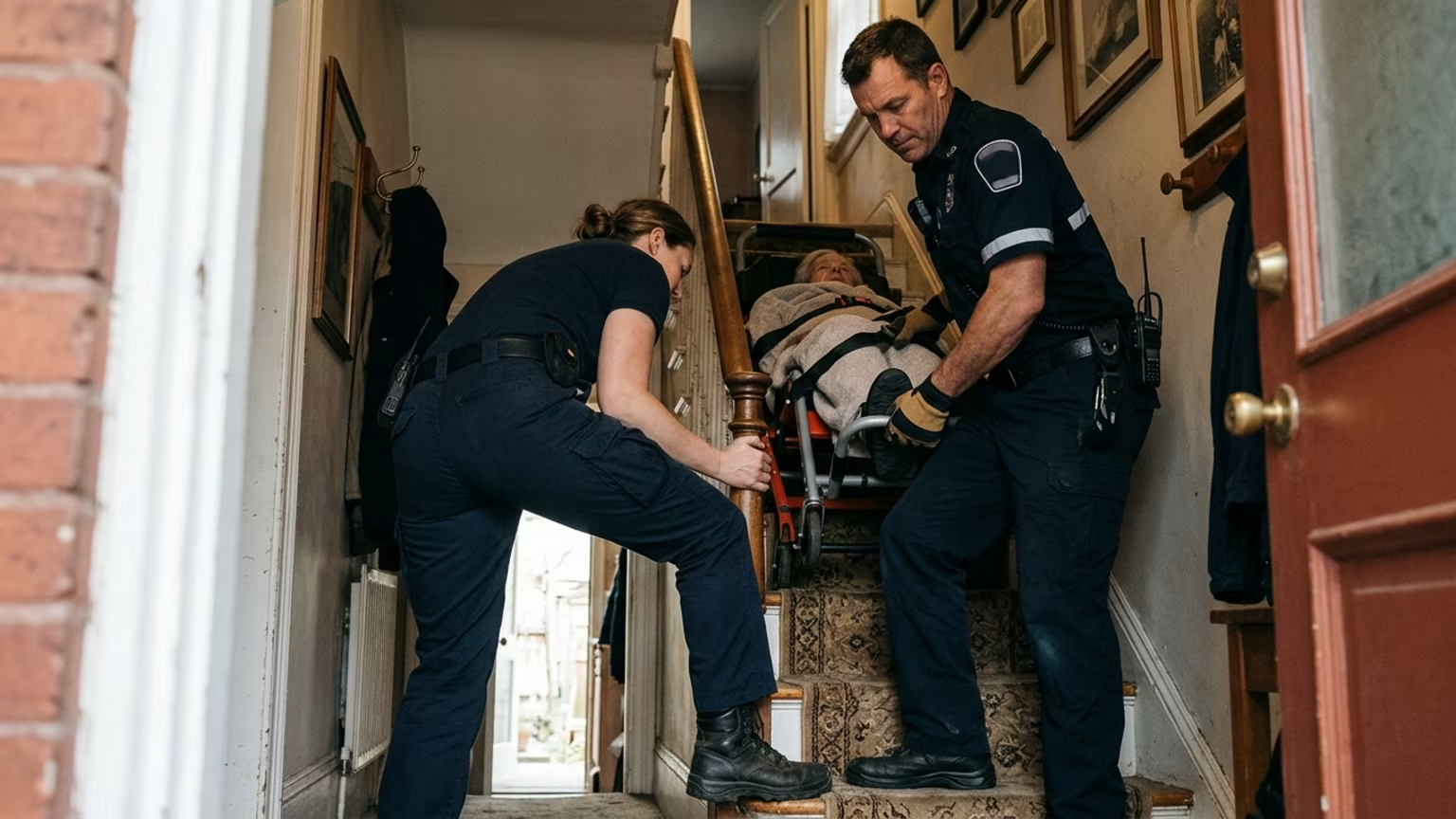

Why safe patient handling needs more than lifting technique, including shared planning, appropriate equipment, workplace support and career-long perspective.





No, patient handling also depends on appropriate equipment and trained assistance, with communication and employer procedures guiding the move.
An EMT-training guide identifies patient and equipment lifting as EMS hazards. Its prevention guidance includes employer policies and training alongside needed equipment. It also recommends using available assistance when appropriate rather than improvising outside training and employer procedures.
Body positioning and coordinated movement can matter. But a technique cue changes how someone approaches a movement, not every condition surrounding it. Better positioning cannot clear a narrow stairwell or supply a missing device. It also cannot resolve uncertainty about the patient's movement needs.
That is the basic problem with “just lift properly.” It treats an individual action as the whole prevention system. The guidance instead places responsibility across the task, the available resources and the organization supporting the crew.
The evidence does not establish a single technique or staffing rule that prevents every patient-handling injury. The practical response is to assess more than form without dismissing the value of trained movement skills.
Treat the move as a coordinated patient-care task: clarify the intended movement and match the approach to the patient, the setting and available resources under local procedures.
In FireRescue1's discussion of EMS and athletic-training coordination, a brief time-out helps the participants agree on the movement plan. The example involves spinal care and professionals working from different protocols. It shows why agreement about the task matters before the team acts.
The article identifies several factors that can shape transfer choices. These include the patient's position and the surface beneath them. Protective equipment and the trained personnel available also matter. That makes the movement decision more specific than choosing a preferred lifting stance.
The sources support these planning considerations rather than a universal transfer checklist:
A healthcare ergonomics resource also recommends task planning and suitable equipment, with assistance requested when required. That is adjacent healthcare guidance rather than an EMS field protocol. Its contribution here is the same broader perspective: review the work being attempted instead of concentrating only on the worker's posture.
For a related planning format, Rescuris's questions to address before patient movement provide another editorial starting point. Any such resource belongs alongside employer procedures and hands-on training, not above them.
When uncertainty concerns the patient's care or movement needs, local medical direction and protocols are the appropriate reference points. The FireRescue1 example illustrates coordination between clinical roles rather than an individual responder settling the question through a lifting adjustment.
A responder's own pain or injury raises a different issue. Personal assessment belongs with a qualified clinician rather than an article offering a supposedly corrective lifting cue.
The clearest timing example is a brief coordination pause before patient movement, not a rule tied to the beginning or end of a shift.
In the FireRescue1 scenario, the time-out gives EMS and athletic-training personnel a point to reconcile their approaches before moving the patient. The article does not specify a fixed pause length or establish a required time-out for every transfer. It is also a clinical discussion rather than an injury-prevention trial.
For shift-based work, the useful distinction is between the current movement decision and a recurring workplace problem. The current task calls for the equipment and assistance appropriate under local procedures. A repeated resource gap calls for attention through the service's workplace-safety channels.
The training guidance supports that organizational discussion by identifying employer policies and needed equipment as prevention measures. Recurring training gaps belong in that discussion too. The reporting route depends on the employer and jurisdiction.
A repeated instruction to improve technique does not answer a repeated equipment problem. Equally, identifying an organizational problem does not settle the immediate clinical plan. Those are related decisions with different purposes, and neither should be mistaken for the other.
Equipment belongs in the handling plan from the outset, with its use matched to the situation and the team's training rather than treated as a substitute for judgment.
A commercial patient-transport guide summarizes an interrupted time-series study in a Winnipeg EMS system. It reports that the study estimated patient-handling injuries fell by about half after power stretchers were introduced.
That finding was a modeled estimate from one agency, relayed through the commercial guide. It does not establish that another service would obtain the same result. The useful lesson is that equipment deserves serious consideration within prevention, not that a purchase comes with a promised injury reduction.
The FireRescue1 clinical discussion adds another consideration: equipment does not resolve every transfer problem. The patient's position and available trained personnel still influence what is feasible. A device and a coordinated movement plan therefore address different parts of the task.
For crews, the supported approach is to use assistance and equipment as appropriate within training and employer procedures. For services, repeated difficulty obtaining needed equipment is a workplace-safety issue to review. Neither point requires treating a device as universally suitable or asking individual responders to improvise around its absence.
This also changes how an equipment discussion is framed. Rather than asking only whether a device is available somewhere in the service, the relevant planning question is whether the available resources fit the movement being considered.
Preserving physical capability after service is a reasonable long-term goal, but these sources do not measure retirement health or show that a particular handling approach produces that outcome.
The career-long perspective is still useful as an editorial frame. It asks whether patient movement is consistently supported by appropriate resources rather than repeatedly depending on individual effort. It also keeps an active life after service in view when discussing what counts as acceptable work practice today.
The training guidance provides a concrete foundation for that discussion: employer procedures and training matter alongside equipment and assistance. Those are reviewable parts of the working system. They are more specific than asking whether a responder is sufficiently strong or committed.
A useful workplace discussion can distinguish among several problems:
These categories should not all receive the same answer. More technique coaching does not automatically address an equipment gap. A workplace report does not replace personal clinical care. Clearer problem definition helps keep the discussion focused on the support actually needed.
For readers considering the wider career picture, a broader view of accumulated physical demands is a related topic. The aim is not to avoid all demanding work. It is to consider duty capability and life after service within the same conversation.
A useful next topic is how services turn recurring patient-movement difficulties into equipment and training decisions. That moves the discussion beyond reminders delivered to individual crews and toward the resources supporting the task.
Rescuris's broader treatment of transferable handling principles is a related read. The useful comparison is between those principles and local procedures, not between an article and a universal “perfect lift.”
The next question worth examining is whether repeated handling problems are being defined clearly enough to receive the right response: clinical coordination, appropriate resources or workplace review.
Patient-movement decisions belong beside plans for an active life after service, which is where Rescuris connects duty fitness with career longevity. Its research-led coverage helps emergency-service professionals assess recovery and physical capability together when accumulated wear makes it difficult to balance readiness with longer-term goals.
Rescuris publishes evidence-aware guidance for firefighters, police officers, paramedics and other first responders on fitness, recovery, sleep, nutrition, stress resilience and long-term capability.


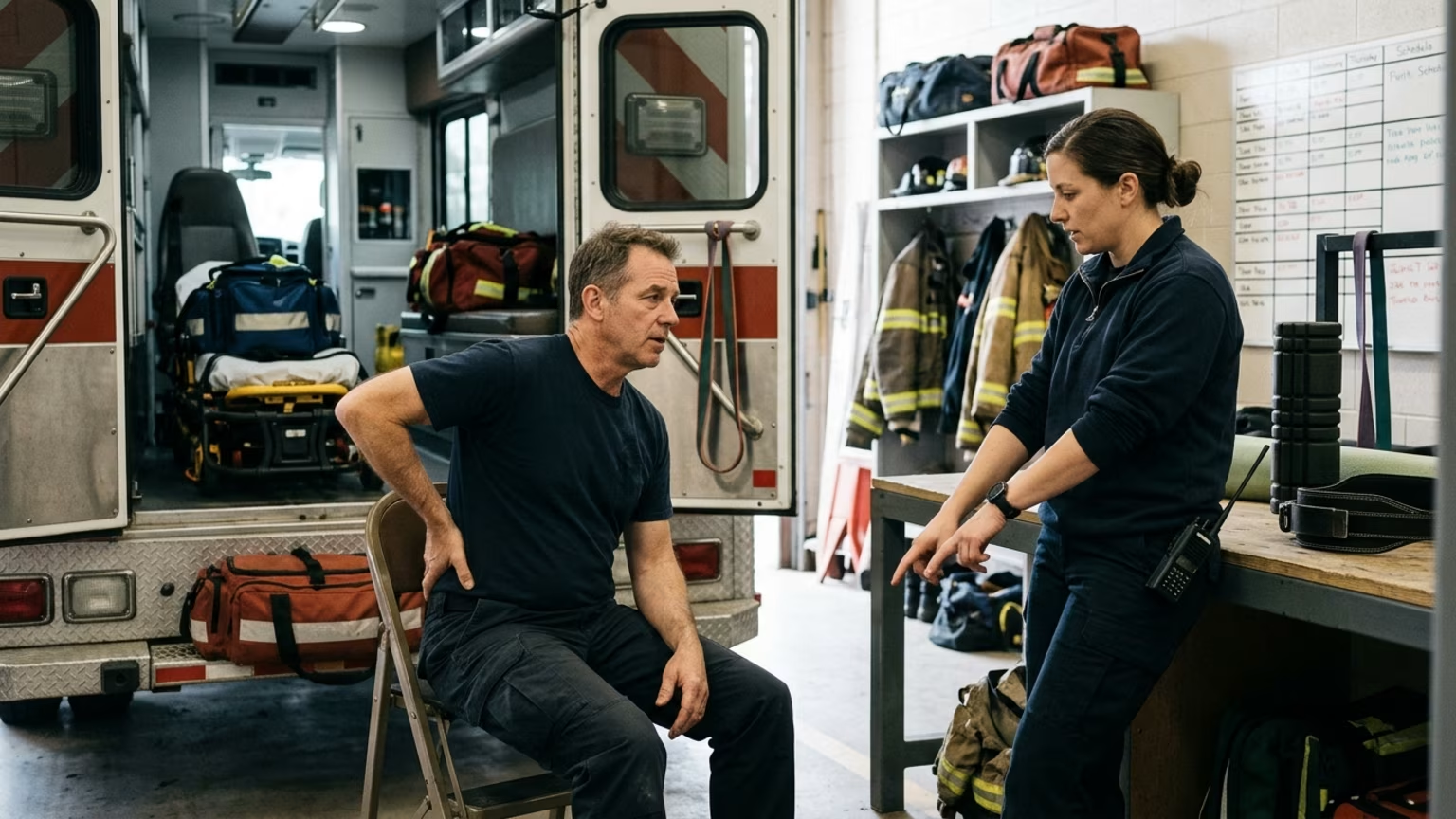



Read practical guidance on first responder fitness, recovery, sleep, nutrition and resilience for demanding work and a long, active career.
read the blog
