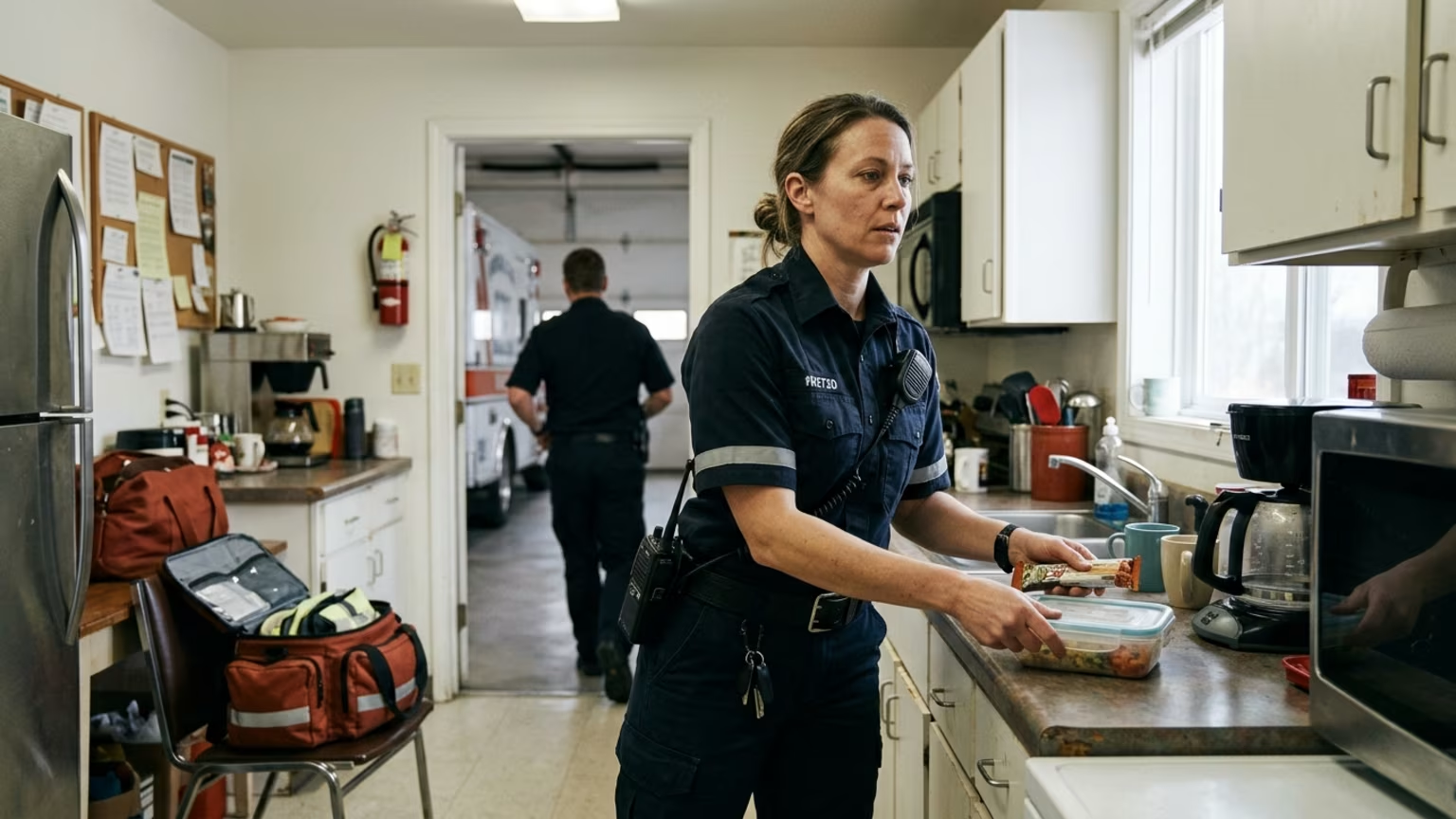

Practical packing ideas for interrupted shift meals, with station, patrol and ambulance options plus clear limits on meal-timing evidence.





Pack a main meal and a separate backup that match your actual food access, so a disrupted break changes your options rather than removing them.
A systematic review of nutrition interventions for shift workers describes workplace constraints and food-access barriers that make healthy eating harder. It identifies organizational support and healthy meal options as potentially useful. The practical target is therefore access to food under changing conditions, not a particular snack or a perfect meal clock.
The mechanism is straightforward: if the whole meal depends on reaching one kitchen, losing access to that kitchen removes the meal option. A separately usable backup is intended to preserve another choice. That is a planning rationale rather than a claim of a special metabolic effect.
The review included 43 studies, but just four involved first responders and only one involved firefighters. Study designs and interventions varied substantially. The authors concluded that definitive dietary guidelines could not yet be formulated and noted limited generalizability from the firefighter evidence, including a predominantly male sample.
The research did not test the portable combinations below or compare packing strategies across station kitchens, patrol vehicles and ambulances. The firefighter meal-timing report also did not provide direct measures of alertness or operational performance. The examples that follow are practical planning suggestions, not a validated first-responder nutrition protocol.
Choose a main meal and a backup that can work separately. Build each around the access you expect to have, then consider what remains usable if the expected break or kitchen access disappears.
Protein, carbohydrate and fiber can serve as prompts for building a varied packing list. There is no need to turn those prompts into a precise ratio or a rule that every small eating opportunity must satisfy. The planning question is whether the available foods offer a workable alternative to the meal that was interrupted.
Possible combinations to consider include:
These are starting points for choosing foods, not interchangeable prescriptions. Preference and the storage directions on the actual product should shape the selection. For a no-fridge backup, choose products whose labels permit the storage conditions available rather than assuming that every packaged food qualifies.
A backup also does not have to reproduce the main meal exactly. Its purpose in this framework is to remain usable when the original plan is not. Keeping that distinction clear avoids making the backup just as dependent on a microwave or station return as the meal it is supposed to replace.
Where kitchen access is dependable, the main meal can remain a conventional packed meal. Consider keeping the backup separate instead of putting every planned food into one container that needs reheating. A meal built around rice, beans and vegetables could sit alongside a separately packed fruit-and-cracker option.
The useful distinction is between having a kitchen and having time to use it. A station-based plan can account for both without assuming that every meal will be interrupted. The main meal remains the preferred option while the backup covers a different set of circumstances.
For shared planning, a useful discussion is which foods remain accessible away from the kitchen. That keeps the conversation focused on access rather than treating a well-stocked refrigerator as the entire solution.
Build the patrol version without assuming a refrigerator or microwave. Start with products that fit the available storage conditions and can be used without preparing a full meal. The pouch-and-cracker combinations above are candidates to assess against their actual labels and personal preferences.
It may help to separate the planned meal from the food intended for an uncertain break. That makes the backup a distinct option rather than something buried inside a meal setup that cannot be used at that moment.
The application question is simple: if the planned stop does not happen, what remains available? This is food planning for an appropriate break, not a suggestion to eat during tasks that require operational attention.
For ambulance crews, consider whether each person has an individual option when a return to the station is uncertain. Separately packed food may fit that planning problem better than a shared meal that only works when everyone stops together.
Do not build the plan around heating food unless that access is genuinely part of the expected break. A main meal can still be included, but the backup should answer a different question: what could be used if the return or heating opportunity does not happen?
The same foods do not have to suit every crew member. The useful shared element is the planning structure: a preferred meal plus an independently usable alternative.
Before treating something as a backup, consider what it still depends on:
For more packing context, the guide to assembling a portable shift-food setup offers a related starting point. Keep the emphasis on access rather than collecting more food than the plan needs.
Use expected breaks as planning opportunities rather than rigid deadlines. A delayed meal does not have to cancel the whole plan, and carrying a backup does not require adopting a fasting schedule.
The systematic review cautions that strict eating windows and macronutrient protocols may be difficult to implement in first-responder settings. That makes feasibility part of the decision rather than an afterthought. A schedule that assumes predictable breaks addresses a different situation from a shift where those breaks may change.
A secondary report of a firefighter eating-window trial describes a 10-hour eating window that did not require participants to skip meals. It reports improved blood sugar and blood pressure among firefighters who had elevated levels at the start. Those findings concern a planned meal-timing intervention.
That distinction matters when discussing interrupted meals. Choosing an eating window is not the same event as intending to eat and then losing the opportunity. A backup-food plan addresses the latter without making the former a requirement.
For practical planning, consider the sequence rather than insisting on an exact clock: the main meal remains available when circumstances permit, while the backup covers a different opportunity. There is no source-supported universal deadline here for switching between them.
Questions about a personal eating window belong with a qualified healthcare professional who can consider individual health needs and the duty pattern. For the operational side, planning around changing meal breaks is a more direct starting point than copying a study schedule.
The research discussed here does not establish retirement-health benefits from a portable-meal strategy. Treat this as a way to make nutrition planning more workable during service, not as a proven method for preventing disease later.
The useful long-term question is whether the approach can change when work changes. A vehicle backup may answer a real access problem during an active career. After leaving shift work, the same person may have different meal opportunities and no reason to preserve the old pattern automatically.
A practical review can ask which parts of the setup still serve a purpose. Foods chosen because they fit a vehicle-based shift need not become permanent defaults at home. Equally, a simple backup can remain an option where access is still unpredictable.
That perspective connects food planning with adapting physical capability across a career. The editorial aim is continuity without rigidity: a nutrition approach that respects current demands while leaving room for life after service.
The next useful topic is flexible meal timing versus fixed eating windows. Focus on how each approach handles a delayed break and which outcomes the research actually measures. A useful follow-up would compare the demands of a planned eating schedule with the food-access problems that remain when duty changes the day.
Keep the practical question visible throughout: does the approach preserve a workable food option when the original plan stops fitting the shift?
Shift-food decisions sit with responders arranging meals for themselves or their crews; Rescuris adds research-led editorial context rather than a one-size-fits-all menu. For emergency-service professionals dealing with inconsistent meal timing, its nutrition coverage helps connect food choices with recovery and an active life after service without treating short-term performance as the only priority.
Rescuris publishes evidence-aware guidance for firefighters, police officers, paramedics and other first responders on fitness, recovery, sleep, nutrition, stress resilience and long-term capability.






Read practical guidance on first responder fitness, recovery, sleep, nutrition and resilience for demanding work and a long, active career.
read the blog
