
A UK blue-light driving project examines cognitive workload. Learn what its announcement supports for training, shift preparation and workload discussions.





In its 2026-09-14 report, BBC News described an 18-month project launched by Devon and Cornwall Police and the Open University to examine cognitive workload during emergency driving. Funded by the Road Safety Trust, the project aims to inform a training-manual resource for approximately 80,000 UK blue-light response drivers.
The project focuses on cognitive workload: the mental effort required to perform a task. Its central question is how that workload affects drivers operating under blue lights and sirens. The practical takeaway from the announcement is that emergency driving needs to be considered alongside the other tasks competing for a driver's attention.
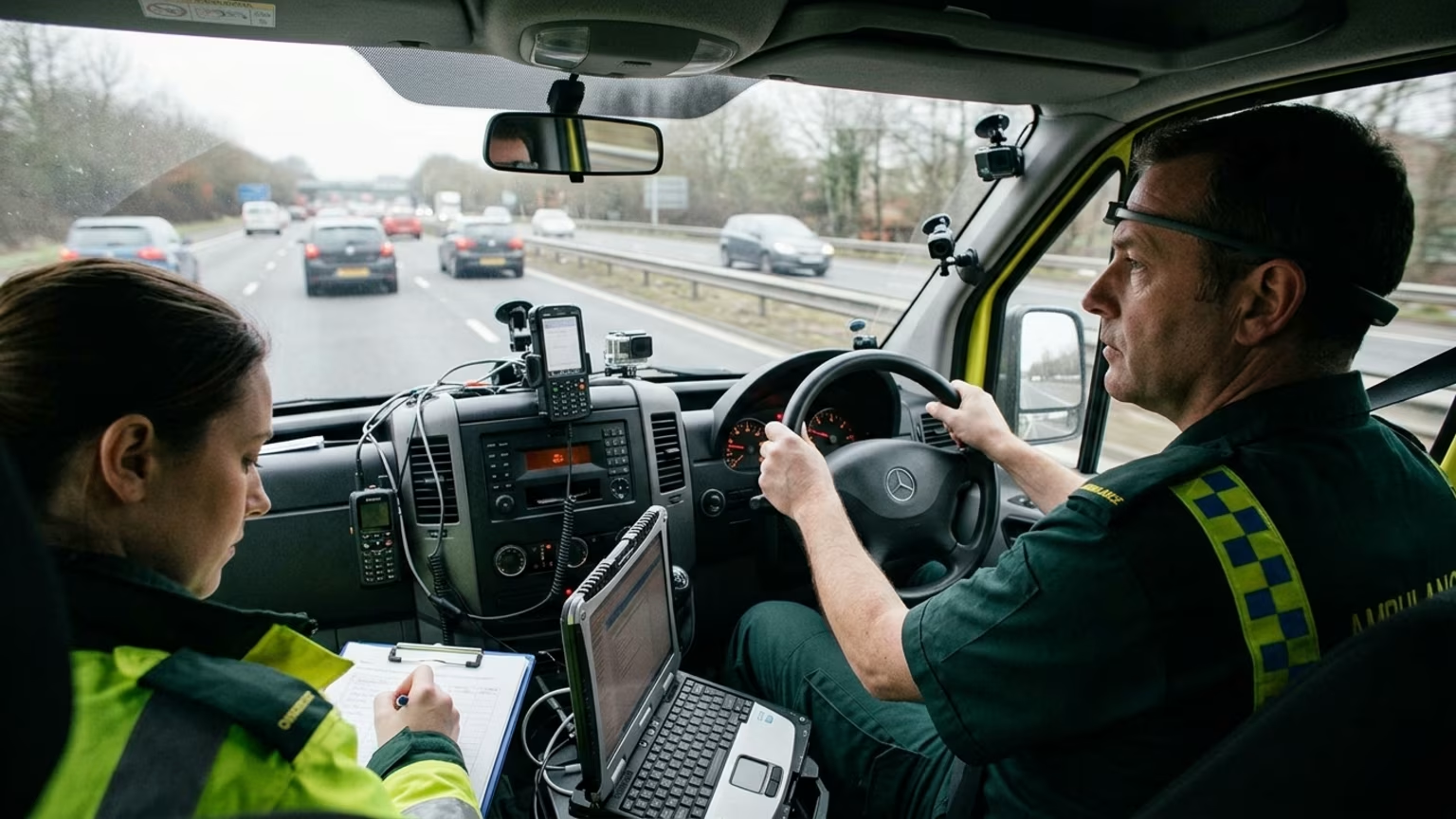
According to BBC News, researchers are examining demands from conversations and radios as well as computers. They are also considering automatic number-plate recognition technology and body-worn cameras. These are not being treated as background details separate from driving but as parts of the driver's overall workload.
Matt Butler, manager of the police driver support team, said the aim is to understand how workload affects police drivers and create a tool to help them manage it. His comments place information-processing capacity at the centre of the issue. Drivers can receive more information than they can reliably process before relevant details are missed.
BBC News reported that Devon and Cornwall Police recorded 426 vehicle crashes in 2025. Within that total, 41 occurred during emergency responses and 58 during emergency pursuits. Eighteen incidents resulted in injury to police personnel or members of the public.
Those figures provide local operational context rather than a national emergency-driver crash rate. The incidents ranged from low-speed parking damage to tactical contact during pursuits. They do not establish that cognitive distraction caused the crashes.
The emergency-response and pursuit figures also should not be combined into a separate blue-light total. The report does not explain whether those categories overlap. Keeping the categories separate preserves the distinction between what the force reported and what an observer might infer.
This is an announcement of an evidence-building project rather than a completed evaluation. The available coverage does not establish that its proposed resource reduces crashes or injuries. Nor does it demonstrate a reduction in stress or cognitive workload.
BBC's report does not detail the participant count or research design. It does not describe simulator methods, physiological measures or assessment scales. It also does not establish whether fatigue, sleep disruption or shift patterns will be measured.
No particular breathing technique, attentional drill or recovery intervention is supported by this announcement. The intended national audience describes the resource's potential reach rather than confirmed adoption by every eligible driver. These boundaries matter when translating the project into practical discussion.
The immediate implication is a change in how workload is discussed rather than a new exercise prescription. Driver trainers can bring communication and equipment demands into existing conversations about operational readiness. Driving skill remains central, but the project's focus asks trainers to consider what else the driver must process at the same time.
For fatigue planning, that means keeping the driving task visible within the wider duty picture. A discussion about readiness should have room for the mental demands of response work as well as physical effort. This is an editorial application of the project's focus, not a reason to replace established departmental fatigue procedures.
For physical training, the relevant distinction is between maintaining capability and managing attention during a response. Strength and endurance planning addresses a different question from deciding which information a driver needs immediately. Treating these as connected parts of duty performance should not turn them into interchangeable solutions.
Rescuris's coverage of considering calls and training within the same workload picture provides a related planning framework. The useful connection is broader awareness of what duty requires. It is not an argument for adding another demanding session to prepare for a mentally complex shift.
Training leaders can therefore retain existing physical-fitness standards while examining how driving exercises represent competing demands. The project's stated focus supports asking whether training discussions account for radios and onboard technology. It does not supply grounds for new workout volumes or recovery thresholds.
Gemma Briggs, professor of applied psychology at the Open University, told BBC News that highly trained police officers are “not immune to cognitive distraction.” That challenges a specific assumption: that qualification or experience makes additional information harmless. It does not suggest that professional driver training lacks value.
Briggs described emergency driving as a combination of high speeds and higher-risk manoeuvres alongside hands-free conversations and police equipment. Additional stressors form part of that picture. Her point is about competing demands within a complex task rather than a simple distinction between skilled and unskilled drivers.
Hands-free communication also should not be treated as attention-free communication. The project's inclusion of conversations makes their mental demands relevant to training discussions even when no device is held. The practical question is what a conversation requires the driver to understand or decide while controlling the vehicle.
For trainers, this supports examining the workload around skilled performance instead of treating distraction as a personal failing. A driver can be competent and still face competing demands. The discussion should remain respectful and specific to the tasks involved.
The research supports a discussion framework built around information priorities. It does not provide a replacement driving protocol. Within existing departmental driving and communication requirements, supervisors and trainers can use the following questions to review how competing demands are handled.
Preparation discussions can distinguish information needed for the immediate driving task from information needed later in the response. The emphasis is on identifying priorities rather than assuming that every incoming detail deserves equal attention. This follows the project's concern with limited information-processing capacity.
For a training session, the discussion can name the demands already present in the exercise. Radio traffic and conversation belong in that account alongside vehicle control. The aim is a shared understanding of what the driver is being asked to manage rather than an informal rule to disregard communications.
The next question is which nonessential conversations or equipment interactions can wait where operational requirements permit. That is a question for departmental procedures and driver training rather than individual improvisation. A task's availability does not by itself determine its priority during an emergency response.
Trainers can use this distinction when discussing computer interaction and other onboard tasks. The useful adjustment is making the timing question explicit. The project identifies these activities as competing demands, so preparation can address when they are required instead of treating them as separate administrative work.
Where operationally possible, preparation discussions can identify communications or equipment tasks that another crew member could handle. This reflects the practical implications set out in the research coverage. It should remain within existing roles and procedures rather than become a blanket instruction to transfer every task.
The benefit of the discussion is clarity about responsibility. It asks who needs to receive information and who needs to act on it. That keeps the focus on the actual demands of the response rather than on a general appeal to concentrate harder.
Physical-training planning can remain a separate but connected discussion. Rescuris's guidance on avoiding unnecessary additions to total training stress addresses the wider challenge of fitting exercise around demanding duty. The driving project adds a reason to describe mental task demands clearly within that overall picture.
Likewise, thinking about attention under operational pressure is relevant to preparation beyond the cab. These related subjects should inform workload conversations without being presented as interventions tested by this driving study. The practical adjustment is better task awareness rather than a new personal readiness score.
The next useful development will be a clear account of how the researchers examine workload. Readers should look for the driving conditions studied and how competing tasks are represented. Details about participants and measurement methods will help establish which operational situations the findings address.
The eventual training resource deserves scrutiny as well. Does it give trainers a workable way to discuss information priorities? Does it address differences between communications and equipment tasks? Its usefulness will depend on the connection between the research findings and the situations drivers actually face.
Follow-up evaluation should then examine outcomes rather than treating publication of a manual as the endpoint. Relevant questions include how training is used and whether it changes workload management. Any claim about road safety or stress reduction should be tied to the outcomes evaluated.
For fatigue and recovery coverage, future reporting on sleep and shift patterns would add a further layer of relevance. Rescuris's editorial focus remains the connection between duty performance and long-term health. The development to watch is transparent evidence that helps services manage competing demands without placing the entire burden on individual drivers.
Recognising the mental demands of emergency driving leaves a separate planning task: fitting physical training and recovery around irregular duty, a subject covered by Rescuris's research-led editorial guidance. Balancing strength and endurance with mobility and body composition across a demanding career is the problem that guidance addresses, while keeping recovery and long-term health in view.
Rescuris publishes evidence-aware guidance for firefighters, police officers, paramedics and other first responders on fitness, recovery, sleep, nutrition, stress resilience and long-term capability.





Read practical guidance on first responder fitness, recovery, sleep, nutrition and resilience for demanding work and a long, active career.
read the blog
