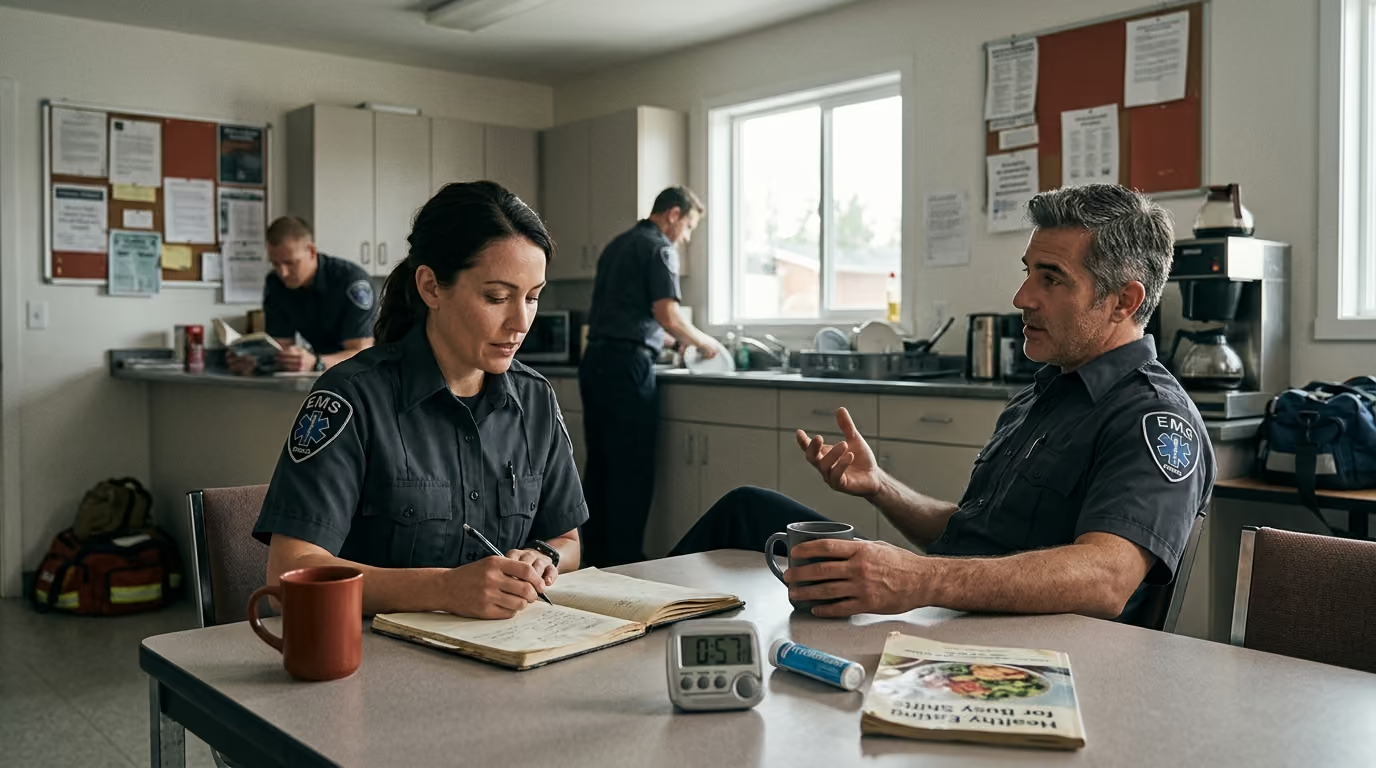

Stepping off an intense twenty-four-hour tour requires evidence-based sleep protocols to protect emergency workers against severe circadian disruption and chronic fatigue.





You pull into the station parking lot at 06:45 after forty-eight hours on duty. Your log shows seven emergency calls between midnight and dawn, broken into ninety-minute fragments that never allowed you to reach deep sleep. You feel a heavy dullness behind your eyes, your reaction time is visibly slowed, and you still have a thirty-five-minute highway drive before you reach your bed.
Every emergency-service professional recognizes this friction. The debate around which shift schedule is best usually focuses on consecutive days off or convenience for personal life. Yet schedule architecture changes the biological recovery problem entirely. A schedule does not merely dictate when you clock in. It determines your circadian strain, the fragmentation of your sleep, your cardiovascular stress, and your cumulative safety risk across a multi-decade career.
A practical comparison requires looking at the actual physiological demands of fixed nights, rotating rosters, quick returns, extended tours, and irregular on-call duty. No single schedule is inherently harmless. Managing fatigue requires matching the specific recovery strategy to the exact biological burden imposed by your roster.
The short answer to shift schedule design is that no single duty pattern eliminates biological fatigue. Every configuration creates a distinct set of physiological costs that require specific countermeasures.
Fixed night shifts protect schedule predictability but run directly counter to human circadian biology. Rotating shifts frequently force the body to reset its internal clock, creating recurring transition fatigue. Quick returns with fewer than eleven hours off severely truncate the real opportunity for sleep. Extended duty periods of twenty-four or forty-eight hours depend entirely on call volume, nighttime interruptions, and protected opportunities for rest.
The most protective approach is multidimensional. Rather than labeling a roster good or bad, emergency personnel must evaluate shift length, rest intervals between duties, circadian timing, schedule predictability, call volume, and commute exposure.
Decades of occupational health research from the American Academy of Sleep Medicine and the National Institute for Occupational Safety and Health demonstrate clear physiological trade-offs between different duty configurations.
The evidence establishes that the human circadian system is an internal twenty-four-hour pacemaker located in the brain. This biological clock regulates sleepiness, core temperature, hormone release, cognitive performance, and metabolic function. When duty forces an individual to work during the biological night and sleep during daylight, internal rhythms clash with the external environment.
Persistent circadian disruption is associated with elevated risks of cardiovascular disease, metabolic syndrome, gastrointestinal distress, mood disturbance, and workplace accidents. Research on emergency personnel demonstrates that subjective alertness is an unreliable gauge of actual impairment. Fatigue accumulates silently across consecutive night duties or extended hours, degrading situational awareness and increasing reaction times long before a responder admits to feeling exhausted.
Occupational data also reveal that scheduled time off does not automatically equal physical recovery. Commuting, household obligations, emotional decompression, and childcare constantly consume nominal off-duty hours. Effective shift management measures the real, protected sleep opportunity rather than calendar days off duty.
Comparing schedules requires a consistent framework. Evaluating a roster across seven core operational dimensions provides an objective assessment of fatigue risk:
Applying this framework reveals why simply counting days off produces misleading conclusions. A schedule featuring four consecutive rest days can still be dangerous if the preceding tour created severe sleep debt and safety risks during the drive home.
Fixed night patterns provide stable start and stop times, typically operating across eight-, ten-, or twelve-hour blocks. This predictability allows responders to establish routine domestic arrangements and consistent sleep timing during the working week.
Working permanent nights places the duty period directly across the biological night, when body temperature drops and sleep propensity peaks. Field studies of emergency personnel confirm that the highest levels of fatigue, drowsiness, and concentration errors happen between 03:00 and 04:00.
The primary recovery challenge occurs during the day. Daytime sleep is generally lighter, more fragmented, and shorter than nighttime sleep because sunlight, ambient temperature, traffic noise, and internal circadian alerting signals constantly promote wakefulness. Responders on fixed nights often struggle with cumulative sleep debt despite having an open calendar window during the day.
A major complication for permanent night workers is the transition on non-work days. Many responders choose to revert to a daytime schedule on their days off to spend time with family.
This weekly flipping pattern prevents the biological clock from adapting to night work. The responder repeatedly experiences the physiological equivalent of traveling across multiple time zones every few days. While socially convenient, rapid flipping maintains chronic circadian misalignment and prolongs physical fatigue.
Managing fixed nights requires aggressive control over light exposure and bedroom conditions. Responders should establish a fixed sleep window immediately following the morning commute rather than delaying sleep until the afternoon.
Responders seeking structured routines can review our shift-specific sleep plan for emergency personnel to tailor their environment.
Rotating rosters systematically alter shift start times across days, evenings, and nights. These rotations can occur rapidly, changing every few days, or slowly, changing over weeks or months.
Rotating patterns prevent the body from ever achieving complete circadian adaptation. Just as the internal clock begins shifting toward a night schedule, the roster changes back to morning or afternoon duty.
The direction of rotation significantly influences the physical burden. Clockwise rotations, which move from morning to afternoon to night duty, follow the natural human tendency toward a slightly longer biological day. Counter-clockwise or backward rotations, moving from night to evening to morning duty, force an unnatural phase advance. This makes falling asleep earlier biologically difficult and worsens acute sleep deprivation.
Rotating shifts also create what sleep researchers call recovery illusions. A responder may appear to have seventy-two hours off between blocks, but the first twenty-four hours are consumed by recovering from sleep debt and shifting sleep timing.
When rotating rosters are mandatory, the objective is to reduce circadian turbulence and protect transition windows between opposing shift types.
Responders navigating irregular schedules can consult our guide on how 24-hour rotations and shorter shifts drive responder sleep debt for broader operational context.
A quick return occurs when the break between the end of one shift and the start of the next is shorter than standard recommendations. In emergency services, this commonly manifests as an eight-to-ten-hour turnaround between an evening shift and a morning start, or after unplanned overtime.
The fundamental hazard of a quick return is mathematical. While a schedule shows ten hours off duty, the real window for biological sleep is dramatically smaller.
Travel time, operational handovers, personal hygiene, decompression, family responsibilities, and pre-shift preparation quickly consume three to four hours. The responder is left with five to six hours of potential sleep time. If sleep onset is delayed by physiological arousal from a difficult emergency call, total sleep can fall below four hours.
Quick returns generate severe acute fatigue, elevated stress hormones, impaired metabolic control, and dangerous lapses in attention on the road and on scene.
Managing quick returns requires strict operational discipline to convert every available minute into restorative recovery.
Agencies seeking structural baselines should review the CDC report highlighting widespread fatigue and shift-work baselines to understand organizational risk mitigation.
Extended tours are standard across fire, rescue, and emergency medical services. These include twelve-hour day or night shifts, traditional twenty-four-hour rotations (such as 24/48 or 24/72), and forty-eight-hour continuous assignments (such as 48/96).
Twelve-hour shifts offer clean operational divisions but leave narrow windows for off-duty recovery during consecutive working days. A twelve-hour shift combined with a sixty-minute commute and basic daily living tasks leaves roughly seven to eight hours of total bed rest. When twelve-hour shifts occur at night, daytime sleep quality issues compound this narrow window, making blocks of more than three consecutive shifts difficult to sustain.
A twenty-four-hour shift cannot be evaluated as a uniform biological exposure. A twenty-four-hour shift in a rural station with one dispatch per day is physiologically distinct from a twenty-four-hour shift in an urban core with sixteen emergency responses.
Systematic reviews in emergency medical services indicate that shifts shorter than twenty-four hours generally produce better outcomes for personnel safety, sleep quality, and clinical performance. However, in low-call-volume settings where crews obtain consolidated sleep on duty, twenty-four-hour tours remain sustainable and provide extended blocks of off-duty rest.
Research on firefighter sleep patterns reveals an interesting paradox. In studies tracking 24/48 and 48/96 schedules, the shortest sleep duration often occurred at home the night before starting a tour, averaging under six hours. Off-duty lifestyle habits frequently compromise physical readiness before the responder even arrives at the station.
The 48/96 schedule has gained popularity in the fire service because it consolidates four consecutive days off duty. Comparative studies show that firefighters on 48/96 rotations frequently report better subjective recovery, fewer total commutes, and equal or slightly improved sleep quality compared to those on 24/48 rotations.
However, the 48/96 pattern carries severe operational risks if call volume prevents rest on the first night. Entering the second consecutive twenty-four-hour duty period with profound sleep deprivation degrades reaction time, motor control, and situational judgment. The schedule performs well only when nocturnal call volume is moderate or when agencies enforce protected rest periods.
Managing extended tours requires active operational pacing and structured daytime rest rather than leaving recovery to chance.
Fire service leaders can review our analysis on operational readiness and the biology of leadership for agency-level sleep management strategies.
Irregular call systems require personnel to remain on standby or work fluctuating rosters without predictable start times. This model is common in rural EMS, volunteer fire agencies, specialized tactical units, and disaster response teams.
The defining problem of irregular call work is sleep fragmentation and psychological uncertainty. Responders resting on call maintain an elevated baseline of sympathetic nervous system arousal. The brain remains partially vigilant, anticipating an alarm, which impairs the descent into deep slow-wave and REM sleep stages.
Furthermore, irregular duty produces unpredictable sleep splits. A responder might get two hours of sleep, work an intense medical call for three hours, sleep for another ninety minutes, and then attempt to resume normal daily activities. Total sleep time may appear adequate on paper, but fragmented sleep does not provide the same physiological restoration as continuous, consolidated rest.
Coping with irregular calls requires tracking accumulated sleep across rolling twenty-four-hour windows and establishing strict post-incident habits.
Responders dealing with acute operational stress during irregular activations can utilize our guide on post-incident transition strategies to clear residual tension.
Fatigue countermeasures can temporarily support alertness during demanding duty, but they cannot replace biological recovery sleep. Understanding the proper timing, physiological mechanisms, and limitations of each tool is essential for operational safety.
Planned naps are an exceptionally effective operational tool for blunting fatigue during night work and extended tours.
Short operational naps lasting fifteen to twenty-five minutes reduce homeostatic sleep pressure by clearing adenosine without allowing the brain to enter deeper stages of slow-wave sleep. This minimizes sleep inertia, which is the groggy, disoriented state that can follow sudden awakenings.
Longer naps of sixty to ninety minutes allow for a complete sleep cycle, including slow-wave and REM sleep. These are highly restorative but require a dedicated fifteen-to-twenty-minute buffer after waking before operating vehicles or making safety-critical decisions.
Caffeine is an adenosine receptor antagonist. It does not provide cellular energy. Instead, it temporarily blocks the brain from sensing accumulated fatigue.
Low-dose caffeine protocols (75 to 150 mg) consumed early in a night shift or right before a brief nap provide effective alertness support. However, consuming caffeine during the second half of a night shift or within six hours of a planned daytime sleep period significantly impairs sleep architecture, delaying sleep onset and reducing slow-wave recovery.
Energy drinks with excessive stimulant formulations should be avoided due to associated cardiovascular strain and erratic blood glucose spikes. You can read more about structured fueling in our guide to caffeine and energy strategies for night duty.
Light is the primary environmental cue regulating human circadian rhythms. Timed exposure to bright blue-enriched light suppresses melatonin secretion and stimulates alert pathways in the brain.
Exposing yourself to bright station lighting during the first half of a night shift helps maintain vigilance. Conversely, shielding the eyes from bright outdoor sunlight during the morning commute using polarized sunglasses helps preserve sleepiness, allowing for rapid sleep onset upon arriving home.
Daytime recovery requires strict environmental control to compensate for natural circadian wakefulness:
Nutrition also plays a major role in daytime sleep quality. Emergency personnel can examine our time-restricted eating frameworks for night work and nutrition guidelines for demanding shifts to align meal timing with metabolic rhythms.
Managing occupational fatigue effectively requires moving beyond subjective self-assessments. Sleep-deprived responders routinely overestimate their alertness, masking impairment behind high adrenaline levels and professional motivation.
Agencies and individual responders benefit from tracking objective metrics across duty blocks:
When fatigue-related symptoms such as eyelid drooping, unintentional drifting between lanes, or severe cognitive slowing occur, operational protocols must mandate removing the individual from critical tasks, especially operating emergency vehicles.
Occupational fatigue is expected in emergency services, but persistent sleep failure is not a normal condition you must endure silently.
Shift Work Disorder is a clinical diagnosis recognized by the American Academy of Sleep Medicine. It involves chronic insomnia or excessive daytime sleepiness directly linked to a recurring work schedule overlapping the normal sleep window, with symptoms lasting for at least three months.
Responders should seek evaluation from a board-certified sleep specialist or qualified occupational medical professional when experiencing:
Clinical evaluations typically include fourteen days of detailed sleep logs, actigraphy monitoring, and overnight polysomnography to rule out underlying sleep disorders before exploring medical therapies.
When to revisit this resource: Review this guide when transitioning to a new shift rotation, bidding on annual agency schedules, establishing department-level fatigue guidelines, or noticing a persistent decline in your off-duty recovery.
Building a sustainable emergency-service career requires respecting the biological laws of human recovery. Matching specific, evidence-based sleep strategies to the structural demands of your duty schedule protects your physical readiness on scene, your safety on the road, and your long-term health for the future.
Stay connected for research-led guidance on duty fitness, shift-work sleep, injury recovery, stress, nutrition and career longevity. Practical ideas for first responders who want to stay capable on the job, recover well and protect their health for the long run.



Read practical guidance on first responder fitness, recovery, sleep, nutrition and resilience for demanding work and a long, active career.
read the blog



