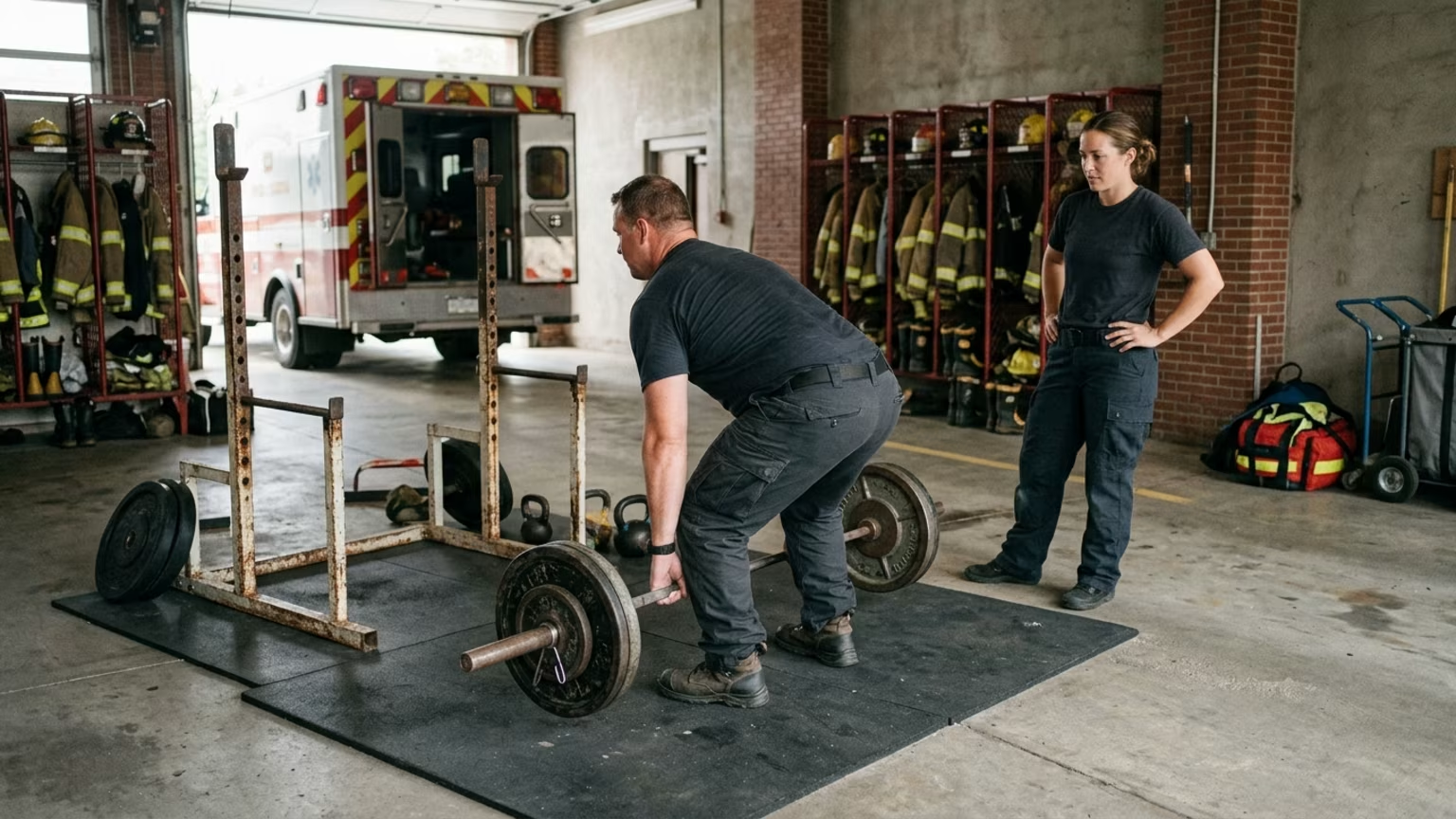

Plan strength and aerobic training around demanding duty with flexible schedule examples, general activity benchmarks and clear evidence limits.





Combine regular strength work with aerobic activity in a flexible schedule, then progress gradually while accounting for the physical demands of duty.
According to UDS's first-responder guide, an aerobic base can support recovery between efforts and make lower-intensity work less physiologically costly. That gives aerobic conditioning a purpose alongside strength work rather than making it an optional extra. The planning goal is to include both without making every workout serve every possible fitness objective.
Lexipol reports general adult guidance of at least 150 minutes of moderate-intensity aerobic activity weekly, 75 minutes of vigorous activity or a combination. It also includes strength-training activities at least twice a week. These are general health benchmarks, not validated thresholds for operational readiness.
The sources provide general activity guidance and practitioner advice rather than a tested first-responder program. They do not establish an ideal weekly split, precise exercise timing around night shifts or retirement-specific outcomes. They also do not verify improvements in duty-task speed or injury rates. The schedules below are illustrative planning examples, not proven protocols or individualized rehabilitation plans.
Personal medical or rehabilitation decisions belong with a qualified healthcare professional rather than a sample schedule.
Give both forms of activity an explicit place in the plan, then build consistency before adding more volume or intensity. Start with a structure that can be repeated rather than a calendar filled with demanding sessions.
UDS recommends training major movement patterns and progressing gradually. Applied to weekly planning, that means keeping strength work purposeful while leaving room for aerobic activity. It does not require every strength session to become conditioning or every aerobic session to become a test.
The following examples organize training opportunities. They leave exercise selection and session demands open rather than assigning the same workload to every firefighter, officer or EMS professional.
A week with reasonably dependable training opportunities could include:
This structure makes the different purposes visible. It does not require a different training goal every day or a demanding session whenever the calendar has an opening.
The general aerobic benchmark concerns activity accumulated across the week. A session label alone says nothing about whether that benchmark has been reached. Likewise, putting strength on the calendar does not turn the schedule into a job-readiness assessment.
When available time is limited, organize the week around repeatable opportunities rather than an elaborate split:
This is a planning approach, not a claim that a smaller schedule automatically meets general activity guidance. Its purpose is to keep both forms of training visible while avoiding the assumption that a useful week must be crowded.
There is also no need to repay a disrupted week by filling every opening in the next one. Resume the structure and account for current workload rather than treating missed sessions as a growing obligation.
For someone establishing consistency, a useful question is whether the structure can be repeated alongside work. For an experienced responder, the question can become whether additional training has a clear purpose or simply makes the week fuller.
Experience alone is not a reason to assign more sessions. In these examples, progression follows consistency and available recovery opportunities rather than a label such as beginner or advanced.
For more background on organizing the two qualities together, see the guidance on planning strength and aerobic work as complementary parts of training.
Use a rolling sequence rather than tying every session to a weekday. After a demanding shift or poor sleep, consider a shorter session, lower intensity or a recovery day instead of trying to make up missed work.
UDS advises first responders to account for the irregular high-intensity loading that work may already provide. A training calendar therefore should not treat every shift as equivalent to a rest day.
An illustrative rolling sequence might move from strength-focused work to aerobic-focused work, then return to strength when the next suitable opportunity arrives. The sequence keeps both priorities in view without requiring Monday to remain a lifting day after the duty week changes.
This is an organizational choice, not a rule that strength must always come before conditioning. It also avoids inventing a fixed number of hours that everyone should wait after a night shift.
For a disrupted week, the conservative options described in the research brief are straightforward:
The decision is about the next session, not about proving that the original calendar was achievable. A demanding shift does not create an obligation to train harder afterward.
Recognizing duty workload is also different from assuming that work replaces planned conditioning. Keep occupational demands visible without automatically counting every shift as a completed workout.
The vigorous-activity option in general adult guidance is not a requirement to turn a disrupted week into a block of hard conditioning. Moderate aerobic activity remains part of the guidance Lexipol reports.
For a closer look at this decision process, see the resource on matching session demands to current readiness and workload.
The practical aim is to carry a balanced activity routine beyond service, using general adult guidance to organize the plan rather than judging every session against the next duty demand.
UDS's advice to progress gradually and adjust training for medical status and schedule provides the relevant planning principles. Strength and aerobic activity can remain separate priorities within that framework. Neither needs to become an all-or-nothing project.
For retirement planning, a useful question is whether the routine has a purpose beyond completing a demanding week. It might retain familiar strength-training opportunities while organizing aerobic activity around the person's current schedule. That is an application of the general guidance, not a requirement to preserve an old duty-era split.
The long-term editorial priority is continued participation without treating accumulated physical wear as a challenge to ignore. Training choices should leave room for recovery and personal medical context rather than relying on toughness as a programming method.
The broader discussion of building and modifying capability across a career places those choices within a longer planning horizon.
The next useful topic is workload tracking: how to consider calls, shifts and planned exercise together without turning record-keeping into another demanding task.
Start with the distinction between what was planned and what the duty week actually required. That provides a practical question for reviewing the next training opportunity: does the original session still fit, or should its demands change?
Read the discussion of tracking occupational demands alongside training for that next layer of planning.
Keeping strength and conditioning in the plan without filling every recovery window is a workload decision that Rescuris addresses through evidence-aware fitness coverage. For responders managing accumulated physical wear, its editorial guidance connects duty readiness with recovery and career longevity so readers can assess training choices beyond the next performance target.
Rescuris publishes evidence-aware guidance for firefighters, police officers, paramedics and other first responders on fitness, recovery, sleep, nutrition, stress resilience and long-term capability.


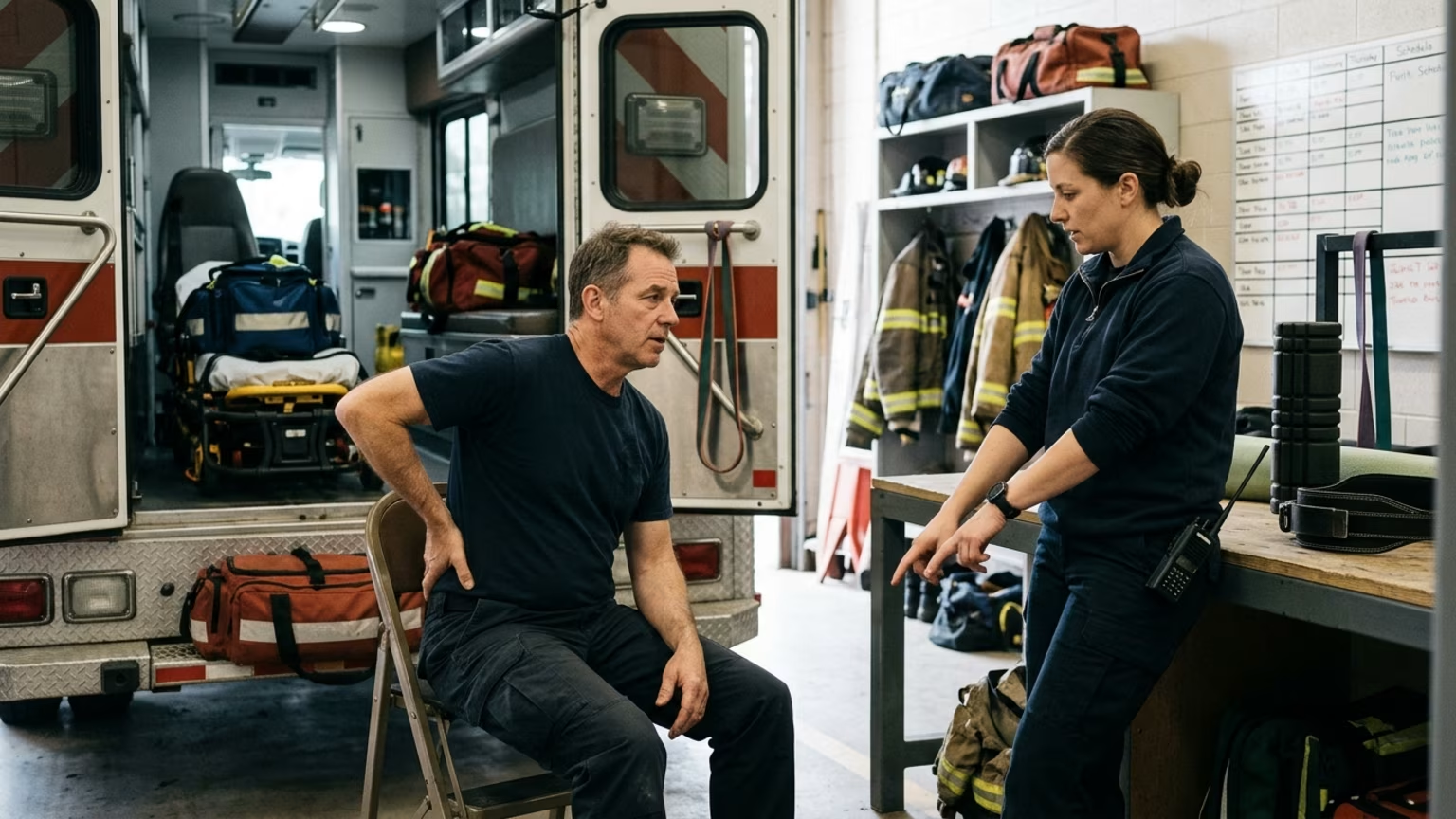



Read practical guidance on first responder fitness, recovery, sleep, nutrition and resilience for demanding work and a long, active career.
read the blog
